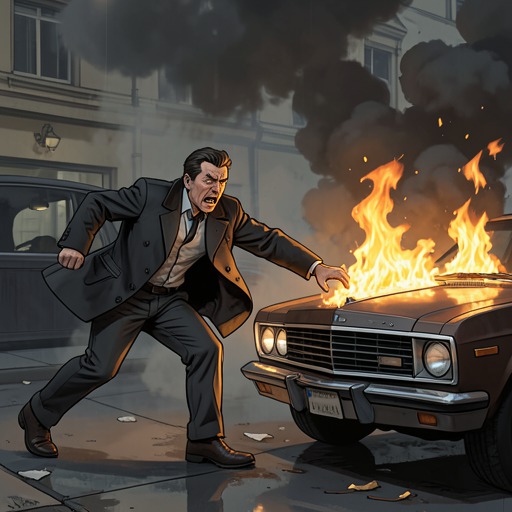
Fenn’s Attempt to Rescue Len Pagett from the Burning Car
ShrineGerry Fenn’s Attempt to Rescue Len Pagett from the Burning Car is a failed rescue during the Banfield fire. When movement is spotted inside a wrecked Capri, Fenn confirms that Len Pagett is trapped in its rear. He tries to approach through the heat, but the locked car and intensifying fire leave him unable to reach Pagett before the vehicle explodes.
Discovery of Pagett
Fenn is alerted by someone who sees movement in the other car. Turning toward the wrecks, he shields his eyes and looks across at them; he had noticed movement himself moments earlier. Behind the Capri’s rear window, a pair of hands beats against the glass. The movement changes the scene from the aftermath of a collision into an urgent rescue situation: someone has survived inside the wreck and is trying to get out.
Fenn recognizes the trapped man as Pagett. That recognition gives the danger a specific human focus. The car is no longer simply one of several burning vehicles; Pagett is visible inside it, and the possibility of reaching him becomes the immediate question. A plea for help follows, and another person asks Fenn to try. The request makes the rescue an appeal from those nearby as well as a response to the evidence in the car.
Fenn’s Attempt
Fenn answers the appeal by running toward the fire, though his response is not presented as calm or unafraid. He is angry at being asked and frightened for himself, but he moves forward anyway. The contradiction matters: the attempt does not arise from confidence that he can safely intervene. He acts despite recognizing the danger, while his fear remains part of the scene rather than disappearing once he has made his choice.
As Fenn draws nearer, the heat becomes more difficult to withstand. He takes off his jacket and holds it in front of himself as a barrier, then struggles to breathe and walk. These details establish the limits on the rescue through Fenn’s own effort: even getting close enough to assess Pagett requires him to protect himself and endure conditions that make movement increasingly difficult. His progress is not a clear path to the car but a hazardous approach that may have to stop at any moment.
The Barrier and the Outcome
Through the smoke, Fenn sees Pagett pressed against the rear window. Pagett is trying to get out through the tailgate, but it is locked. The window remains intact, leaving the visible escape route blocked; the car’s enclosure, rather than lack of effort, is the immediate obstacle. Fenn can see the predicament, but seeing it does not give him a way through the barrier.
On a further look, Fenn realizes that the glass is melting in the fire and that Pagett is trying to force his way through it. The scene’s central reversal is stark: what looked like a possible exit becomes part of the danger, while the heat that Fenn is struggling to approach has already made the car itself perilous. The account gives no successful intervention by Fenn. Instead, the Capri’s fuel tank explodes, ending the attempted rescue before he can reach Pagett.
The blast knocks Fenn down, and he rolls onto one side, moving his legs as he tries to get away from the immediate danger. Around him, people who had jumped from a bus, been near the garage, or come close while trying to help are also moving away from the fire. The rescue attempt thus ends not with Pagett brought to safety, but with Fenn and others forced into their own efforts to escape the expanding danger.
Significance in the Scene
The attempt turns on the difference between recognizing a person in peril and being able to save him. Pagett’s hands at the window and his effort to get out make his need unmistakable; Fenn’s approach shows that he responds to that need. Yet the locked tailgate, the intact but melting glass, and the fire’s escalation sharply restrict what action can accomplish. The sequence does not treat willingness as sufficient to overcome the material conditions of the wreck.
Fenn’s jacket makes that limitation concrete. It is an improvised shield that allows him to move closer, not a means of overcoming the fire or opening the car. The same distinction shapes the outcome: he can look, understand the danger, and attempt to advance, but the explosion interrupts the rescue. The episode therefore marks a change in the surrounding scene from rescue effort to immediate survival, with the people gathered near the vehicles forced to retreat.