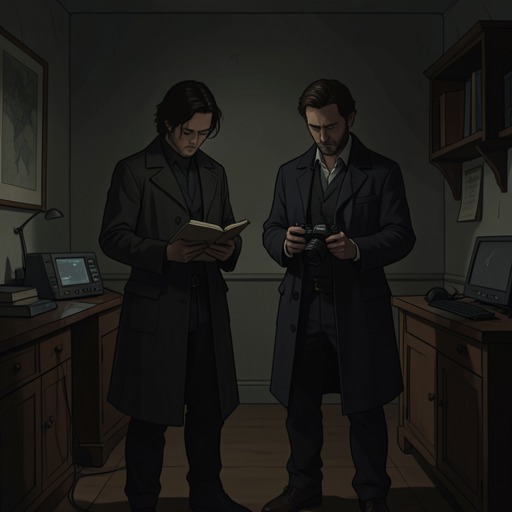
Fenn Discovers Thomas Woolgar’s Secret Manuscript
ShrineGerry Fenn’s discovery of Thomas Woolgar’s secret manuscript turns a search through an old church chest into an encounter with a buried account of the past. The find is not a straightforward historical record: its loose leaves are difficult to read, their author’s state of mind is questioned, and Woolgar’s confession presents a deeply compromised witness. Yet the papers disclose a connection between Einor, the missing children, and the history of St. Joseph’s Church in Banfield, while revealing how Woolgar’s own guilt shaped the story he left behind.
The chest and its contents
At St. Peter’s Church at Stapley, Fenn works through a chest containing vestments, old books, parish papers, and Mass books. The church is being battered by a storm, and sounds in the building make him uneasy, but he continues searching for records old enough to be relevant to his investigation. An accounts book for St. Peter’s dates to 1697; other volumes are older, but none reaches the period he seeks.
The crucial find is a set of three compact books, each roughly twelve by eight inches, with yellow vellum covers and pages fastened with twisted vellum. Their precise, angular handwriting is faded, and the text is in Latin. The books are dated 1556 and the two consecutive years that follow. Loose leaves fall from the back of the third volume. Their handwriting resembles that of the books but is less controlled and more difficult to read; the leaves are also in Latin. Fenn gathers them with the volumes and places the material in his holdall, putting the loose pages back inside the book from which they fell.
Fenn leaves the remaining contents in the chest rather than extending his search. The combination of the storm and his growing unease hastens his departure. The find therefore consists not simply of three old books but of a distinct, undated group of leaves that appears to belong with them. Those leaves will prove more revealing than the orderly volumes.
Delgard’s translation and Fenn’s reading
After falling asleep, Fenn wakes close to one in the morning and discovers that Monsignor Delgard has left. At the desk he recognizes the loose parchment as the pages that fell from the vellum manuscript at the church on the Stapley estate. Delgard’s notebook lies among the papers. Its pages show that the Monsignor has translated most, if not all, of the old material and added his own notes and initials.
Delgard’s introductory note cautions that the loose writing is partly illegible and erratic, and that some Latin is incorrect. He says that producing a coherent translation requires interpretation, and suggests that the writer may have been mentally disturbed. Fenn considers whether the text might instead reflect fear, but the surviving evidence does not resolve that question. The distinction matters: the story is presented through a translated and annotated manuscript, not through an independently verified account. Fenn nevertheless begins to read, and the papers’ contents change the significance of his archival discovery.
The chronicle is dated 1560 and attributed to Thomas Woolgar. Its writer describes Einor as dead but still present to him, and says that she pursues him because of his sins. He presents the document as a warning to later readers and repeatedly insists that it should not be dismissed as the ravings of a madman. At the same time, his fear and self-accusation, together with Delgard’s warning about the handwriting and language, leave the reader to weigh the testimony rather than accept it as unproblematic fact.
The history disclosed in the chronicle
Woolgar’s account describes Einor as a nun whom villagers regarded as virtuous and credited with healing people. He claims that she secretly kept valuable gifts in the crypt of St. Joseph’s Church in Banfield, while giving less valuable offerings to the priory. He also confesses to a sexual relationship with her, but attempts to shift responsibility by describing himself as controlled or ensnared. The chronicle thus connects his testimony about Einor to his effort to explain—and partly excuse—his own conduct.
The most consequential disclosure concerns three children who disappeared over a period of months. Woolgar admits that he helped Einor harm them and says that he had helped conceal their fate. The chronicle also recounts the decline and death of the Prioress, Einor’s alleged involvement, and the abuse of two young novices. One novice, it says, confessed to the ailing Prioress and then took her own life. These claims are attributed to Woolgar’s manuscript; the passage’s damaged text and his conflicted account counsel against treating every detail as settled history.
Woolgar further recounts denouncing Einor as a witch and heretic after the Prioress learned of his relationship with her and the children’s disappearance. He describes returning to Banfield and telling members of his congregation about Einor, after which villagers gathered at St. Joseph’s Church and seized her. Although he says that he pleaded for the violence to stop, he also records denying Einor’s accusation that he had been her partner and directing the crowd to search for a supposed Devil’s Mark. His account makes his role in the accusation and the mob’s actions part of the same history: he is both a witness to the villagers’ violence and a participant whose confession is marked by evasion and guilt.
A hidden record and its limits
The manuscript’s survival is itself explained within Woolgar’s account. After the events, his father and the bishop judged his mental condition unstable and moved him from St. Joseph’s Church in Banfield to St. Peter’s on the family estate. Woolgar says that his father also had the church chest transferred there, since it held parish records. He claims that his father searched the papers for material that could disgrace the family but found no written account of Woolgar’s relationship with Einor. Woolgar then presents the loose chronicle as a separate text he intentionally hid for a future reader.
This history supplies a reason the manuscript could remain among older church records, while also complicating its authority. Woolgar’s father and the bishop, as he reports their view, believed that drugs had affected him and that his visions were not real; the manuscript preserves Woolgar’s contrary insistence that his account is a warning. Fenn’s discovery does not settle that dispute. It gives him access to a first-person confession whose information is indispensable but whose author’s self-exculpation, fear, and possible mental disturbance are integral to how that information reaches the present.