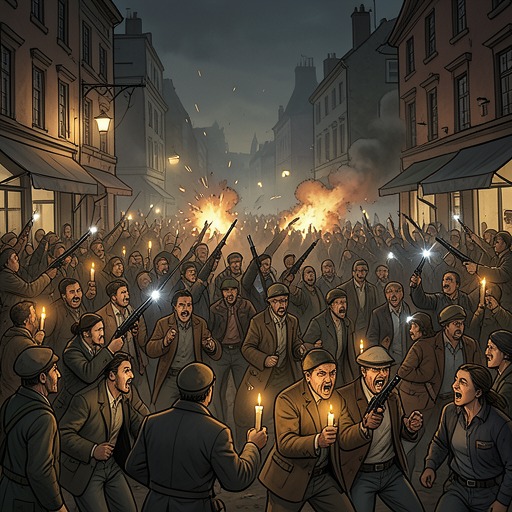
Wilkes Shoots Alice During the Candlelight Mass
ShrineWilkes’s shooting of Alice Pagett during the candlelight Mass at the Banfield shrine turns a public act of devotion into an attack witnessed by the assembled crowd. He waits until Alice rises above the altar before firing, and the shooting is followed by immediate public chaos and the collapse of the healings associated with her.
Preparation and Opportunity
Wilkes comes to the shrine expecting to make an act that will bring him public attention. He has travelled to Banfield the previous night and slept in a bus shelter, sustaining himself with thoughts of the future recognition he imagines the act will bring. At the gathering, he conceals a German Luger Pistol against his body. Security staff inspect bags and containers but do not search worshippers, allowing him to enter armed.
The Shooting
As the third hymn nears its end, Alice rises and walks to the center of the platform. The singing fades as the congregation notices her beneath the illuminated, twisted oak behind the altar. She looks upward, then turns her attention to the crowd and spreads her arms. With the assembly watching, she begins to rise, reaching a height of roughly eighteen inches above the platform. Wilkes, who had chosen a seat near the center aisle, leaves his bench and advances toward the altar while the congregation remains fixed on Alice.
Wilkes raises the German Luger Pistol and fires at Alice from close range. Fenn sees the attack but, overwhelmed by the scene, does not register the gunshots; he watches Alice fall onto the platform. For a moment the gathered pilgrims, sightseers, believers, and skeptics stand in silence. The shooting abruptly breaks the service’s atmosphere of expectation and turns the crowd’s attention from Alice’s apparent miracle to the violence before them.
Immediate Aftermath and Reversal
The crowd’s first response is stunned silence, followed by sharply different forms of grief and anger. Some pilgrims weep or stand numbed; others cry out for revenge, while those who missed the shooting try to learn what has happened. Fenn catches Sue as she slumps and keeps an arm around her, then protects Ben, who clings to his mother. Other people surge toward Wilkes and overpower him before he can leave the altar area.
The shooting does not end with Alice lying motionless on the platform. In the account that follows Wilkes’s perspective, she opens her eyes and sits up again. Her survival transforms the congregation’s shock, but it does not restore the certainty that had gathered around her healing reputation.
Across the field, people who had come because Alice’s earlier cures had changed their lives begin to lose those benefits. A girl who had received help develops uncontrolled movements; a boy whose legs had regained strength finds himself unable to stand securely. Another pilgrim’s returning vision clouds again, while a girl loses the ability to form words. The reversals unfold among the benches as the crowd is still reacting to the attack, making the shooting a turning point not only in the service but in the apparent operation of Alice’s miracles.
Historical Echo
The crowd’s attack on Wilkes also recalls the violence recorded in Thomas Woolgar’s Chronicle Manuscript. Woolgar describes villagers who, after hearing accusations of witchcraft against Einor, seized and killed her, while her dying curse extended beyond her immediate persecutors to those gathered around her. The circumstances differ: at the Mass, the crowd turns on a man who has shot Alice Pagett. Yet in both episodes, a religious community’s response to perceived evil becomes collective vengeance, complicating the distinction between defending the sacred and committing violence in its name.