CISG report
StrangersThe CISG report is a classified assessment of the social consequences of first contact with an intelligent extraterrestrial species. It gives the government’s secrecy policy an intellectual framework: contact might bring not only wonder, but a profound loss of confidence in human institutions and ways of life. Its predictions are treated as serious enough to justify years of concealment, yet the novel also shows how those predictions become entangled with fear, coercion, and arguments over who has the right to decide what the public can bear.
Origin and Scope
The report emerged from the Contact Impact Study Group, a government research committee established about nine years before the events under discussion. Its membership crossed disciplinary boundaries: biologists, physicists, cultural anthropologists, medical doctors, sociologists, and psychologists were brought together to assess the positive and negative effects on human society of face-to-face contact with an intelligent species from beyond Earth. Leland Falkirk was the committee’s sole military member. The report itself is not reproduced in full; its contents reach the reader through the people who have encountered or discussed it, so its conclusions are reconstructed through disagreement as well as exposition.
The document had become classified by the time the witnesses investigated their missing memories. Mr. X, whose information reached Father Michael Gerrano and then Father Stefan Wycazik, identified two suspicious changes: several scientists associated with the committee were on unusually long or unexplained leaves, and CISG files received a new level of security restriction on July 8, two days after the July 6 crisis in Nevada. That timing tied the committee’s work to the government’s response to the incident, without by itself establishing what the report had said or what every scientist knew. The report thus appears both as an assessment of a possible future and as part of the machinery used to control information about an event that had already occurred.
Predictions About Contact
The report’s central concern, as Wycazik explains it to Parker Faine, is cultural rather than simply military. An advanced civilization might unsettle a less advanced society by making its inherited traditions and institutions seem provincial or invalid. The consequences could include declining religious faith, distrust of government and other secular systems, a sense of inferiority, social disruption, and suicide. The danger, in this account, is not that extraterrestrials must attack humanity; the encounter itself could alter the assumptions through which people understand their society and their place in the universe.
Wycazik presents this argument by analogy with historical encounters between cultures. He recalls accounts of Indigenous Arctic communities experiencing alcoholism, generational conflict, and suicide after contact with Western civilization, and invokes the damage done to Indigenous peoples of North America through cultural collision. The examples frame the report’s warning as a question of unequal power and confidence: even a culture that does not set out to destroy another can undermine the latter’s institutions and self-esteem. Wycazik also connects the concern to the Jesuit examination of the harm caused by missionary efforts, acknowledging that the spread of a faith could bring both enlightenment and damage. These comparisons explain why the committee’s study considered social and psychological consequences, not merely the physical safety of a first encounter.
The report’s implications remain open to challenge. Parker Faine assumes that discovering humanity is not alone would be a joyous revelation, pointing to popular fascination with fictional aliens. Wycazik distinguishes that imaginative response from real contact, while also refusing the conclusion that contact must destroy religious belief. For him, evidence of life throughout the universe could affirm rather than negate faith in a creator. The exchange makes clear that the report’s subject cannot be reduced to a single predictable public reaction: the same discovery may produce fear, disorientation, or renewed belief, depending on the person and the framework through which it is understood.
Secrecy and the State’s Response
The report’s feared consequences help explain why officials argue that the public must be prepared gradually. Leland Falkirk says that people would cope poorly with the new world following disclosure, predicting chaos and political and social upheaval. Lieutenant Horner likewise supports a slow release of the news, perhaps over ten years. In their view, controlling the timing of disclosure is a protective measure: the public should not be forced into a destabilizing encounter with knowledge it cannot yet absorb.
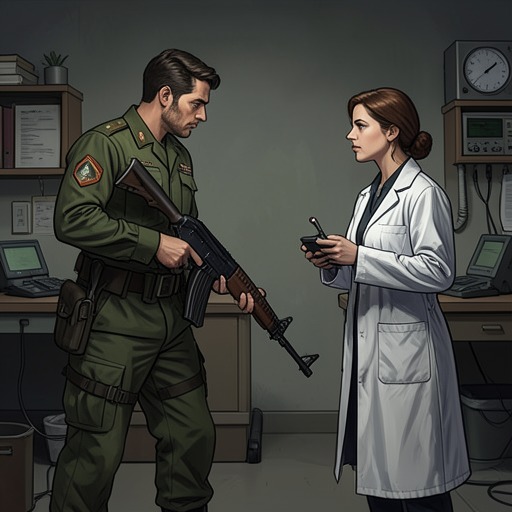
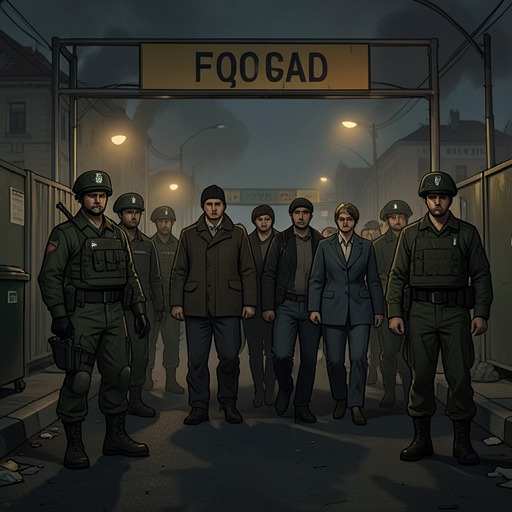
That rationale sits beside the government’s concrete actions during the purported toxic emergency in Elko County. The United States Army closed a ten-mile stretch of I-80 and established roadblocks before informing local and state authorities; its personnel kept civilian officials out of key aspects of crisis management. Ginger Weiss reasons that the use of a DERO company suggests the people enforcing the quarantine were trusted with a highly classified secret, not merely an ordinary chemical spill. Dom Corvaisis, trying to explain the witnesses’ psychological problems and the drugged people in the Polaroid photographs, considers whether the Army and federal government had concealed a more extraordinary event, treated the motel’s guests, and replaced their memories. Those ideas are presented as a developing theory, not as proof supplied by the report. They show, however, how the language of societal protection can accompany isolation, secrecy, and the denial of witnesses’ agency.
The dispute over containment sharpens this ethical divide. Foster Polnichev argues that killing the Halbourgs, the Tolks, and the Nevada witnesses would make the cost of keeping the story secret intolerable; he also sees the emerging abilities as evidence that contact may be a historic opportunity rather than an infection. Falkirk answers that the issue has become the survival of the species, and that public and political interference would prevent decisive action. His position turns the report’s warnings into a security argument for extreme measures. The report is not shown to order those measures, but its account of possible upheaval supplies a rationale that officials can use to present secrecy as necessity.
Interpretation and Narrative Significance
The report’s authority is contested within the very institution that keeps it classified. Miles Bennell explains that some people involved in the work reject the CISG conclusions as elitist and doubt that disclosure would cause catastrophe. Falkirk, by contrast, declares his confidence in the report and treats its forecast as a reason to control public knowledge. The disagreement is not simply between informed and uninformed characters: it concerns whether precaution protects society or assumes that ordinary people are incapable of adapting. The report’s multidisciplinary origins lend its conclusions weight, but the story does not make that weight equivalent to certainty.
The CISG report therefore functions as both a document and a political instrument. Its subject—the possible cultural shock of first contact—is genuine within the story, while the actions justified in its name are shaped by officials’ judgments, rival interpretations, and fear of losing control. The contrast between the report’s broad inquiry into human society and Falkirk’s increasingly absolute language is especially consequential: an assessment of risk becomes a warrant for treating witnesses as threats. Against that logic, Polnichev’s response to Emmy Halbourg and Wycazik’s religious interpretation preserve the possibility that contact might enlarge human understanding rather than destroy it. The report leaves the reader with a tension rather than a settled verdict: preparation may matter, but secrecy and coercion can themselves produce the catastrophe they claim to prevent.