VIGILANT
StrangersVIGILANT is Thunder Hill’s security computer: an isolated system that controls access to the installation and, through a secret program installed by Leland Falkirk, can restrict who leaves and who can reach the tactical nuclear arsenal. Its layered checks make the facility difficult to penetrate, but Falkirk’s hidden overrides reveal the danger in concentrating security authority in one person. The computer that is meant to prevent betrayal becomes the mechanism by which he can imprison the staff and place weapons of mass destruction under his sole control.
Design and Access Control
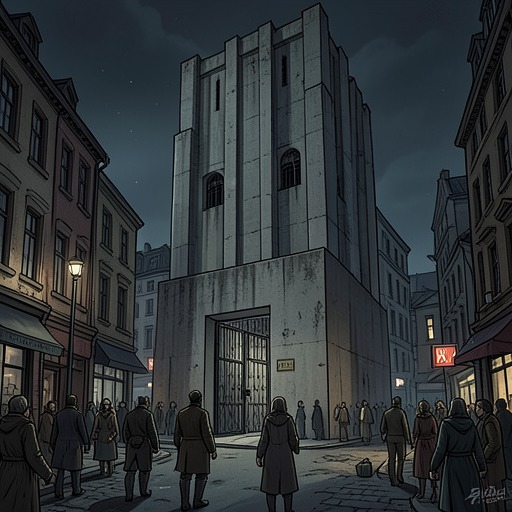
VIGILANT operates the entrance to Thunder Hill without human observers. After a perimeter guard reports an expected arrival, cameras track the visitors through the entrance tunnel. The system compares their appearance with stored holographic images, rapidly matching forty-two points of facial resemblance. Makeup or a look-alike cannot satisfy the check; an impostor or unauthorized visitor triggers an alarm and sedative gas in the tunnel.
The entrance itself reinforces this scrutiny with physical barriers. The first door is a fourteen-inch-thick, lead-core slab, and the second cannot open until the outer door has closed. The enclosed tunnel is twelve feet long and about nine feet in diameter. Once inside, a visitor faces a second identity test: a glass panel scans the palm and fingerprints against VIGILANT’s records. The inner door has no keypad, so a code alone cannot grant entry.
The computer is deliberately disconnected from both Thunder Hill’s main computer and the outside world. That isolation is intended to prevent saboteurs from taking control through an electronic connection. The system’s apparent vigilance is therefore both technical and architectural: cameras observe the approach, doors enforce the sequence, biometric checks establish identity, and the isolated computer decides whether passage is allowed.
Falkirk’s Secret Override
Falkirk had secretly arranged for VIGILANT to impose a special exit restriction. He had anticipated the possibility eighteen months earlier, and the program made leaving Thunder Hill impossible without a code known only to him. When he entered the installation, he identified himself with his left hand rather than his right. That deviation was not a mistake: it signaled the computer to activate the new order.
Falkirk disclosed the lockout to Miles Bennell only after it was already in force. Bennell recognized the implication as Falkirk explained it: the colonel and Tom Horner could leave, but no one else could depart until Falkirk decided conditions were safe. The episode turns an authentication detail into a political act. The computer does not simply recognize an authorized user; its programmed response lets Falkirk convert his own credentials into unilateral authority over everyone inside.
VIGILANT’s isolation, intended to make the system resistant to hostile interference, also makes Falkirk’s override harder for others to countermand electronically. Bob Alvarado later observes that Falkirk would take the system’s new codes with him if they killed him. Alvarado expects the occupants could eventually dismantle the exit if necessary, but the prospect shows how the security system’s protection can become confinement: the people trapped inside must consider physically breaking the facility’s defenses to escape them.
Control of the Nuclear Arsenal
VIGILANT also oversees access to Thunder Hill’s tactical nuclear weapons. Under the standard procedure, only eight people among the hundreds at the installation are authorized to enter the vault, and no individual can open it alone. Three of those eight must present their palms to a glass panel within one minute. This rule distributes responsibility and makes access depend on a tightly limited group rather than on a single credential.
Falkirk’s new program supersedes that safeguard. The computer’s altered rules make him the sole keeper of the Depository’s tactical nuclear arsenal. At the vault, his palm alone is sufficient to open the layered steel door. Inside are twenty backpack-bomb frames, with their detonators and explosive packages stored separately. Falkirk selects two frames and assembles two weapons in eight minutes, setting both timers for fifteen minutes. VIGILANT does not itself assemble or detonate them; its significance is that Falkirk’s override grants him access to the components and removes the ordinary requirement for multiple authorized people.
That change recasts the system’s security logic. The three-person rule is a check against individual action, while Falkirk’s code makes the arsenal answer to one man who is already contemplating the destruction of everyone in Thunder Hill. His authority is not merely administrative: the program gives him the practical means to turn a guarded installation into a weapon against its own occupants.
Breakdown and Significance
When the witnesses are brought to Thunder Hill, VIGILANT admits Falkirk under the emergency program even though the entrance cameras are not working. The ordinary visual-identification procedure is no longer required; the computer responds only to the palm and all the fingerprints on Falkirk’s left hand. The system has not simply failed. It is operating according to the exceptional rules Falkirk has imposed, prioritizing his biometric credential over the safeguards that normally verify visitors by sight.
This altered entry procedure completes the transformation of VIGILANT from a neutral-seeming security apparatus into an extension of Falkirk’s command. Its automation removes human eyes from routine surveillance, its disconnection limits outside interference, and its layered authentication makes access depend on controlled credentials. Those features can protect Thunder Hill from a traitor at the perimeter, but they do not protect it from a colonel who has secretly rewritten the rules. In the crisis, the system’s most consequential vulnerability is not an electronic saboteur: it is the trusted officer authorized to make its protections serve his own decisions.