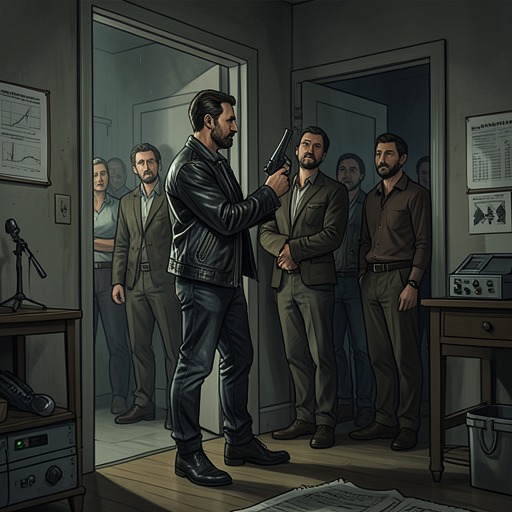
Rifle microphone
StrangersThe rifle microphone is a directional listening device whose power in the story lies in making private speech vulnerable without requiring anyone to enter the room. At the Tranquility Motel, Jack Twist identifies it as one of the ways hostile observers might monitor the witnesses, then helps them alter their meeting place and surroundings. The device turns a seemingly ordinary question—where can people talk?—into a problem of exposure, architecture, and trust.
Definition and Threat
Jack explains that listening technology has changed since Ernie Block’s years in Marine Intelligence. In his account, observers do not need to plant a bug inside a room: rifle microphones have improved, and a telephone can also be exploited through an infinity transmitter. He describes the latter as opening the handset microphone when a call is made, without ringing the telephone, so that a caller can listen in on conversations wherever an extension is present. The rifle microphone and the telephone transmitter are distinct threats in his warning, but both undermine the witnesses’ assumption that an unsearched room is necessarily private.
Jack gives the warning immediate force by presenting the living-room telephone as a possible listening device, telling the group, “Here's your bug. You had it installed yourself.” His point is not that the phone has been conclusively identified as compromised; he is illustrating how surveillance could operate without a conspicuous object being planted. He says he has been listening to the group for nearly an hour and warns that their opponents may be able to do the same. The possibility of being overheard is enough to make their previous conversation unsafe.
The Motel Meeting and Its Defenses
The witnesses respond by moving their discussion to the diner beside the motel, which offers a room without windows large enough for a meeting. Jack asks for a space suitable for a war council and insists that any telephone there be unplugged. His warning changes the group’s immediate conduct: instead of continuing to talk where they are, they relocate and begin treating ordinary fixtures as possible routes for surveillance.
The diner is not automatically secure. Jack notices that its front door has thick glass that survived the earlier window damage, but that it has not been boarded up. He identifies the glass portal as a weak point for anyone trying to listen with a directional microphone. Dom Corvaisis says plywood remains from the window repairs; Dom and Ned fetch a piece from the maintenance-room stack. Jack places the wood in front of the door and braces it with a table, judging the improvised barrier “Not perfect,” but probably sufficient to defeat a rifle microphone.
He also tells Sandy Sarver to turn on the jukebox and play songs. The music supplies background noise intended to make eavesdropping more difficult. These defenses are practical and improvised rather than assurances of complete safety: the board covers a vulnerable opening, the jukebox adds sound, and unplugging the telephones removes another suspected channel. Together, they show the witnesses adapting the room around the danger rather than trusting that a change of address alone will protect them.
Surveillance and Counter-Surveillance
Jack’s warning is deliberately sharp. He confronts Ernie with his earlier experience in Marine Intelligence, stressing that techniques have changed since then, and uses the telephone to make the danger tangible. Ernie is stung by the rebuke and follows Jack outside toward the diner to object to his snide manner. But the argument carries him into the dark between the motel office and the diner, where his fear abruptly overwhelms him: he cannot draw breath and makes a mewling sound. Jack immediately offers his arm and encourages him to continue. The sequence brings a personal vulnerability into the same exposed night that has made the group’s conversations vulnerable to surveillance.
Ernie later recognizes that the newcomer’s quick decisions, precision, and ability to shift from intimidation to cajolery suggest the experience of a capable career soldier. Jack’s manner is therefore part of the counter-surveillance effort: he wants the witnesses to understand the danger quickly, even at the cost of offending them, and then directs concrete measures against it. His performance succeeds in silencing the group and moving them toward a more guarded meeting.
The surveillance threat is not merely hypothetical within the larger operation. Leland Falkirk hears a recording of Jack explaining rifle microphones and infinity transmitters, and Horner reports that the witnesses have moved to the diner and ripped out the phones. Observers stationed south of I-80 have watched them move to the Tranquility Grille but have been unable to tune in with a rifle microphone. Falkirk recognizes that Jack knows what he is doing and concludes that the witnesses must be approached quickly now that they know about Thunder Hill. The device thus figures on both sides of the confrontation: the witnesses anticipate being monitored, while their opponents attempt to listen and discover that the precautions have frustrated them.
Narrative Significance
The rifle microphone makes surveillance a force that reorganizes space and behavior. A room can be searched and still feel unsafe; a telephone can serve as a listening route, while glass becomes a weakness and music becomes a defense. The witnesses answer the possibility of unseen observation by relocating, removing phones, covering the diner door, and adding background noise. Their actions do not prove that every conversation is secure, but they turn passive exposure into active resistance.
The device also clarifies the stakes of Jack’s arrival. His warning interrupts the group’s discussion, establishes the need for secrecy, and gives their meeting a new physical arrangement. The observers’ failed attempt to listen confirms the immediate value of those precautions, even as Falkirk’s reaction shows that counter-surveillance has alerted the people pursuing them. The rifle microphone is therefore more than a piece of equipment: it is the means by which the possibility of being heard becomes a pressure on every choice about where, and under what conditions, the witnesses can speak.