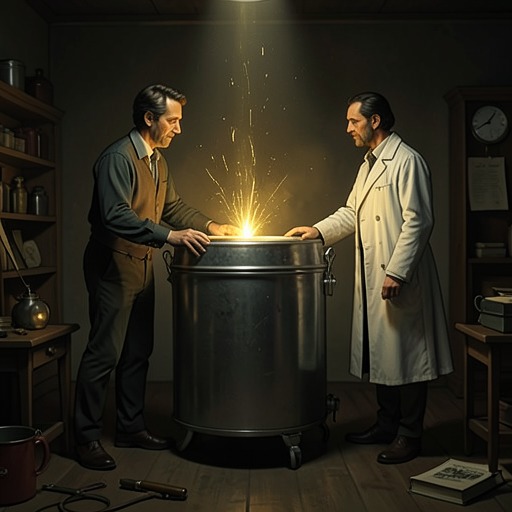
IBM Displaywriter
StrangersThe IBM Displaywriter begins as an ordinary writing tool in Dom Corvaisis’s study and becomes a material record of what he cannot recall doing. Its green screen turns sleepwalking into text: first 268 repetitions of “I'm scared.”, then hundreds of repetitions of “The moon.” Because the machine records instructions without explaining who gave them, it offers Dom evidence but not an answer. Its role shifts from manuscript workstation to uncertain witness, and finally to a tool for comparing a mysterious note with the limits of his own equipment.
Workstation and first unexplained text
Dom uses the Displaywriter to work on an untitled book. At his desk, he calls up chapter eighteen from the first disk and expects to resume in the middle of its sixth page, where he had stopped the previous day. Instead, the screen shows a full sixth page, followed by pages seven and eight, all bearing unfamiliar green lines. The disturbance is not simply that his manuscript has changed: the new material has appeared without any memory of his entering it.
The added text consists of a two-word sentence, repeated hundreds of times. Its layout is as specific as its content: double-spacing, quadruple indentation, four sentences to a line, thirteen lines on page six, and twenty-seven lines on each of pages seven and eight. Dom counts 268 repetitions of “I'm scared.” The machine has made the words visible, but their presence does not explain the fear they name or identify what provoked them.
Dom reasons that the Displaywriter could not have generated the material by itself: it is an obedient machine that does what it is told. He also rejects a break-in as an explanation, finding no signs that anyone entered the house and no plausible prankster. He concludes that he must have come to the word processor while sleepwalking and typed the sentence without remembering it. The device therefore supplies a physical trace that lets him infer an action occurring outside his conscious awareness, while leaving the cause of that action unresolved.
Deletion and the limits of the record
After considering whether his sleepwalking itself could account for such terror, Dom tries to contain the episode within familiar explanations. He thinks his imagination may be working too hard and turns back to work. He also relies on his research that adult sleepwalking usually ends after a short period: few people have more than half a dozen episodes, generally within six months or less. That expectation gives him grounds to hope the nocturnal wandering will stop, but it does not explain the words already on the screen.
He deletes the unwanted text from the disk and returns to chapter eighteen. The deletion removes the message from the working manuscript, not the fact that it appeared there. In this scene, the machine makes an unconscious episode legible and then allows Dom to erase its visible trace; the action restores his work routine without settling the meaning of what he has seen. The contrast matters: the Displaywriter can preserve a record, but the person using it can also remove that record, and neither function provides certainty about the mind that produced it.
On another morning, Dom believes that he has slept peacefully, waking in the same position in which he went to bed. Yet the current work diskette again carries evidence of a nighttime visit to the Displaywriter. This time, instead of the earlier sentence, the screen bears hundreds of repetitions of “The moon.” He remembers hearing himself murmur those words as he was falling asleep on the previous Sunday, but he does not know whether the phrase has any special meaning for him. The repeated text establishes recurrence and a change in its wording; it does not establish an interpretation.
That recurrence unsettles the assurance provided by treatment. Valium and Dalmane have been working well, with no new sleepwalking episodes or dreams since the previous weekend’s nightmare of being forced face-down into a sink, and Dr. Cobletz is pleased with Dom’s progress. Nevertheless, the diskette reveals another apparent nocturnal intervention. The Displaywriter’s record complicates the difference between a quiet night and a night without sleepwalking: Dom’s waking impression is peaceful, while the file supplies evidence that he cannot account for.
A failed attempt to receive an explanation
Dom hopes that his subconscious might use the Displaywriter to explain the source of his anxiety. In his understanding, the subconscious knows what the conscious mind does not; during sleepwalking it controls his actions and might communicate through the word processor. The device is thus not merely a surface on which symptoms appear. Dom imagines it as a possible channel between divided forms of awareness, one that could turn involuntary action into information he can read while awake.
On a later morning, he checks the documents left on the diskette and finds no new material. The diskette is unchanged from Thursday. This blank result offers no explanation and no message from the state of mind he hoped to reach. Dom switches off the machine and sits looking toward the ocean. The episode marks a contrast with the repeated sentences: the Displaywriter has sometimes preserved a trace, but it does not reliably produce one, and it cannot be made to answer a question simply because Dom asks it to.
Printwheel comparison and uncertain authorship
The Displaywriter also becomes part of Dom’s effort to investigate an anonymous note. Because only Dom, Parker Faine, and Dr. Cobletz know about his sleepwalking, and he has ruled out Parker and Cobletz as its sender, Dom considers whether he himself might have typed the note and forgotten doing so. He takes the rumpled original to his study, types its two sentences onto the machine, and asks the printer to produce a hard copy. The resulting print gives him a way to compare the note’s appearance with output made on his own equipment.
Dom owns two of the machine’s printwheels and has bought two more for different tasks. He uses three additional printwheels to make four copies, labeling the typefaces PRESTIGE ELITE, ARTISAN 10, COURIER 10, and LETTER GOTHIC. Placing the copies beside the original allows him to compare the forms directly. Courier 10 appears to be a perfect match, making the possibility that he produced the note harder to dismiss.
The comparison does not establish authorship. Dom recognizes that Courier 10 printwheels and printer elements must be widely available, so a matching face cannot identify which machine made the original. He also compares the paper: both sheets are twenty-pound, 8 1/2 x 11-inch stock, but neither has fibers, a mill seal, or a brand-name watermark that could show whether the original came from his supply. Here the Displaywriter serves less as a confessional instrument than as a testing device. It can generate controlled comparisons, yet those comparisons narrow possibilities without resolving who sent the note.
Narrative function
Across these appearances, the IBM Displaywriter links text to actions Dom cannot consciously claim. Its screen exposes repetitions he does not remember entering; its disk can remain unchanged when he expects a message; its printer can reproduce a note closely enough to raise suspicion but not closely enough to prove its source. The machine is dependable in a limited sense: it displays and prints what has been entered. That reliability makes the unexplained entries more disturbing, because the uncertainty lies not in whether the words are present but in how they came to be there.
The shift from “I'm scared.” to “The moon.” also gives the device a structural role in the book’s developing pattern of recurring words and incomplete explanations. It records a progression in the content of Dom’s sleepwalking without telling him what the progression means. As a result, the Displaywriter is neither a supernatural source nor a transparent extension of its user. It is an ordinary instrument whose exact, repeatable output brings the gap between action and memory into view—and whose evidence remains stubbornly insufficient to close that gap.