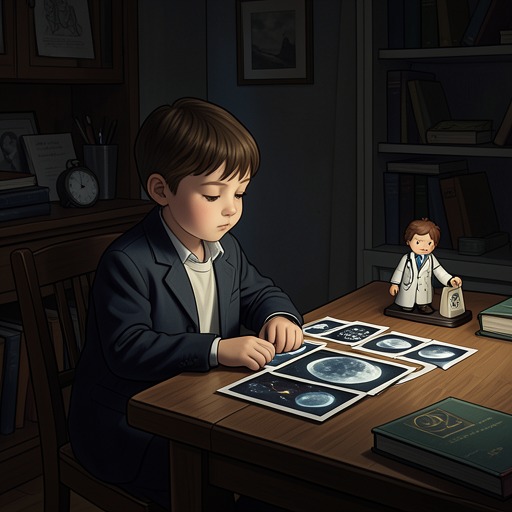
Little Ms. Doctor Doctor Toy Set
StrangersThe Little Ms. Doctor kit begins as a hidden Christmas surprise and becomes the object around which Marcie’s behavior turns disturbing. She searches for it among her presents with an intensity that unsettles Jorja and her parents; once she has it, she plays at giving injections and insists she must practice to become her own doctor. The kit’s plastic syringe and bedside pieces make a possible medical fear tangible, but the story does not explain its source. Instead, the toy marks the boundary between ordinary childhood play and an anxiety the adults cannot yet understand.
Identity and Appearance
The kit is a make-believe doctor’s set, including a plastic-and-rubber hypodermic syringe with a plunger. Jorja has bought it for Marcie and concealed it in a bedroom closet, behind shoe boxes, as a final Christmas surprise. It is therefore not initially missing or forgotten: the apparent absence is part of the gift’s planned reveal, though Marcie does not know this as she opens the other presents.
The kit is a familiar toy, but its details acquire unusual weight through Marcie’s response. She wants it so intensely that more expensive and, to Jorja, more interesting gifts fail to hold her attention. Once she gets the set, the pretend syringe becomes the instrument of repeated play, and later the kit’s separate pieces remain close beside her bed. The object itself does not change; what changes is how insistently it draws Marcie’s attention.
The Christmas Search
Marcie arrives in her pajamas at six-thirty on Christmas morning and asks whether Santa brought her the kit. The tree and a mountain of gifts briefly lift the mood in Jorja’s apartment, but the excitement sours as Marcie opens her presents. She leaves a wanted doll unopened in its box and tears into the next packages, searching for the doctor set. With only three boxes left, she is already pale and trembling.
When the presents beneath the tree and those from Mary and Pete are gone, Marcie sobs that Santa has forgotten the kit. Her despair seems disproportionate to the gifts around her, and Jorja’s parents are startled by the tantrum. Afraid that Christmas is collapsing, Jorja retrieves the hidden package from behind the shoe boxes. Marcie snatches it and tears at the wrapping; as soon as she recognizes the kit, she stops trembling and grows calm. Jorja points out that the present may not be from Santa and asks her to check the tag. Marcie finds that it is from her father. The discovery briefly resolves the immediate distress, but it does not explain why this particular gift has such power over her.
Play as Rehearsal
Later, the kit’s importance returns in a different form. Pete tries to interest Marcie in a doll, but she refuses it and holds the toy syringe instead. She says she wants to give him another shot. When Pete remarks that she has already given him twenty, Marcie answers, “I've got to practice,” explaining that she wants to grow up to be her own doctor. The repetition gives the game a compulsive quality: this is not simply a passing preference for one toy, but a practice she treats as necessary.
Jorja and her parents do not know what to make of the fixation. Mary asks what is going on with the doctor set, and Jorja admits that she does not know. Marcie continues pressing the syringe’s plunger, with perspiration visible on her brow. The physical details complicate the idea of harmless make-believe: Marcie’s urgency appears in her body as well as in her words, while the adults can only watch and wonder.
A Toy Beside the Bed
The family’s Christmas improves after its rocky beginning. Mary and Pete stop criticizing Jorja and join Marcie’s play; at dinner, served at twelve-fifty, Marcie eats at leisure and has, for the time being, worked off her consuming interest in the kit. The calmer hours do not settle the larger concern. After her grandparents leave, Marcie returns to playing doctor with the same unnerving intensity and wants to take the set to bed.
Some pieces lie on the floor beside her side of the bed and others on the nightstand. In the dark, she dreams and whimpers about doctors, nurses, and needles. Jorja stays awake listening, hoping that Marcie’s sleep talk might help explain what is troubling her. After two o’clock, Marcie’s speech changes: she says, “The moon, moon, the moon,” with amazement and fear. The movement from the kit and its medical imagery to the moon introduces a further mystery; the account does not establish that the toy causes or explains what follows.
Narrative Significance
The kit works as a concrete focus for a fear whose meaning remains out of reach. Its concealment creates a short-lived misunderstanding on Christmas morning, and its arrival brings Marcie visibly back to calm. Yet the relief is incomplete: the same object soon organizes repeated injections, nighttime play, and dreams filled with medical words. That contrast makes the gift more than a prop in a holiday scene. It lets the narrative show Marcie’s distress through observable actions before Jorja can name its cause.
The set also sharpens the limits of the adults’ interpretations. They can offer presents, redirect Marcie toward a doll, and ask what makes the doctor game so important, but none can answer the question. Jorja recognizes that her daughter’s behavior exceeds the hurt she already associates with her father’s departure, while the kit gives that otherwise unexplained unease a visible center. Its meaning remains deliberately unresolved: the toy is evidence of Marcie’s fixation, not an explanation for it.