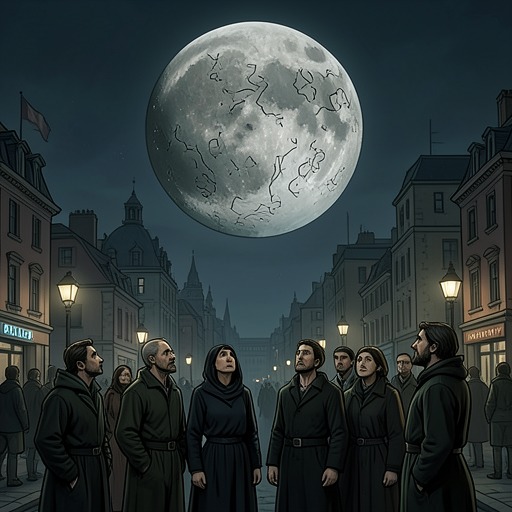
Moon images in Zebediah Lomack's home
StrangersMoon images in Zebediah Lomack's home are at once the material record of a dead man’s consuming fixation and the instruments of an inexplicable encounter with Dom Corvaisis. First encountered as a domestic archive of thousands of pictures, they acquire a more disturbing significance when Dom discovers his name among Lomack’s handwritten marks. In the house’s living room, the images then leave their fastenings and move without any visible force, turning a collection of paper into a spectacle that seems connected to the memories Dom cannot recover.
A House Covered in Moons
After a neighbor reported shotgun fire, police found Lomack dead in his kitchen. Their investigation uncovered thousands of moon photographs covering the walls, ceilings, and furniture. The images were not confined to one display or room: when Dom entered the house with a flashlight, he found the kitchen cleaned and stripped of its moon pictures, but the living room remained papered with large lunar posters. Their closeness made the room feel to him like a crowded realm of cratered worlds, an impression that left him dizzy and dry-mouthed.
From there the display spread through the bungalow. Hundreds of pictures—some in color, some black and white, and in assorted sizes—covered every inch of the hallway walls, fixed with glue, Scotch tape, masking tape, and staples. Both bedrooms had been treated the same way. The accumulated images made the moons seem less like a collection deliberately hung than a growth that had spread into every corner. Dom had read that Lomack’s sister had begun clearing and preparing the house for sale; the cleaned kitchen briefly raised the possibility that the obsession’s traces had been erased. The living room and bedrooms showed how much of it remained.
The images also carried a history of withdrawal. The newspaper account said no one but Lomack had entered the house for more than a year before his suicide, while neighbors recalled his change from a sociable man into a recluse. His fascination with the moon had begun during the summer before last, a period whose timing uncannily paralleled changes in Dom’s own life. The pictures therefore preserve more than the scale of Lomack’s collecting: to Dom, they make his private fixation seem adjacent to a past he himself cannot remember.
Names on the Lunar Surface
The connection becomes explicit when Dom trips over books in the living room and falls facing a moon poster. Across its luminous surface, someone has written “Dominick” in felt-tip pen. The newspaper had not mentioned the name. Dom does not believe he knew Lomack, yet the handwriting makes it difficult to dismiss the possibility that the poster refers to him. The image shifts in that moment from evidence of another man’s obsession to a message whose significance is directed toward Dom.
On nearby posters, Dom finds three more names: “GINGER, FAYE, ERNIE,” alongside his own. The four names suggest a link among Dom, Ginger Weiss, Faye, and Ernie Block, although Dom cannot remember sharing any experience with them. He wonders whether the priest in a Polaroid might be Ernie and whether a blond person strapped to a bed might be Ginger or Faye. These are questions prompted by the evidence, not answers supplied by it; the images identify a circle of apparent fellow sufferers without restoring the episode that might explain their connection.
As Dom looks from name to name, a memory stirs but remains beyond his grasp. He recognizes that someone has interfered with his mind and angrily demands to know why he cannot remember. His attention fixes on the poster bearing his name, as if recovering the thought that led Lomack to write it could also recover the obscured past. The lunar image thus becomes a surface on which a missing memory is both signaled and withheld: it offers Dom a clue, but not the history that would make the clue intelligible.
The Posters Break Their Fastenings
The first movement is concentrated and unmistakable. Without Dom touching it, the poster bearing his name tears loose from the wall. Its four strips of masking tape peel away, and the sheet floats toward him before stopping at eye level. The flashlight reveals the ordinary printed surface and the handwritten name, but gives no visible explanation for how the poster remains suspended. Dom can only consider the possibility that he is hallucinating.
The phenomenon spreads beyond that single image. Tape begins pulling free across the room, and roughly fifty large posters detach from the ceiling, walls, and windows. They hang unsupported in midair, then start rotating around Dom in an orderly circuit. Their motion first brings him wonder rather than panic: he turns to watch, astonished, and a tremulous laugh escapes him. That response does not last. The same papers abruptly swoop and dart at him, striking his face and back like enormous bats. Disoriented, he searches for a door or window but sees only the circling moons.
Then the activity expands from the living room to the rest of the house. A thousand pictures, and then more, tear free from walls in the hallways and other rooms as tape releases, staples pop out, and glue gives way. The images converge in the living room and orbit Dom in layers. Color pictures flash in the beam of his flashlight, while black-and-white ones spiral like ash; their motion and sound make the room seem to him like a storm of paper worlds. He gasps and has to spit out images caught in his mouth. The posters are no longer merely the setting of the encounter: their sudden movement governs what Dom can see, where he can move, and whether he can keep his composure.
Fear, Possible Purpose, and Aftermath
Within the storm, Dom intuitively senses that the display may be trying to break through to his lost memories—to reveal the nightmares and the frightening cause of what happened to him on the road eighteen months earlier. This is his perception, not an explanation verified by the phenomenon. He wants the revelation but fears what it may contain, and he refuses to surrender to the images or let them draw him into a trance. He covers his ears, shuts his eyes, and shouts for them to stop. The tumult cuts off abruptly, although Dom does not believe his commands caused it.
When he opens his eyes, thousands of pictures remain suspended in the air. He plucks one down and examines it between his fingers; the paper itself seems ordinary, despite its impossible position. Then the images fall together to the floor, as if whatever had held them aloft has released them. Dom leaves the hallway to find its walls stripped bare of every moon picture and returns to kneel among the heaps, sifting through them as he tries to understand what he witnessed.
The episode leaves the images suspended between two readings that the scene does not resolve. They remain the physical evidence of Lomack’s obsessive collecting, and the names written on them offer Dom a concrete connection to people and an experience missing from his memory. Their animation, meanwhile, is a real event within Dom’s experience but an unexplained one: he senses a possible purpose in it, yet neither the pictures nor the encounter identifies who or what might be acting through them. That uncertainty gives the lunar display its force. The moons appear first as accumulated traces of an isolated life, then as a moving barrier around Dom, and finally as a possible—though frightening—route toward the past.