Ben Gunn's coracle
Ben Gunn's coracle is a small, homemade boat that Jim Hawkins discovers hidden under the White Rock on Treasure Island, and it becomes the unlikely vessel for his daring night expedition to cut the Hispaniola adrift, leading to his capture by the mutineers and the eventual recapture of the ship.
Construction and Appearance
Ben Gunn's coracle was a product of three years of solitary marooning. Jim Hawkins, having slipped away from the stockade on a self-appointed mission to find the boat, located it in a small hollow beneath the White Rock, hidden by banks and thick underwood. The boat was a rude, lop-sided framework of tough wood, stretched over with a covering of goatskin, with the hair inside. It was extremely small, even for a boy, and Jim doubted it could have floated with a full-sized man. It had a single thwart set as low as possible, a kind of stretcher in the bows, and a double paddle for propulsion. Jim later compared it to the first and worst coracle ever made by man, but noted its great advantage: it was exceedingly light and portable.
The Night Expedition
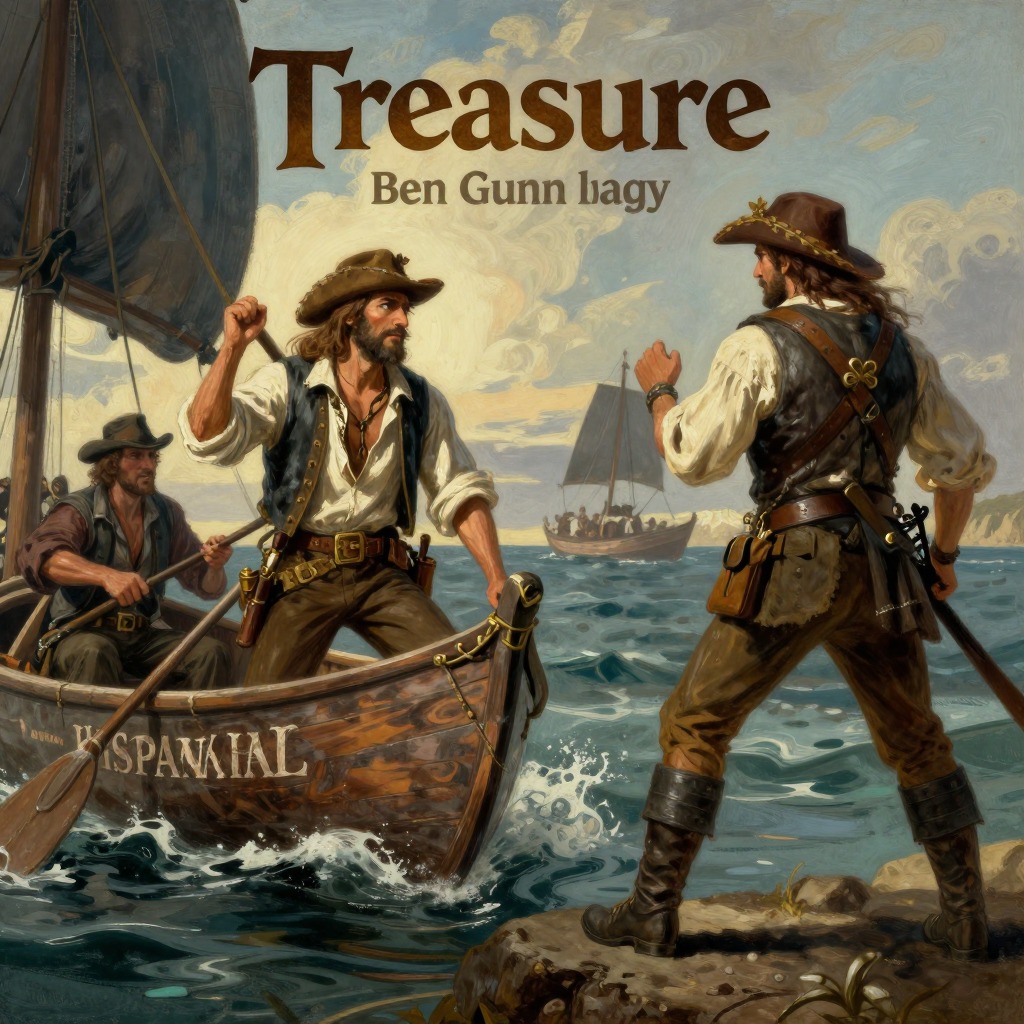
Jim's discovery of the coracle came at a moment of high tension. The mutineers, having been repulsed at the stockade, were carousing on shore, and Jim conceived a bold plan: to slip out under cover of night, cut the Hispaniola adrift, and let her go ashore where she fancied. He waited for darkness, which fell with absolute blackness, and then shouldered the coracle and waded through a belt of swampy sand to the edge of the retreating water. Setting the coracle keel downwards on the surface, he began to paddle towards the anchored ship. The coracle proved cross-grained and lop-sided, turning in every direction but the one he wanted, and he was only able to make progress thanks to the ebb tide sweeping him down towards the Hispaniola. He managed to lay hold of her hawser and, after a tense wait for a favourable puff of wind, cut the cable strand by strand, setting the ship adrift.
The Coracle's Fate
After cutting the Hispaniola adrift, Jim was swept alongside the ship and, on a sudden impulse, grasped a trailing cord and pulled himself up to peer through the cabin window. There he saw Israel Hands and another mutineer locked in a deadly wrestle. The coracle, however, was not to survive the night. As the current carried both the schooner and the little boat through the narrows towards the open sea, Jim lay flat in the bottom of the coracle, expecting death at any moment. He eventually fell asleep, and when he awoke at broad day, he found himself tossing at the south-west end of the island. The coracle, left to herself, proved remarkably buoyant and clever in a seaway, riding the waves like a bird as long as Jim remained motionless. But when he tried to paddle, the boat became unmanageable, and he was forced to lie still and use the paddle only in smooth places. Eventually, he sighted the Hispaniola under sail, unmanned and drifting, and resolved to board her. As the schooner bore down on him, he sprang to his feet and leaped, stamping the coracle under water, and caught the jib-boom, leaving the coracle to be struck and sunk by the ship. The little boat that had carried him on his adventure was gone, but it had served its purpose.
Significance
Ben Gunn's coracle is a testament to the maroon's ingenuity and a crucial instrument in Jim Hawkins's sea adventure. It enabled Jim to cut the Hispaniola adrift, an act that ultimately led to the ship's recapture and the defeat of the mutineers. The coracle's fragility and Jim's struggle to control it highlight his youth and inexperience, yet also his courage and resourcefulness. It is a symbol of the makeshift and the homemade, contrasting with the professional seamanship of the Hispaniola, and it underscores the theme of survival against the odds that runs through the novel.