Captain Flint (pirate)
Captain Flint (pirate) is the legendary, long-dead buccaneer whose buried treasure on Treasure Island sets the entire adventure of Robert Louis Stevenson's novel in motion. Though he never appears alive in the narrative, his presence pervades every corner of the story—through the fear his name still inspires, the former crew members who once sailed under him, the map that leads to his hoard, and even the parrot that learned his favorite phrases. Flint is the absent center around which the plot revolves, a figure of absolute ruthlessness whose legacy of violence and gold shapes the fates of all who seek his fortune.
Identity and Legend
Flint was, by all accounts, the bloodthirstiest buccaneer who ever sailed. Squire Trelawney, who had seen Flint's topsails off Trinidad, declared that Blackbeard was a child compared to him and that the Spaniards were so prodigiously afraid of Flint that Trelawney was sometimes proud he was an Englishman . The old sea-dog Billy Bones, who had been Flint's first mate, told dreadful stories about hanging, walking the plank, storms at sea, the Dry Tortugas, and wild deeds on the Spanish Main—stories that shocked the plain country people who heard them . Flint's own ship was the Walrus, a vessel that Long John Silver, who served as Flint's quartermaster, had seen "amuck with the red blood and fit to sink with gold" . The name Walrus was later found branded on packing cases near the empty treasure pit on the island .
The Burial of the Treasure
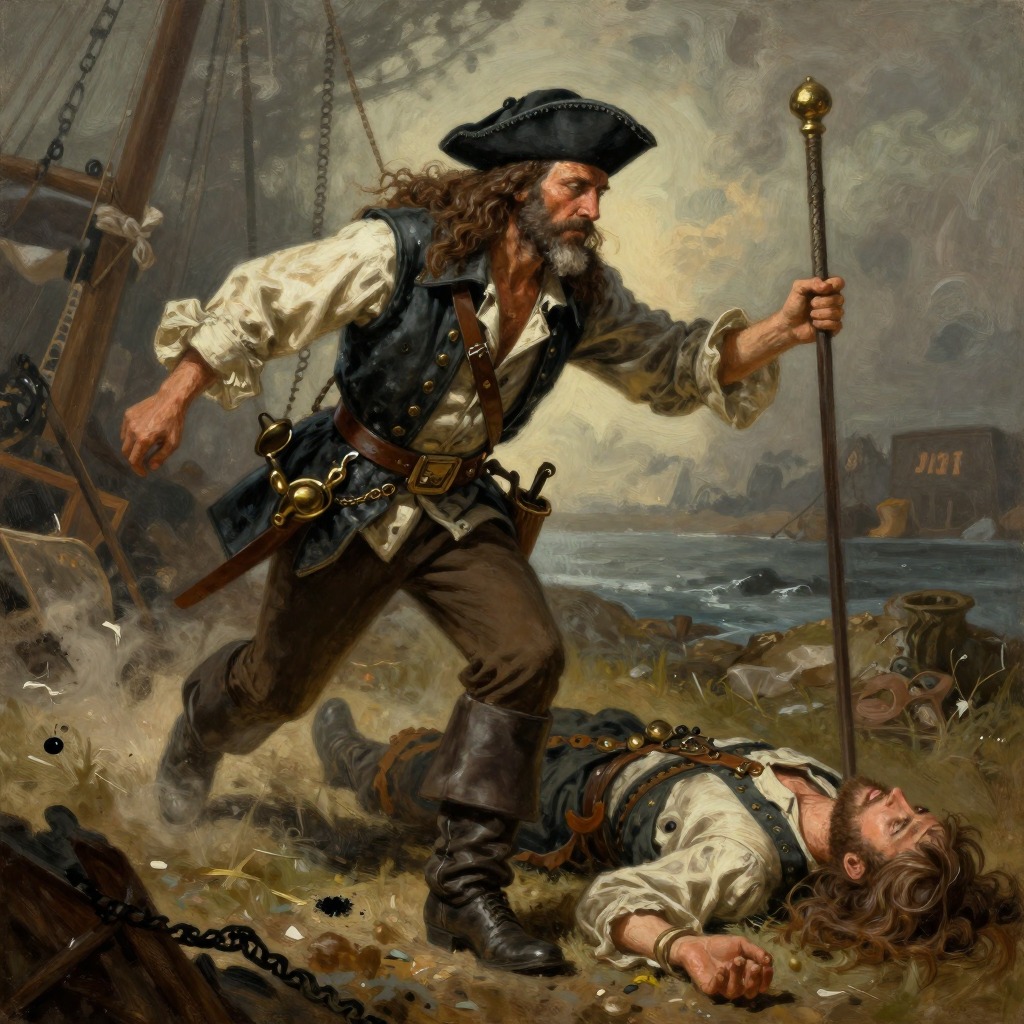
Flint's most consequential act was the burial of his immense treasure on a remote island. According to Ben Gunn, who was in Flint's ship when the treasure was buried, Flint went ashore with six strong seamen and was gone for nearly a week while the Walrus stood off and on. One day the signal went up, and Flint returned alone in a little boat, his head done up in a blue scarf, looking "mortal white about the cutwater." The six men were all dead—dead and buried. How Flint, one man against six, accomplished this murder remained a mystery to everyone aboard . The treasure map, with its latitude and longitude, soundings, names of hills and bays, and three red crosses marking the caches, was the key to the hoard. On the back, in a small, neat hand very different from Billy Bones's tottery characters, were written the bearings: "Tall tree, Spy-glass shoulder, bearing a point to the N. of N.N.E. Skeleton Island E.S.E. and by E. Ten feet" (E00251-E00258). The map also bore the initials "J.F." .
Legacy and Influence
Flint's death did not diminish his power. He died at Savannah, singing and shouting for drink, and his last words—"Fifteen men on the dead man's chest"—became the song that haunted his former crew . Long John Silver kept a parrot named Captain Flint, which he claimed was two hundred years old and had sailed with the great pirate Captain England, been at Madagascar, Malabar, Surinam, Providence, and Portobello, and learned to cry "Pieces of eight!" from the wrecked plate ships . The parrot's refrain became an omen of danger, as when it announced Jim Hawkins's arrival in the captured stockade (E01113-E01114).
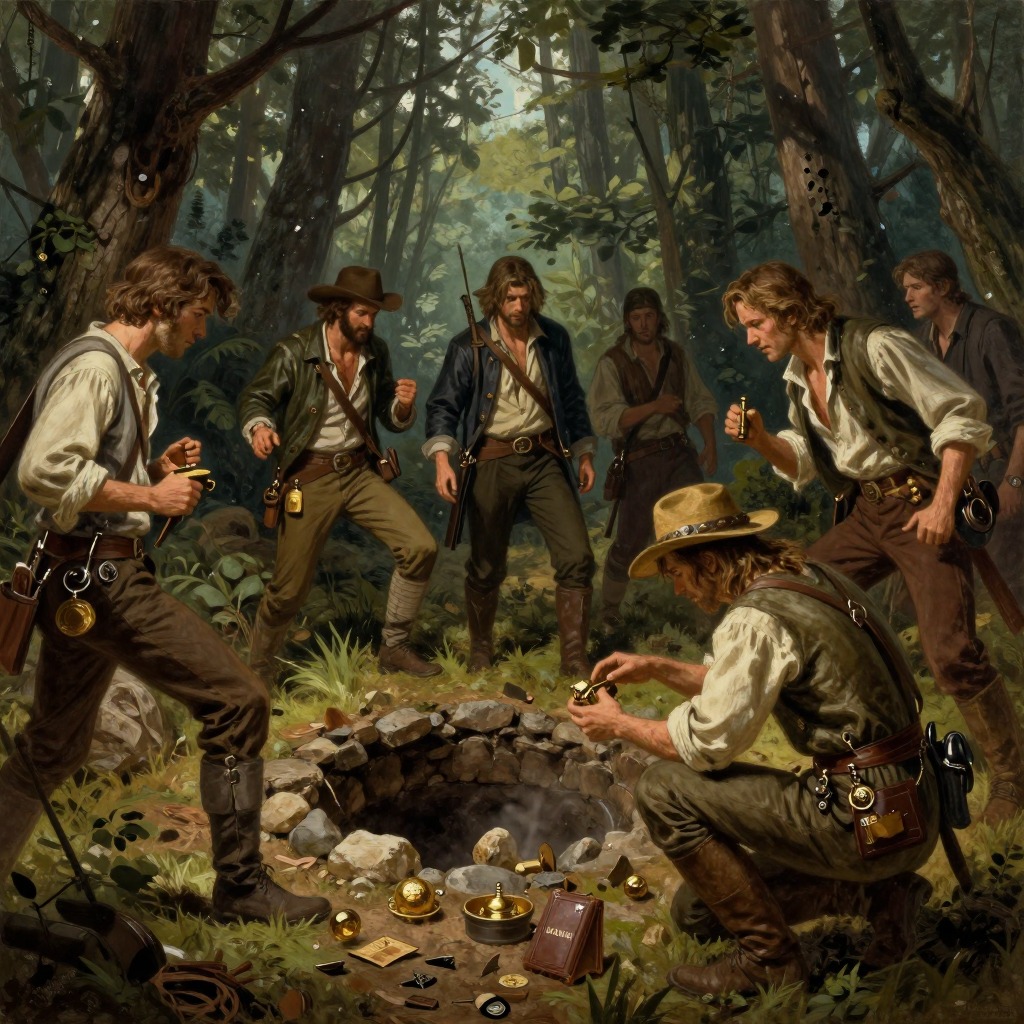
Flint's treasure itself was a collection of staggering diversity—English, French, Spanish, Portuguese coins, doubloons, double guineas, moidores, sequins, and strange Oriental pieces—that had cost the lives of seventeen men from the Hispaniola alone, and untold more in its amassing . The skeleton of one of Flint's victims, laid out by compass as a pointer toward the treasure, was discovered by the mutineers during their hunt, a grim reminder of Flint's methodical cruelty (E01303-E01306).
Narrative Role and Significance
Flint functions as the novel's ultimate offstage antagonist, a figure whose actions before the story begins determine the entire course of events. His treasure map, passed from Billy Bones to Jim Hawkins to Dr. Livesey and the squire, and finally to Long John Silver, is the object of desire that drives the plot. His former crew members—Billy Bones, Long John Silver, Israel Hands, Ben Gunn, and others—are all defined by their relationship to him. The terror of his name is so great that even after his death, the mutineers are paralyzed by the sound of a voice they believe to be Flint's ghost singing "Fifteen Men" in the woods (E01326-E01330). The treasure itself, when finally found, has already been moved by Ben Gunn, and the empty pit with the broken pick-ax and the Walrus branding delivers the ultimate reversal to the pirates (E01363-E01364). Flint, though dead, remains the most powerful presence on the island, a figure of absolute evil whose legacy of greed and violence consumes all who seek it.