American isolationism before World War II
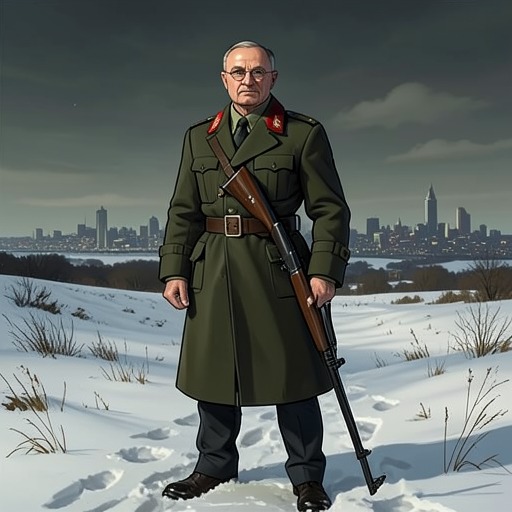
TrumanAmerican isolationism before World War II was a political argument over whether the United States could remain secure by withholding aid and avoiding deeper involvement in overseas conflict. In the evidence surrounding Harry S. Truman, it appears not as a settled national consensus but as a struggle over neutrality, military preparation, and assistance to countries resisting Nazi aggression. Truman’s own course moved from an earlier vote for neutrality legislation and a politically expedient alliance with Bennett Clark toward outspoken opposition to isolationism and support for aid to Britain.
Neutrality and political calculation
In 1939, as Adolf Hitler’s radio speeches and Germany’s military advance darkened Truman’s view of events, he began pressing for a stronger American response. He had voted for the 1936 Neutrality Act, but now considered it a mistake. He called for a special session of Congress to revise it, argued that neutrality had become obsolete, and urged that the arms embargo be lifted so the United States would not deny weapons to countries resisting aggression. In October, he described the dictators Adolf Hitler, Joseph Stalin, and Benito Mussolini as having returned to a code of “cave-man savagery.” With James F. Byrnes, he also pressed for greater defense appropriations, an immediate Army buildup, and a Navy “second to none.”
That emerging position sat uneasily beside Truman’s electoral maneuvering in early 1940. When he formally announced his Senate reelection candidacy on February 3, he opposed Franklin D. Roosevelt seeking a third term and named Bennett Clark as his choice for president. Clark was a conservative isolationist, and the book presents Truman’s endorsement as an effort to secure support in eastern Missouri and signal his displeasure to Roosevelt. Truman’s opposition to a third term, however, was sincere: he believed democracy should not depend on any one person’s life or health. The episode exposes the difference between a principled view of political succession and the compromises of a Senate campaign; it also shows Truman aligning himself with a politician whose later position on foreign affairs conflicted with his own developing judgment.
The fight over aid to Britain
By the end of 1940, the conflict between intervention and isolation was becoming harder to separate from the worsening war. On December 29, as London endured its most savage bombing yet, Roosevelt addressed the country in the speech known as the “Arsenal of Democracy” speech. He called for large-scale production to supply nations under Nazi attack. Truman heard the next major appeal on January 6, 1941, when Roosevelt addressed Congress in support of the Four Freedoms: freedom of speech, freedom of religion, freedom from want, and freedom from fear. Truman considered Roosevelt at his best.
The proposed Lend-Lease plan, which would send Britain arms on credit, brought the disagreement into Congress. Burton K. Wheeler, Arthur Vandenberg, Bennett Clark, Gerald P. Nye, and Robert Taft objected, presenting the bill as a road to war. Wheeler warned that it would “plow under every fourth American boy.” Clark opposed aid to Britain and argued that the United States should defend itself rather than spend supplies in Europe if Hitler conquered the continent. Truman judged those arguments shortsighted. He repeatedly voted against amendments intended to restrict Roosevelt’s ability to carry out Lend-Lease, making his opposition to isolationism a matter of legislative action, not simply public speech.
Preparedness and the lesson of the previous war
Truman’s support for aid formed part of a broader argument that American security required preparation before danger reached the country. He served on the Military Affairs Committee and the Military Subcommittee of the Appropriations Committee, and in September 1941 voted for the first peacetime draft. By December, more than $10 billion had been awarded in defense contracts. General George C. Marshall asked Congress for a force of two million men and another billion dollars, describing that sum as only a beginning. The scale of the requests sharpened the question at the center of the isolationist debate: whether preparation was a safeguard against war or an unnecessary step toward it.
In the summer of 1942, with the war under way, Truman called on the Senate floor for a second front in Europe to relieve the Soviet Union, presenting it as a military necessity. Speaking in Jackson County, he described the new war as a tragic continuation of the conflict of 1917–1918. In his view, the victors of the earlier war had failed to secure a peace that could protect later generations, and a “spirit of isolationism” had helped bring about a still worse calamity. His argument made the avoidance of involvement itself a consequential choice: refusing to act after victory, he believed, had not preserved peace but left conditions for another war.
From wartime debate to postwar policy
The book’s later episodes place Truman’s wartime rejection of isolationism within a continuing commitment to international engagement. After Roosevelt’s death, Truman heard warnings from Averell Harriman about Soviet control in Poland and Romania and the threat it posed to political freedoms. Harriman argued that workable relations with the Soviet Union were still possible through concessions on both sides. Truman acknowledged that complete agreement with Joseph Stalin was unrealistic, but said he would be satisfied with 85 percent cooperation. When he addressed Vyacheslav Molotov over the unresolved Polish question, he invoked the risk that the Senate might reject American participation in the United Nations. The scene presents international cooperation not as the absence of disagreement, but as a goal pursued under pressure from foreign events and domestic approval.
In 1947, when the administration considered aid to Greece and Turkey, Truman summoned congressional leaders to the White House. George C. Marshall warned that Soviet domination might extend across Europe, the Middle East, and Asia, and framed the choice as acting energetically or losing by default. Truman emphatically agreed. This later approach contrasts with the prewar insistence that the United States could safely keep its distance: in both cases, the question was whether inaction would protect the country or allow danger to grow. American isolationism before World War II therefore serves as more than a record of congressional opposition to aid. Through Truman’s changed position and his later efforts to sustain cooperation abroad, it becomes a warning about the political and strategic costs he believed could follow from mistaking withdrawal for security.