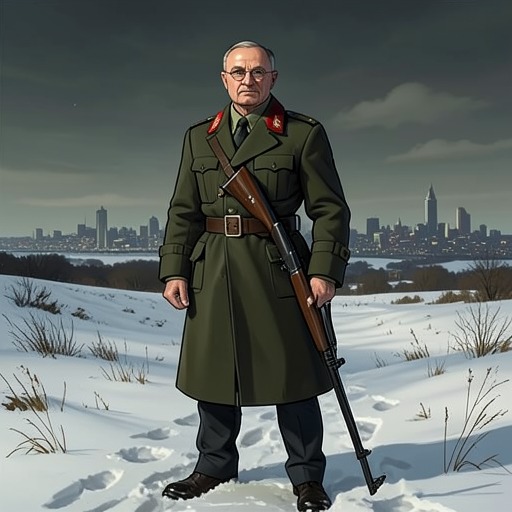
Soviet domination of Eastern Europe
TrumanSoviet domination of Eastern Europe was the central obstacle to the postwar hope that the Allied powers could turn victory over Germany into a cooperative peace. At Potsdam, Harry S. Truman sought democratic governments, free elections, and practical access for Western representatives in territories under Soviet control. The conference exposed how little those demands could accomplish against the Red Army’s established position. Agreements were reached, but important disputes were deferred, qualified, or settled in ways that reflected Soviet power on the ground.
The problem behind the negotiations
The concern was not simply that the Soviet Union would influence neighboring governments. W. Averell Harriman warned Truman that Russian control in Poland and Romania meant power over foreign policy as well as the use of secret police and the loss of freedom of speech. He argued that American policy had to be reconsidered: the United States could no longer assume that the Soviet Union would act according to accepted principles in international affairs. Harriman did not consider workable relations impossible, but believed they would require concessions on both sides.
Truman accepted that complete cooperation from Joseph Stalin was unrealistic, while still hoping for substantial agreement. The immediate test was whether arrangements made with the Soviet Union would produce governments capable of acting independently and openly. This left the American president balancing two aims: pressing Moscow to honor commitments to democratic government, and preserving a working relationship with a wartime ally whose forces already occupied much of Eastern Europe.
Potsdam and the dispute over democracy
At Potsdam, the disagreement took a concrete form in discussion of Italy, Romania, Bulgaria, and Hungary, the former German-aligned states described as satellite countries. The American and British position was that Italy could be admitted to the United Nations, while Romania, Bulgaria, and Hungary should not be admitted until democratic governments had been established. Stalin challenged the distinction, noting that Italy had not held democratic elections either. Truman answered that the difference was access: representatives could travel freely in Italy, whereas Western Allies did not have free access to the Balkan countries.
Truman argued that the satellite governments should be reorganized along democratic lines, as agreed at Yalta. Stalin offered a different definition, treating the absence of fascism as sufficient evidence that a government was democratic. Winston Churchill pointed to the contrast between Italy’s free press and accessible diplomatic missions and the restrictions imposed on the British mission in Bucharest. Stalin dismissed those objections. Charles Bohlen later judged that this exchange revealed the gulf between the Soviet Union and the Western Allies more clearly than any other moment at the conference. The argument was about more than a label: it concerned whether the people and governments of Eastern Europe could be judged by standards open to outside observation, or by a definition that left Soviet authority largely unchallenged.
The conference’s proceedings also limited what the public could know about these disputes as they unfolded. Reporters covering Potsdam were excluded from important transactions, denied access to participants and the Babelsberg compound, and given only occasional releases by Charles Ross. In the absence of reliable information, journalists speculated about events in Berlin, including whether Stalin had secretly toured the conquered city. That speculation should not be confused with the diplomatic record. It does, however, show how secrecy around the negotiations made it harder for the public to assess what the Allies were deciding about the postwar order.
Borders, occupation, and unresolved elections
The territorial settlement reflected the military facts Truman disliked. He recorded that Russia and Poland had agreed on the Oder and West Neisse rivers as Poland’s western frontier without consulting the other Allies. The rivers were accepted as the boundary. Poland also received the southern portion of East Prussia, including Danzig, while the Soviet Union received the northern portion. The arrangement strengthened Poland’s westward shift while placing the decision within a settlement shaped by Soviet and Polish agreement and the Red Army’s advance.
The promise of free elections in Poland remained much less definite than the territorial decisions. The parties agreed only that elections should be held as soon as possible, wording that left the question unresolved rather than establishing a firm timetable or a clear means of ensuring political freedom. Truman wanted free elections in Poland and across Eastern Europe, but could not secure more definite terms. In his account of the conference, this was a recurring pattern: a stated goal survived in the agreement, while its implementation remained uncertain.
Germany’s division illustrated the broader structure of the postwar settlement. The country was already divided into American, British, Russian, and French occupation zones, in effect separating East from West. The Allies agreed to demilitarize Germany and bring Nazi war criminals to justice, with Nuremberg chosen for the tribunal. Reparations were set through a complicated formula that gave the Soviet Union the largest share, principally in capital equipment, in recognition of its enormous losses of life and property. These provisions addressed Germany’s defeat, but did not resolve the fundamental political tensions created by Soviet power in Eastern Europe.
The limits of compromise
Truman sought agreements on several major questions: Germany’s future, free elections in Poland and elsewhere in Eastern Europe, and Soviet participation in the war against Japan. He believed the conference had accomplished much, but the account distinguishes the one clear success—Russian entry into the assault on Japan—from the ambiguity and frustration surrounding the European issues. Stalin had no incentive to accept agreements that threatened the control already exercised wherever the Red Army stood. Despite Truman’s insistence on obtaining concrete results, he made little progress with Stalin on those questions.
The Western Allies accepted compromises partly because Soviet occupation of Eastern Europe had become a fait accompli, as William D. Leahy observed, and partly because they hoped cooperation could still be maintained. Some Soviet aims were refused: Stalin did not obtain trusteeship over Italy’s former African colonies, a naval base on the Bosporus, or four-power control of the Ruhr. But the larger imbalance remained. Military occupation gave the Soviet Union leverage that diplomatic language about democratic principles could not erase, and Western concessions were made in circumstances where refusal offered no easy means of changing the facts on the ground.
Truman continued to propose shared access to inland waterways, including the Danube, Rhine, Dardanelles, Kiel Canal, and Suez and Panama canals, as a way to support a prosperous Europe and reduce the likelihood of future conflict. Stalin declined to accept the proposal, even when Truman made a personal appeal for it to be included in the final communiqué. The failure of this initiative, alongside the unresolved election question, shows the distance between Truman’s vision of common rules and the narrower settlement the Soviet Union was willing to accept.
A contested postwar order
The account does not present Soviet domination as a question settled by one declaration at Potsdam. It emerges through the contrast between commitments to democracy and the practical reach of Soviet control: restricted Western access, disputed definitions of democratic government, unresolved elections, and borders accepted after the Red Army had advanced. George F. Kennan later regarded faith in Soviet adherence to words such as democracy and justice as deeply misguided; Harriman, shut out of serious discussions by James F. Byrnes, concluded that he should resign. Their judgments underscore the divide between hopes for an agreed international order and the conduct of negotiations shaped by unequal power.
Potsdam therefore records both an effort to limit Soviet influence through diplomacy and the limits of that effort. Truman pressed for observable political conditions rather than assurances alone, but the conference could not compel those conditions where Soviet occupation supplied the decisive leverage. The resulting settlement left the future of Eastern Europe contested: its democratic language pointed toward self-government, while its uncertain provisions and the balance of forces allowed Soviet domination to endure as the defining reality of the region’s postwar politics.