Limited war
TrumanLimited war was the policy Harry S. Truman and his advisers adopted to keep the Korean War from becoming a global conflict. Faced with Chinese intervention and a collapsing United Nations front, they chose to continue the war without authorizing Douglas MacArthur’s proposals to widen it against China. The policy narrowed the objective from reunifying Korea by force to holding a defensible line and seeking an armistice, making restraint—not decisive victory—the governing test of military action.
Strategic Premise
Truman’s commitment to intervene had rested on the belief that failing to oppose North Korea’s attack on the Republic of Korea would encourage further aggression. During the flight back to Washington on June 25, 1950, he recalled earlier failures by democracies to act against aggression in Manchuria and Ethiopia. He reasoned that if the Communists could take the Republic of Korea without opposition, smaller nations would have little reason to resist stronger neighbors, and the failure to challenge the attack could help bring about another world war. The decision to enter the conflict therefore began with a concern about the consequences of allowing aggression to succeed; the later limited-war policy confronted the opposite danger, that resisting it without limits could itself produce a wider war.
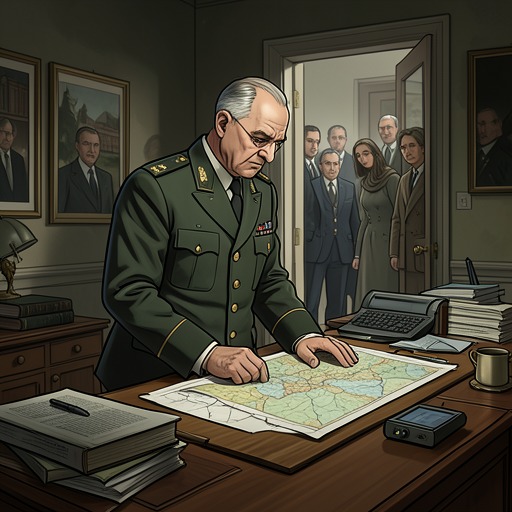
The distinction became urgent as MacArthur responded to the Chinese intervention by demanding reinforcements, Nationalist Chinese troops from Formosa, a naval blockade of China, and authority to bomb the Chinese mainland. He described his forces as battered and the existing directives as overtaken by events. These proposals treated the battlefield crisis as a reason to enlarge the war. Truman’s administration instead saw expansion as a route into direct conflict with China and possibly the Soviet Union. Its broader commitment to civilian control of the war effort sharpened the institutional stakes: military commanders could advise on operations, but the scope and political purpose of the war remained decisions for civilian leadership.
The November Decision
On November 28, 1950, as the Chinese counteroffensive turned the United Nations offensive into a retreat, Truman presided over a National Security Council meeting that effectively settled the administration’s response. The battlefield picture was bleak. The Eighth Army was falling back from the Chongchon River toward Pyongyang, while the 1st Marine Division faced a punishing withdrawal from the Chosin Reservoir toward Hungnam. Chinese forces had struck the flanks of MacArthur’s divided formations, and winter conditions compounded the crisis. In that setting, the administration had to decide whether military reverses justified widening the conflict or made restraint more necessary.
George C. Marshall argued that the United States should remain involved as part of a United Nations effort but must avoid becoming trapped in Korea. The country needed a way to leave with honor, he said in substance, and must not go to war with China. Political, economic, and psychological measures should help limit the fighting. Dean Acheson added a practical warning: China could commit more forces than the United States could, and successful American attacks in Manchuria might prompt the Soviet Union to support its Chinese ally. He urged the administration to identify a line its forces could hold. The discussion joined military limits to a strategic calculation: an attempt to turn retreat into victory by attacking beyond Korea could create the larger conflict the policy was designed to prevent.
The choice was also framed by the danger of Soviet involvement. The prospect of a global war with the Soviet Union was not an abstract afterthought but a central concern in the room. Truman later described all-out action against China as a trap. The policy therefore did not equate restraint with indifference to the retreat or its human cost. It treated the possibility of a much larger war as a limit on what could responsibly be done to reverse events on the Korean battlefield.
Revised Objective and Allied Agreement
The administration’s original aim of uniting Korea by force was abandoned. Its best hope became an armistice near the 38th parallel, and the British agreed to assist through the United Nations. When British prime minister Clement Attlee met Truman in Washington in December, the two leaders agreed that the war must not be widened. Their understanding established both a military boundary and an allied political position: the United States would keep resisting within the conflict, but would not make the war with China the means of pursuing reunification.
This shift defined limited war by what it ruled out as much as by what it sought. It did not promise a quick settlement or erase the costs of fighting. Rather, it accepted that the conflict might continue without a decisive victory, because escalation carried risks beyond the immediate campaign. The armistice objective also gave restraint a concrete purpose: holding a line and pursuing an agreement, rather than expanding operations in pursuit of total victory.
Public Defense of a Limited War
The policy’s logic was stated explicitly during the congressional hearings on MacArthur’s dismissal. Asked whether the Korean conflict was a police action or a war, Marshall characterized it as a limited war that he hoped would remain limited. Omar N. Bradley made the military case against MacArthur’s proposed expansion in a sharper formulation: widening the war with China would involve the United States in the wrong war, at the wrong place, at the wrong time, and with the wrong enemy. The Joint Chiefs, despite their admiration for MacArthur, had not supported his plan for victory.
These hearings made visible the disagreement at the heart of the policy. MacArthur’s proposals promised to bring greater force to bear on the enemy, but they also risked drawing the United States into a broader confrontation. The administration’s answer was not that force had no place in Korea; it was that force had to remain subordinate to a bounded political objective. Calling the conflict limited clarified that the desired outcome was not worth any military means or any enlargement of the war.
Significance
Limited war placed a ceiling on the conflict while leaving the military situation unresolved. Its central discipline was to separate the decision to resist aggression from permission to pursue every possible means of defeating the adversary. The November crisis made that distinction consequential: even as United Nations forces retreated and MacArthur pressed for escalation, Truman’s administration chose to keep the war within limits and seek an armistice rather than risk a general war. Marshall’s description of the conflict captured the policy’s precarious balance: a limited war, with the hope that it would remain limited.