Korean War military stalemate
TrumanThe Korean War military stalemate emerged when the sweeping advances and retreats of the war gave way to entrenched fighting near the 38th parallel. Battles for ridges and hilltops consumed lives while the front moved little, and negotiations could not quickly resolve the conflict. For Harry S. Truman, the impasse brought together the war’s human cost, the limits of military action, and a defining question of presidential responsibility: how to pursue an end to the fighting without surrendering civilian control or compelling prisoners to return against their will.
From sweeping movement to entrenched front
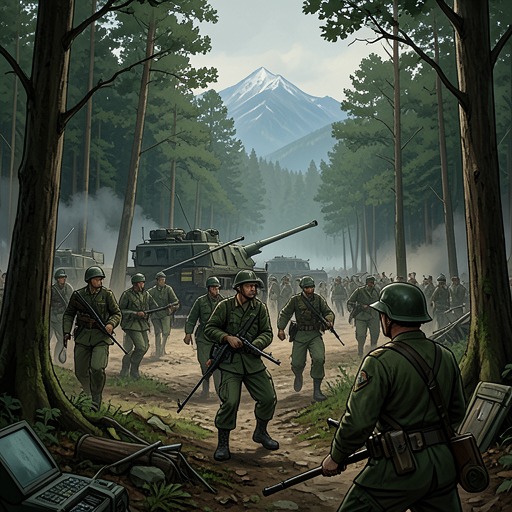
By midsummer, the war had begun to resemble World War I in its concentration of combat along a comparatively fixed line. The earlier seesaw of advances and retreats had passed; fighting now clustered near or along the 38th parallel. Some of the war’s most desperate battles were fought for limited features of the landscape: numbered hilltops and ridgelines defended by barbed wire, mines, and camouflaged tunnels. Reports from Hill 1179, Bloody Ridge, and Heartbreak Ridge brought the names of these positions into public view.
The resemblance to the earlier war was not just a matter of position. American troops had by then been fighting in Korea for nearly as long as Truman’s generation had fought in France during World War I. The terrain might offer only a hill or ridge as an immediate objective, but taking and holding such ground came at a grave price. American casualties sometimes reached 3,000 in a week and never fell below 300 during this period. By late August, American casualties had passed 80,000, including 13,822 dead. Losses among South Korean and other United Nations forces were greater still; the costs to their opponents and to Korean civilians were not yet known.
Peace talks, which had begun at Kaesong on July 8, did not stop the fighting. By late August they had broken down, while the front remained fixed and casualties continued. The resulting stalemate was therefore not a pause in the war. It was a protracted contest in which negotiations and combat ran alongside one another, neither yet producing an agreement to end hostilities.
Command, policy, and the limits of escalation
The military impasse sharpened Truman’s commitment to keeping the war effort under civilian authority. His concern predated Korea: in 1942, he had warned that growing military influence over industry and agriculture could shape the country’s political and economic structure after the war. He distinguished the military’s responsibility to fight and specify its needs from the civilian government’s responsibility to direct the larger effort. Korea made that principle immediate as well as institutional.
Early in the conflict, Averell Harriman urged Truman to seek a congressional war resolution while public support remained strong. Dean Acheson argued instead that the President should rely on his authority as Commander in Chief. Truman sided with Acheson, reasoning that asking Congress for approval during the emergency could make it harder for future presidents to respond to emergencies. The choice was not simply about the conduct of the war: it concerned how far presidential authority could be used, and what precedent an appeal to Congress might establish.
The conflict over authority also surfaced in Truman’s dealings with General MacArthur. When MacArthur issued a statement on foreign policy without authorization, Truman regarded it as defiance of presidential orders and of United Nations policy. A later letter from MacArthur, made public by House Minority Leader Joe Martin, argued that the administration should seek victory in Asia and supported bringing Chiang Kai-shek’s forces into the fighting. The dispute exposed a central pressure of the stalemate: public calls for a broader military effort competed with the President’s responsibility to set policy and control its presentation. Truman did not immediately dismiss MacArthur after the public statement; he first issued a restrained reprimand, mindful of the general’s immense public standing and the risks of an impulsive confrontation.
The prisoner question and a costly restraint
As talks resumed at Panmunjom, the fate of 132,000 North Korean prisoners held by the United Nations Command became a sticking point. An earlier understanding had envisaged an immediate exchange of all prisoners when hostilities ended. The United States now opposed compulsory return because about 62,000 of the prisoners did not wish to be repatriated. Truman insisted they should have a choice. He would not accept an armistice that, in his view, handed people over to possible slaughter or slavery.
This position made the negotiations harder, but it was not a matter Truman treated as disposable for the sake of a quick agreement. He saw the possible consequences for prisoners as part of the terms of peace itself. At the same time, the war continued to consume lives and resources, damage his presidency, and poison domestic politics. Public frustration was substantial: polls showed that half of Americans favored using the atomic bomb to end the conflict. Truman remained committed to restraint, though in a private handwritten outpouring he considered a severe ultimatum to Moscow if the intervention in Korea continued. The proposal recorded his anger and frustration; it was not an action he took.
Armistice without a decisive victory
The deadlock ended in an armistice signed at Panmunjom in the final week of July 1953, after Truman had left office and while he was beginning work on his memoirs in Missouri. The agreement provided for voluntary repatriation and left the dividing line between North and South Korea at the 38th parallel. In its essential terms, it was the settlement that had eluded Truman: the war ended without the decisive victory his critics demanded and without the front shifting to a new dividing line.
Several developments preceded the agreement. Joseph Stalin died in March; his successor, Georgi M. Malenkov, then said that Moscow and Washington had no issue that could not be resolved peacefully. The Communists in Korea subsequently agreed to an exchange of wounded prisoners and said it should lead to a peaceful settlement of the prisoner issue. The book also identifies Stalin’s death and Eisenhower’s threats to use newly developed tactical nuclear weapons as influences on the outcome. The armistice thus came not from a battlefield breakthrough alone but amid diplomatic change and continued pressure.
The final toll underscored what the stalemate had cost. The war caused extensive bloodshed and destruction; some estimates placed civilian deaths as high as two million and overall casualties at four million. The American dead included 33,629 killed in battle and another 20,617 who died from other causes. The agreement stopped the fighting while preserving the division at the 38th parallel. Truman’s critics could call that outcome a no-win settlement; the account also notes that he would have faced fierce condemnation had he accepted the same terms while in office. The stalemate’s significance lies in that tension: an unresolved political division, a negotiated end to hostilities, and a presidency shaped by the demands of restraint, command, and the continuing cost of war.