Public reaction after Truman’s succession
TrumanThe public response to Harry S. Truman’s succession was a rapid passage from disbelief to tentative confidence. Franklin D. Roosevelt’s death left the country mourning a wartime leader while confronting an almost unknown successor; Truman’s first address to Congress and the responses of people who knew him helped transform alarm into a fragile sense that the country might be in capable hands.
Shock at the Succession
The news struck across the country and beyond it like successive earth tremors. For veterans of the New Deal, members of Congress, military leaders, government officials, and Americans serving overseas, Roosevelt’s death was immediately followed by the startling fact of Truman’s accession. Many interpreted the change not simply as the loss of a great president but as the elevation of a man they regarded as the least likely successor. The prospect of Truman in the White House seemed to make the distance between the presidency and ordinary life suddenly, unsettlingly small.
The reaction was voiced in a phrase said to be heard everywhere: “Good God, Truman will be President.” The thought that “If Harry Truman can be President, so could my next-door neighbor” captured both the unfamiliarity of the new president and the fear that the country had been left without a leader equal to the war. Some worried that the fighting would last longer. David E. Lilienthal, then head of the Tennessee Valley Authority, called Roosevelt’s death and the succession “What a great, great tragedy. God help us all,” and wrote that the thought of Truman made him feel physically ill. The succession was thus received not as a routine constitutional transfer, but as a test of whether national leadership could survive the loss of the figure around whom the war effort had gathered.
Historical comparisons sharpened the anxiety. Roosevelt, like Abraham Lincoln, had died in April near the end of a great war. The parallel also recalled that Lincoln had been followed by a successor many considered lackluster, making Truman’s perceived ordinariness seem ominous rather than reassuring. Edward R. Stettinius Jr. privately wondered whether the country might be entering another Harding-like administration, run by courthouse politicians. In Germany, American commanders stayed up discussing Roosevelt and the uncertain character of the man who would replace him; the question among troops was often not whether Truman was qualified, but simply who he was.
Confidence Among Those Who Knew Him
The broad alarm was not universal. People who had known Truman, watched him exercise responsibility, or understood his background were more likely to trust him. Their confidence rested less on national familiarity than on personal knowledge: they believed he was honest, patriotic, practical, and capable of meeting pressure. John Nance Garner told Sam Rayburn that Truman had horse sense and courage; Rayburn, in turn, assured reporters that Truman had the substance to be a sound president. Arthur H. Vandenberg, a Republican, described him as a person of high honesty and good intentions, and privately concluded that he could probably manage the job.
John J. McCloy later explained his confidence simply: he felt good because he knew Truman and knew what kind of man he was. Dean Acheson likewise judged him straightforward, decisive, and honest, while recognizing that his judgment and wisdom were bounded by his limited experience. Acheson expected him to learn quickly and inspire confidence, and considered it fortunate that Truman, rather than Henry A. Wallace, had become president. Such assessments acknowledged the gap between Truman’s preparation and the scale of the office without treating that gap as proof of failure.
The strongest early assurances came from Truman’s longstanding associates. Jim Pendergast sent a cable urging him to get to work and assuring him that he could handle the task. Eddie Jacobson told a reporter that he wished people knew Truman as well as he did. At Grandview, Truman’s mother offered a more complicated response: she could not be glad he was president because Roosevelt had died; had Truman been elected, she would have waved a flag, but under these circumstances it did not seem right to celebrate. She nevertheless believed Harry would get along all right. Truman admired the statement and recorded that it was a jewel. Her response held public grief and private confidence together without confusing succession with victory.
The First Address and a Change in Mood
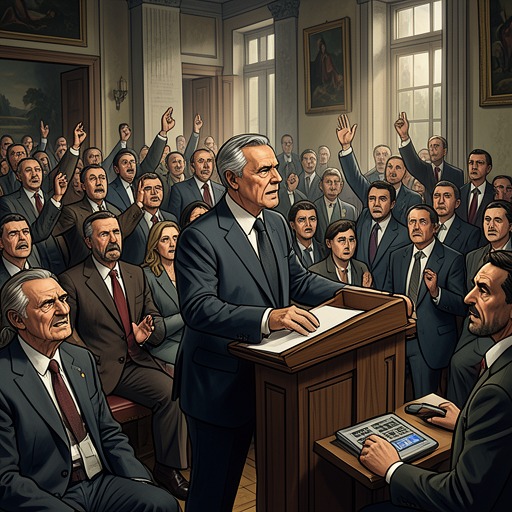
Truman’s first major public test came on April 16, when he addressed Congress. He entered to a standing ovation, opened a large black loose-leaf notebook, and began speaking before Sam Rayburn had formally introduced him. Rayburn interrupted to make the introduction, producing a moment that was both comic and poignant: the new president was still “Harry” to the speaker even as the office demanded a new formality. Truman’s address lasted fifteen minutes and drew applause seventeen times.
The reception depended not only on what Truman promised but on how he sounded. Listeners had to adjust to his distinctive pronunciation, yet many heard sincerity in his voice and directness in his manner. He pledged to pursue the war without letup, seek a lasting peace, improve the lot of ordinary people, and defend the ideals associated with Franklin D. Roosevelt. He also called for a strong and lasting United Nations organization and rejected the idea that the country could again find safety behind geographical barriers. The speech’s conclusion, which Truman had written himself, framed the presidency as a duty requiring discernment and faithful service. Its appeal joined humility to resolve rather than pretending that he could simply replace Roosevelt.
The address brought relief and, for many, hope. David Lawrence described a bond of friendship between Truman and his audience, while messages of approval arrived at the White House from across the country. Correspondents praised his humility and earnestness, expressed sympathy for his burden, and offered cooperation. Labor unions, veterans’ organizations, church groups, employee groups, and others pledged support. Even a Republican doctor, writing after stopping during a birth to congratulate the newborn for arriving at such a moment in history, reported a striking local unity of purpose around the incoming administration.
A Provisional Honeymoon
The welcome was more than the ordinary honeymoon granted a new president. Many people felt Truman was “one of us”: familiar in manner, modest in presentation, and easier to approach than the towering figure he had succeeded. Republicans in the Senate, despite their reservations, decided that it was no time to obstruct him. They described him as someone who knew them and thought as they did, and even opponents recognized that a person thrust into such a difficult office deserved help getting established. The response did not erase doubts about his experience; it made room for cooperation while those doubts remained.
The change in mood took visible, everyday forms. On the day of his congressional address, the Trumans moved temporarily from their apartment to Blair House because the security presence made ordinary life in the building difficult. In the following days, Truman walked across Pennsylvania Avenue to work, accompanied by his Secret Service detail. A taxi driver slowed to call, “Good luck, Harry,” an informal greeting that seemed to express the country’s emerging goodwill. That public intimacy was an important counterpart to the formal ovation: the new president was not only being judged from a distance but addressed as someone recognizably among the people.
The confidence was real but provisional. Truman himself told his family that the address seemed to have gone well, yet admitted he was almost as frightened as when he learned of Roosevelt’s death. In the months that followed, Congress repeatedly resisted requests, and Truman persisted rather than changing his approach. The initial warmth therefore did not guarantee agreement or lasting approval. It gave him a measure of public and political room in which to begin the work, while the contrast between early trust and later resistance remained part of the story of his succession.