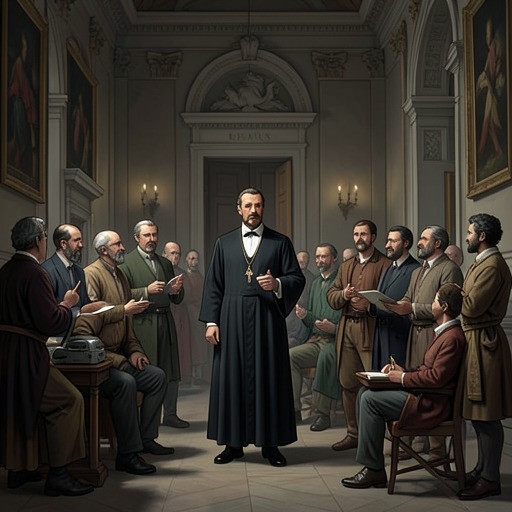
John Morton
UtopiaJohn Morton was an influential churchman and royal adviser whose authority in Utopia is joined to a distinctive capacity for judgment. He appears first in the historical account as a patron of the young Thomas More, and later in Raphael Hythloday’s recollection as the presiding figure at a dinner where arguments about theft, poverty, and punishment expose the habits of a political court. In both roles, Morton is associated with attentive discernment: he recognizes promise in a young client and takes seriously a proposal that others dismiss when it comes from a stranger.
Background and Political Standing
Morton’s career placed him near the center of English government. Before his rise under Henry VII, he had been the Bishop of Ely whom Richard III sent to the Tower, and he later became active in opposition to Richard. Henry VII relied on his counsel; in 1486 he made Morton Archbishop of Canterbury, and nine months later Lord Chancellor. The introduction presents his authority as the product not only of office but of long practice in public affairs and experience of changing fortune.
The account of his household establishes a personal connection with Thomas More. As a boy, More was placed in Morton’s service, a customary arrangement in which a young person from a good family entered the household of a wealthy or influential patron. The client wore the patron’s livery and added to the household’s standing; the patron could later use wealth or influence to advance the client. Morton’s household was therefore both a place where More grew up and an early setting for the recognition of his abilities.
Morton noticed the young More’s quick wit and predicted that he would become an exceptional man. His forecast makes the patronage relationship more than a matter of social arrangement: Morton is shown identifying a quality in More before the latter’s public career had developed. The prediction also gives the later narrative of Morton a personal resonance, since More remembers him not only as a powerful statesman but as the patron in whose family he was raised.
Character and Political Judgment
Raphael’s account of Morton supplies a fuller portrait. He describes him as of middle stature and not yet broken by age, with a manner that inspired reverence rather than fear. Morton’s conversation could be easy while remaining serious and grave. When petitioners came on business, he sometimes tested their composure by addressing them sharply but decently. He valued a spirited answer when it stopped short of impudence, regarding such people as especially suited to public affairs.
The portrait emphasizes the combination of natural ability and acquired expertise. Morton spoke gracefully and with weight, was deeply skilled in law, and possessed a powerful understanding and memory. Study and experience had strengthened these talents. Raphael further presents him as an experienced administrator: the king depended heavily on his counsel, and government seemed chiefly supported by him. His authority thus rests both on his intellectual gifts and on a life spent learning the practical demands of affairs.
The Dinner Debate on Theft and Poverty
At a dinner in Morton’s house, an English lawyer praised the severity of the punishment for theft, noting that many thieves were hanged while theft continued. Morton asked why so many remained if so few escaped punishment. Raphael answered that severe penalties neither addressed the causes of theft nor provided an effective remedy. He argued that people driven by poverty and lack of work could not be restrained simply by making the penalty harsher, and that measures enabling people to earn a living would be better for the public.
Raphael developed the argument through specific social conditions. He pointed to people disabled from their trades by service in war, tenants pressed by wealthy landowners, and retainers dismissed when a lord died or fell ill. He also described the consequences of land being put to pasture, the decline of villages, and the lack of work for people displaced from agriculture and wool production. His conclusion was that a society which leaves people without viable means of subsistence and then punishes their theft makes the conditions for crime before imposing its penalty.
A counsellor prepared to answer Raphael in the formal manner of a debate, first repeating his points and then promising to refute them. Morton stopped him, postponing the response until the next day, and instead asked Raphael to explain why theft should not be punished by death and what alternative punishment would serve the public. The intervention changes the direction of the gathering: rather than letting the counsellor turn the exchange into a display of rhetorical procedure, Morton asks for the reasoning behind Raphael’s challenge.
Raphael argued that taking a life for theft was disproportionate and that treating theft and murder as equally capital offences could encourage a thief to kill a witness, since the penalty would be no worse. He proposed alternatives including lifelong public labor for serious crimes and recounted the system he had observed among the Polylerits, where thieves made restitution and served the community rather than being executed. Their treatment combined labor and public support with the possibility of eventual release for good conduct.
Morton did not simply endorse the proposal without qualification. When a counsellor dismissed the Polylerite practice as too dangerous for England, Morton observed that its success could not be judged confidently because it had never been tried. He suggested that a prince could reprieve a condemned thief temporarily, withhold sanctuary, and test the alternative; if the experiment failed, the sentence could still be carried out. He also applied the proposal to vagabonds, against whom existing laws had not achieved their intended result. The suggestion was presented as a limited trial rather than a settled policy, but it gave practical form to Raphael’s case for testing a less severe punishment.
Influence and Narrative Role
The company’s response reveals a contrast between Morton’s judgment and its own deference to rank. The proposal had been treated dismissively when Raphael advanced it, but after Morton spoke, the guests praised it, especially the part concerning vagabonds. Raphael interprets this change as evidence that courtiers value the approval of a powerful host more than the substance of an argument. Morton’s intervention therefore has two effects: it brings a neglected proposal into serious discussion, while the guests’ reaction exposes how authority can determine which counsel receives attention.
The episode also places Morton amid the comedy of the dinner. A jester proposes, in mock concern for the poor, that beggars be sent to monasteries, assigning men to the Benedictines and women to convents. A clergyman extends the jest to friars, and the jester answers by comparing them to vagabonds. The clergyman becomes angry and denounces him; Morton signals the jester to withdraw, redirects the conversation, and soon leaves to hear legal cases. The scene makes his authority visible as a means of ending a quarrel, while its humor turns on the difference between a joke Morton can tolerate and a rebuke the friar cannot.
More’s response to Raphael gives the portrait an explicitly personal ending. He says that the recollection has made him imagine himself young again in his own country and brought back the good Cardinal who had helped raise him. More says that Raphael is dearer to him for honoring Morton’s memory. Yet he does not accept Raphael’s argument against serving rulers: he continues to urge that wise counsel might benefit humanity. Morton’s memory thus joins affection and political debate. He stands as the admired patron whose household shaped More’s early life, and as a statesman whose conduct at the dinner provides a measure of how serious political listening might differ from courtly flattery.