Utopians
UtopiaThe Utopians are the people of an island society whose organization tests the possibility of replacing private accumulation with common provision. In Raphael Hythloday’s account, their civic order joins shared property and coordinated labor to detailed regulation of work, travel, settlement, and war. Its attractions are substantial: hunger and begging are prevented by distribution, and the island’s towns cooperate as parts of a single household. Yet the same account reveals coercive limits and unresolved tensions, and Thomas More’s framing narrator closes with qualified rather than complete approval.
Identity and Setting
The Utopians inhabit an island that, Raphael explains, was once part of the continent. Utopus conquered the country, formerly called Abraxa, and ordered a fifteen-mile channel cut to separate it from the mainland. The work was imposed on both the original inhabitants and Utopus’s soldiers; its rapid completion astonished neighboring peoples who had first regarded the undertaking as foolish. Raphael attributes the society’s transformation to Utopus’s conquest and government, describing the inhabitants as having been brought from uncivilized conditions into a polity whose customs and laws surpass those of other nations.
The island’s crescent shape and difficult sea entrance help define its security. A broad bay gives its inhabitants convenient internal communication, but submerged rocks make passage dangerous to strangers without a native pilot. A tower and garrison stand on the visible rock within the entrance, while coastal defenses combine natural features and human construction. This protected geography is not merely a backdrop: the island’s founding separation, its guarded approaches, and the Utopians’ capacity for collective action all give material form to a society organized as a distinct political community.
Civic Organization and Shared Provision
The island contains fifty-four cities, built as similarly as their sites permit and governed according to common customs and laws. Once a year, each sends three senators to Amaurot to consider common affairs. The cities are spaced at least twenty-four miles apart, while the distance between the most remote neighboring cities can be covered on foot in a day. Their jurisdictions include surrounding farmland, but the inhabitants do not seek to enlarge their boundaries, regarding themselves as tenants rather than owners of the land.
Agriculture is treated as a common competence rather than a specialized occupation. Men and women learn it from childhood through schooling and practical work in the fields. Families take turns living in country farmhouses: a group remains for two years, while twenty members return to the city annually and are replaced by others who learn from people already experienced in the work. The arrangement circulates agricultural knowledge and is intended to prevent errors that could cause a shortage of grain. Although the rotation keeps anyone from being compelled to remain in the demanding rural life indefinitely, some inhabitants ask to stay longer because they enjoy it.
Alongside agriculture, each person learns a trade, such as working wool or flax, masonry, smithing, or carpentry. Clothing is made by families in a uniform, unchanging style adapted to the climate; differences mark sex and marital status rather than changing fashion. Trades usually pass from parent to child, but a person whose inclination lies elsewhere may be transferred to a family practicing the desired occupation, with the father and magistrate overseeing the placement. Learning a second trade is also permitted, and the worker follows whichever trade is preferred unless the public has greater need for the other.
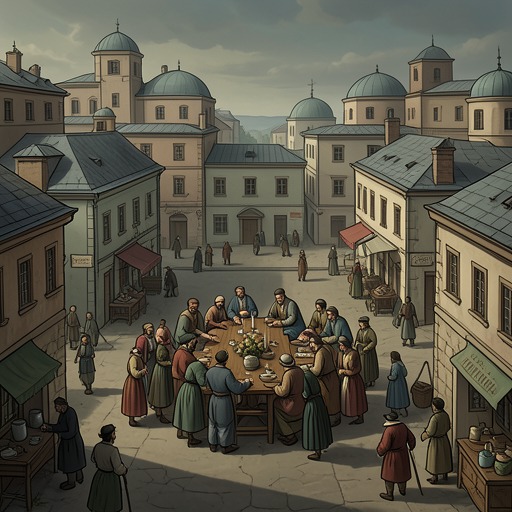
Provisioning turns the principle of common ownership into an everyday practice. Each city is divided into four parts, each with a central marketplace where goods made by families are stored together by kind. A family head takes what the household needs without payment or exchange. Raphael explains that abundance removes the incentive to take more than necessary, while the laws leave little scope for the pride expressed through competing in display and excess. Food markets supply produce, bread, fish, fowl, and cattle; the killing of animals and the washing away of refuse take place outside the towns, tasks assigned to slaves. Citizens are not permitted to butcher animals, because the practice is thought to diminish pity and kindness.
Labor, Movement, and Islandwide Cooperation
The Utopians’ provision depends on organized labor and limits on idleness. Travel outside one’s city requires permission and a passport; a person caught wandering without one is treated as a fugitive, sent home in disgrace, and, if the offense is repeated, condemned to slavery. Travel within the city’s territory is allowed with a father’s permission and a wife’s consent. A traveler who stays at a country house must work and observe its rules, so movement does not release anyone from the system of labor.
Raphael describes public life as arranged to discourage both idleness and private gathering outside ordinary oversight. There are no taverns, alehouses, or brothels, and people live in view of one another, performing their assigned work and using their spare time productively. In his account, the result is abundance distributed across the population, with no one reduced to begging. The arrangement’s promise of security is inseparable from its discipline: work, residence, and even travel are governed as matters of common concern.
Cooperation extends beyond individual cities. At the annual council in Amaurot, representatives compare supplies and shortages, transferring provisions freely from cities with a surplus to those in need. The island stores two years’ provisions against poor seasons before exporting what remains, including grain, honey, wool, flax, timber, wax, tallow, leather, and cattle. One-seventh of exported goods is given freely to the poor in the receiving countries; the rest is sold at moderate prices. Raphael says the trade brings back goods the island lacks, especially iron, as well as a great store of gold and silver. In this respect the society does not simply lack contact with money: it accumulates wealth through external trade, though the account distinguishes that public reserve from the private competition in possessions that its domestic arrangements suppress.
War, Expansion, and Contradictions
The Utopians detest war as brutal and regard glory won in battle as inglorious. Nevertheless, men and women train in military exercises so they will not be useless in an emergency. They fight to defend themselves or their friends against unjust attack, and may assist an oppressed nation seeking to escape tyranny. Their aid is conditional: before joining a war on an ally’s behalf, they must be consulted, judge the grounds satisfactory, and conclude that demands for reparation have been rejected. They also treat injuries to foreign merchants under unjust or perverted laws as a possible cause of war.
Raphael’s example of the war involving the Nephelogetes and the Aleopolitanes complicates the ideal. The Utopians entered on the side of the Nephelogetes after judging their merchants to have suffered injustice. The conflict became terrible, drew in neighboring states, and ended in the conquest and enslavement of the Aleopolitanes. The Utopians claimed no share of the spoils, but their intervention had helped bring about a sweeping defeat and the enslavement of a people who had been superior to their opponents before the war. Their declared opposition to martial glory therefore coexists with a doctrine that can lead to large-scale destruction.
Their settlement policy reveals a related tension between common use and coercion. When the island’s population increases, the Utopians send colonists to neighboring mainland where they find more land than its inhabitants can cultivate. If the local people agree to adopt Utopian customs, they are admitted into the community, a change Raphael presents as beneficial to both populations. If they refuse, the Utopians expel them from the territory they have marked out for themselves and use force if resisted. They consider preventing others from occupying unused land a just cause of war. In the account, a principle of subsistence and cultivation thus authorizes the displacement of people who do not consent to the newcomers’ laws.
Narrative Role and Evaluation
The Utopians reach the reader through layered narration rather than as an independently voiced group. Thomas More’s account begins from a diplomatic setting in Flanders and turns toward Raphael Hythloday, whose travels with Amerigo Vespucci provide the pretext for his reports about distant societies. After discussing political errors and institutions across different nations, Raphael is invited to describe the Utopians’ laws and customs in detail. Their commonwealth is therefore both a reported society and the central subject of a conversation about whether practical political counsel can correct existing abuses.
Raphael’s account gives the Utopians’ institutions persuasive coherence, but the ending preserves distance from his judgments. Thomas More’s narrator acknowledges that several features seem absurd to him, particularly the Utopians’ ways of making war, their religious beliefs, and their communal life without money, which appears to remove the splendor commonly treated as a nation’s ornament. He refrains from challenging Raphael at that moment because Raphael is tired and might take criticism as an attack on his wisdom. Instead, he commends the constitution in general and postpones a fuller examination. His final position is deliberately divided: he cannot agree with everything Raphael has related, yet wishes that many features of the commonwealth might be adopted, even if he does not expect to see them. The Utopians’ significance lies partly in that unresolved space between an attractive alternative and a system whose discipline, expansion, and use of force resist easy endorsement.