Utopus
UtopiaUtopus is the conqueror and founder whose name replaces Abraxa and whose engineering turns the territory into the island of Utopia. His decisive legacy is both physical and political: he separates the land from the continent, imposes an effective government on its inhabitants, and establishes a civic design that later generations continue to elaborate. The society described by Raphael Hythloday presents his founding as the beginning of an enduring order, while its later policies also reveal the force and territorial claims that order can entail.
Conquest and the Making of an Island
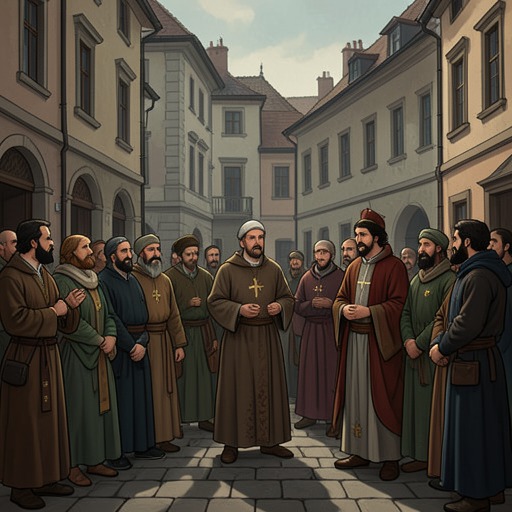
Utopia, Hythloday reports, was once part of the continent. Utopus first subdued its inhabitants, who are described as having been rude and uncivilized, and brought them under a government and a degree of refinement that now surpass those of other peoples. The account makes conquest the threshold of the society’s celebrated political transformation: the inhabitants’ later excellence follows a victory that established Utopus’s authority over them.
After the conquest, Utopus resolved to separate the territory from the mainland. He ordered a channel fifteen miles long to be dug, setting a vast number of men to the work. To prevent the inhabitants from feeling that they were being treated as slaves, he required his own soldiers to labor alongside them. The work was completed with a speed that exceeded expectations; neighboring peoples who had initially mocked the scheme were instead struck with admiration and terror when they saw it finished. The episode joins practical engineering to a calculated display of power: Utopus changes the landscape, but also makes the scale and success of his rule visible to those beyond it.
Geography, Defense, and the Reach of His Design
The resulting island is crescent-shaped, with a broad, sheltered bay between its horns. Its entrance is perilous: submerged rocks and shallows make passage dangerous, while a single visible rock bears a tower and garrison. Only local pilots know the channel, and coastal markers guide even native sailors; if those markers were shifted, an invading fleet could be wrecked. Other harbors and a coast fortified by both nature and human art further strengthen the island’s defenses. These details show the strategic consequences of Utopus’s separation of the territory: the channel is not merely a boundary but part of a landscape difficult for outsiders to enter safely.
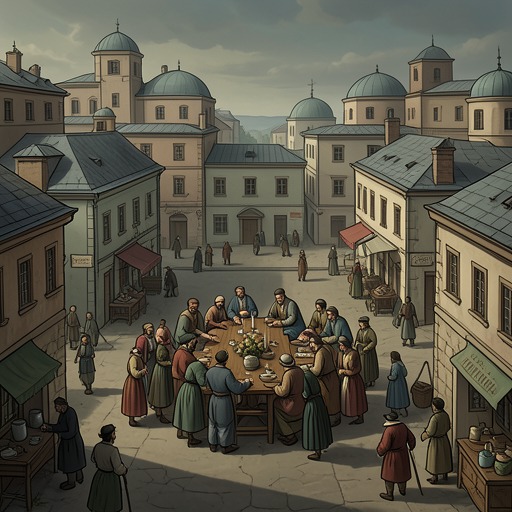
Hythloday also credits Utopus with the original plan for the towns, while explaining that their ornament and improvement were left to later inhabitants. The island has fifty-four large cities, built as similarly as their sites permit and governed by common customs and laws. Each sends three senators to an annual assembly at Amaurot, the central city, to discuss shared concerns. The account therefore distinguishes a founding framework from its later completion: Utopus supplies the initial civic design, but the towns’ developed form belongs in part to those who come after him.
The Society That Develops from the Foundation
Later descriptions make clear how thoroughly the founding order extends into the organization of everyday life. The towns are composed of families, with rules limiting each city to six thousand families and each household generally to between ten and sixteen people. Population is redistributed between families and cities when their numbers grow unevenly. If the island as a whole becomes overpopulated, citizens are sent to establish colonies on neighboring land; if a city suffers a severe population loss that the other cities cannot repair, settlers are recalled from those colonies. Hythloday says such a return has been necessary twice, after plague carried off many inhabitants.
The colonial policy also exposes a harder edge in the society’s account of its own order. Utopians may absorb neighboring inhabitants who agree to live under their customs and laws, and they present cultivation as a means of making land fruitful enough for both peoples. But if local inhabitants refuse to conform, the colonists drive them from the territory they have marked out and use force if they resist. The Utopians regard a nation’s refusal to let others use land it leaves idle as a just cause of war, appealing to a natural right to uncultivated ground needed for subsistence. These policies are not presented as personal acts by Utopus; they belong to the later political system whose foundation his conquest established. They nevertheless complicate the account’s celebration of good government: the society’s internal order and claims to communal prosperity coexist with coercive expansion beyond the island.
Founding and Inheritance
The island’s records reach back seventeen hundred and sixty years and preserve a history of material change: early houses were low cottages of timber, mud, and thatch, whereas later ones rise three storeys and use stone, plaster, or brick facings. The narrative gives Utopus the first design of the town while assigning its subsequent improvement to generations of inhabitants. His significance thus lies less in having completed every feature of Utopian life than in establishing the conditions under which an organized society could continue to build upon his plan.
Utopus’s founding combines reform with conquest, and separation with exposure to later expansion. The channel secures the island; the common civic framework coordinates its cities; and the account of colonization shows that the reach of that framework can extend through displacement as well as consent. As the name-giving ruler of a polity that treats itself as a model of good government, he stands at the point where its ideal begins—and where the force behind its creation remains impossible to overlook.