Raphael Hythloday
UtopiaRaphael Hythloday is the Portuguese traveler and philosopher whose reports give Thomas More’s dialogue its passage from a diplomatic encounter into a sustained examination of political life. His travels provide both the stories that establish his authority and the comparisons through which he argues that European customs are neither inevitable nor well governed. Most consequentially, he describes Utopia from five years of residence there, presenting its institutions as a practical alternative while leaving the dialogue’s final judgment open.
Identity and Introduction
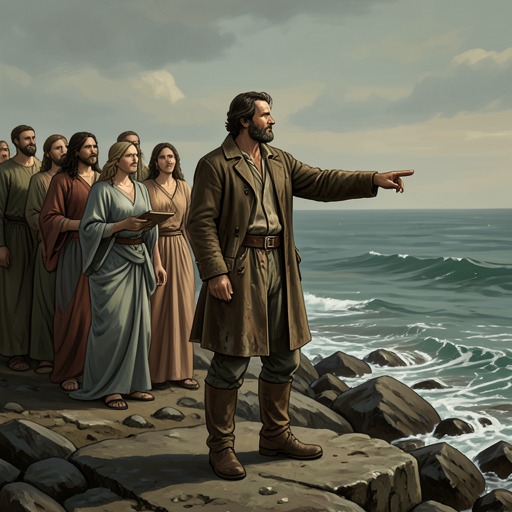
Raphael enters through the meeting between Thomas More and Peter Giles in Antwerp. More first takes him for a seaman: he is older, tanned, long-bearded, and wears his cloak carelessly. Peter corrects that impression. Raphael has traveled by sea, but is a traveler and philosopher rather than a sailor by profession, and Peter introduces him as someone able to give an unusually full account of unfamiliar countries. His weathered appearance initially signals the life he has led, while his conversation reveals the learning behind it.
Raphael is Portuguese by birth, knows Latin, and is especially learned in Greek. His philosophical reading helps explain that preference: he considers Roman philosophy valuable chiefly in Seneca and Cicero. The account of his name adds a note of literary irony: Hythloday is explained as meaning “knowing in trifles.” Yet his knowledge is not represented as trivial. He speaks with confidence about institutions, laws, customs, and government, and More describes him as able to discuss the nations he has visited as if he had spent his whole life among them.
Voyages and the Making of an Eyewitness
Raphael’s independence is established by a consequential choice. He divided his estate among his brothers rather than reserve it for his own later comfort, then joined three of the four voyages associated with Amerigo Vespucci. On the final voyage, he did not return with Vespucci. He secured permission, almost by force, to remain with the twenty-four men left at the farthest point they reached in New Castile. The decision reflects his stated preference for travel over returning home to be buried there; he reasons that heaven is equally accessible from every place and that a person without a grave still has the sky above him.
The choice exposes him to serious danger. After traveling through many countries with five Castilians, he eventually reaches Ceylon and then Calicut, where he finds Portuguese ships and returns home. His later narrative makes survival only one part of what travel has given him: the more important result is access to communities whose political arrangements can be compared with those of Europe.
After Vespucci’s departure, Raphael and his companions gradually gain the trust of the people they encounter by meeting them often and treating them gently. They eventually live among them without danger and become familiar with their society. A prince provides supplies and the means to travel, including boats for journeys by water and wagons for travel over land, and assigns them a guide to introduce them to other rulers. Raphael’s account thus presents knowledge as something acquired through sustained contact and hospitality, not merely through observation from a passing ship.
He distinguishes harsh equatorial deserts from regions where the air and soil grow milder and communities become more populous and interconnected. In those more settled lands, he encounters towns, cities, commonwealths, and trade by both sea and land. The ships he describes range from flat-bottomed vessels with sails woven from reeds and wicker, or made of leather, to craft with rounded keels and canvas sails. Their sailors understand astronomy and navigation. Raphael introduces them to the magnetic needle, previously unknown to them, and the change allows them to sail in every season rather than cautiously limiting voyages to summer. He also recognizes the danger in the discovery: confidence in the lodestone may make them less safe if they use it imprudently.
Political Counsel and Resistance to Service
Raphael’s travel accounts become politically charged when he identifies institutions abroad that might correct errors at home. He has observed not only what is amiss in newly encountered countries but also practices that might serve as examples to other nations. In the discussion of theft and punishment, his reported argument gives a practical reform a hearing at a dinner attended by Cardinal John Morton: the Cardinal proposes testing a different treatment for condemned thieves before carrying out their death sentences. A jester then turns the discussion toward the poor and religious orders, exposing the ease with which a serious question about social provision can become a vehicle for mockery. The episode shows Raphael’s account of policy entering a social world where ideas are judged not only by their reasoning but also by who voices them and how a powerful listener responds.
Peter Giles urges Raphael to enter a king’s service, reasoning that his learning and knowledge of people and countries would make him useful to rulers and to the public. Raphael refuses. He has already given his inherited estate to his kindred and friends while young and healthy, and he rejects the suggestion that serving a king would be different in substance from becoming a slave to one. Calling the arrangement assistance rather than service, Peter argues, cannot alter its nature. Raphael adds that he values living as he chooses and sees no great loss in rulers going without the counsel of someone of his temperament. His refusal establishes a conflict between philosophical usefulness at court and personal freedom outside it.
Utopia and the Force of His Testimony
When More objects that common ownership would discourage labor, produce want, and undermine respect for magistrates, Raphael answers from experience rather than speculation. He says he lived among the Utopians for five years and was so delighted with their arrangements that he would never have left, had he not wanted to make the new world known to Europeans. This declared attachment gives his description unusual force, but also makes clear that he is not a detached observer: the society he praises has become the standard by which he measures other political systems.
Raphael contests assumptions about European superiority by invoking the Utopians’ own histories. According to their chronicle, a shipwreck twelve hundred years earlier brought Romans and Egyptians to their coast. The survivors remained there, and the Utopians learned useful arts from them, sometimes developing further knowledge from hints the visitors could not fully explain. Raphael contrasts that capacity to learn from a chance encounter with Europe’s failure, as he sees it, to remember or adopt valuable institutions encountered elsewhere. He argues that the difference in government and well-being comes not from an inferior understanding or lack of external advantages, but from the Utopians’ greater industry and application.
At the close of his account, Raphael’s confidence meets a deliberate check. More acknowledges that several Utopian customs seem absurd to him, especially their conduct of war, their religious beliefs, and their common life without money, which removes what many people regard as a nation’s ornaments: nobility, magnificence, splendor, and majesty. Rather than challenge Raphael when he appears tired, More praises the constitution in general and postpones a fuller discussion. He then states that he cannot agree with everything Raphael has related, while wishing that many features of the commonwealth could be adopted elsewhere.
Narrative Role and Significance
Raphael serves as the dialogue’s traveling witness, political critic, and advocate for a society that unsettles familiar measures of wealth and authority. The movement from the diplomatic setting in Flanders to his chance meeting with Peter in Antwerp, and from that meeting to his reports of distant communities, makes exploration the bridge between the book’s opening frame and its institutional argument. His credibility rests on specific experiences—shipwreck dangers, travel with guides, encounters with rulers, and five years in Utopia—rather than on abstract political theory alone.
That credibility does not settle the meaning of his account. Raphael’s refusal to serve a king contrasts his ideal of independence with the political usefulness Peter hopes to secure from him. His praise of Utopia, in turn, is answered by More’s concluding hesitation. Raphael makes alternative arrangements imaginable and forces European institutions into comparison, but the ending preserves a distance between his conviction and the narrator’s qualified admiration. His significance lies in holding that tension open: Utopia is at once a reported society, an argument against complacency, and a proposal whose value the dialogue refuses simply to declare settled.