Utopian Law of Religious Toleration
UtopiaThe Utopian Law of Religious Toleration, established by Utopus after his conquest of Utopia, protects freedom of worship as a means of preventing religious conflict and allowing conviction to develop without coercion. It permits people to follow different faiths and to persuade others by argument, but excludes intimidation and violence; its protection of belief is thus substantial yet bounded by public peace and the commonwealth’s requirements for civic trust.
Origins and Principles
Before Utopus arrived, the island’s inhabitants were divided by religious disputes. Their factions fought separately rather than uniting against him, making the divided population easier to conquer. After subduing them, Utopus made religious liberty part of the new order: each person could follow the religion they chose and try to win others over through argument and amicable, modest persuasion. Those who used force or inflamed religious disputes through reproaches could be condemned to banishment or slavery.
The law rests partly on restraint in the face of uncertainty. Utopus considered it rash to decide that one form of religion alone must be acceptable; different forms might all come from God, who could inspire people differently and welcome such variety. Even if only one faith were true, he reasoned, truth could eventually emerge through argument addressed to a gentle and unprejudiced mind. Tumult and coercion, by contrast, could smother even the best religion beneath superstition. The law therefore treats freedom not as indifference to religious truth, but as a condition for seeking it without force.
Religious Diversity and Conversion
Religious variety is widespread among the Utopians: some worship the sun, moon, or planets, while others give divine status to people remembered for virtue or glory. The greater and wiser portion worships one eternal, invisible, infinite, and incomprehensible deity. Though believers differ about the particular objects of worship, they share a belief in one supreme being who created and governs the world, called Mithras in their language. The account describes a gradual movement away from various superstitions toward a more widely favored religion, while acknowledging that fear of apparent divine punishment had sometimes discouraged people from abandoning older practices.
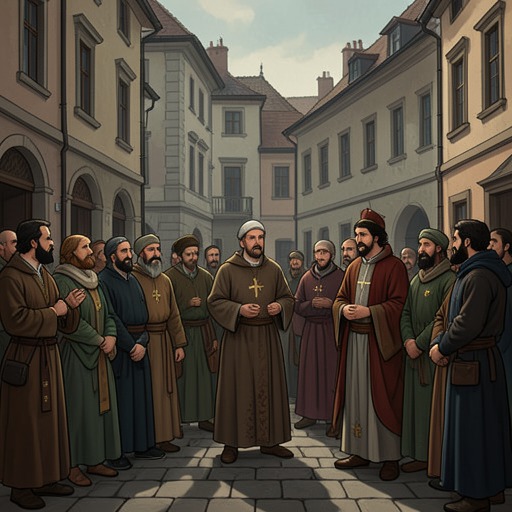
The arrival of Christian teaching meets no legal barrier. After hearing about Christ, Christian life, miracles, and the constancy of martyrs, many Utopians accept the faith and receive baptism. The account leaves open whether their readiness comes from divine inspiration or from Christianity’s apparent affinity with communal ownership, an arrangement they already value. The visitors cannot administer the other sacraments because none of the surviving members of their party is a priest. The converts are taught about those rites and strongly desire them; the possibility of choosing a priest among themselves is debated, but no one has yet been appointed when Raphael leaves.
Enforcement and Limits
The law distinguishes peaceful conversion from agitation against other believers. A newly baptized man repeatedly denounces the island’s rites and condemns those who retain them. He is tried and banished, but the stated ground is incitement to sedition, not his preference for Christianity or his criticism of other religions. The episode shows the rule operating in practice: a person may change faith and seek converts, but religious advocacy becomes punishable when it inflames the population into disorder.
Religious freedom also does not extend without qualification to people who deny an afterlife or believe that the world is governed by chance rather than providence. The Utopians regard these beliefs as incompatible with the moral expectations on which their society rests. They do not punish people merely for holding them, since they accept that belief cannot simply be chosen and reject forcing people to disguise their opinions. But such people cannot hold public office or be entrusted with public responsibilities, and they are discouraged from defending these views before ordinary people. They may discuss them privately with priests and other respected men, who are expected to answer them with reason. The arrangement protects private conviction while withholding civic standing and limiting public advocacy.
Public Worship and Significance
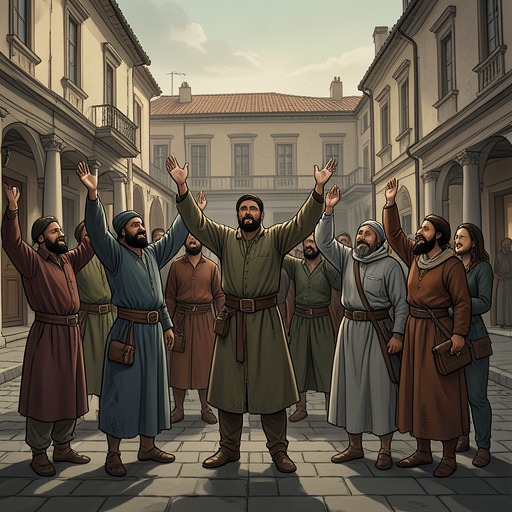
The island’s temples give institutional form to the same balance of shared practice and religious difference. Although religious communities have different rites, public worship contains nothing that contradicts the various sects; distinctive ceremonies are performed in private homes. Temples contain no images of God, leaving worshippers free to represent the divine according to their beliefs. The common name Mithras and prayers that adherents of different faiths can use provide a shared public language without requiring uniform doctrine.
The law’s governing distinction is between disagreement, which it permits, and coercion or civic disruption, which it restrains. It accommodates conversion, a wide range of worship, and shared ritual, yet places limits on public religious speech and excludes certain convictions from public responsibility. Its pluralism is therefore neither unrestricted nor merely ceremonial: it protects religious choice while making social peace and confidence in the commonwealth the conditions of that protection.