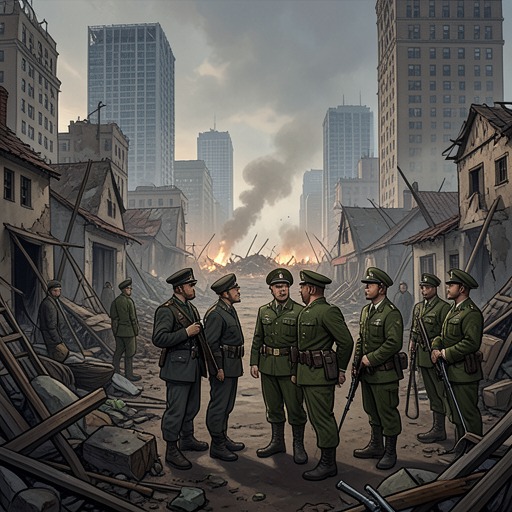
Utopian Rules of War
UtopiaThe Utopian Rules of War set out a code that regards armed conflict as a regrettable necessity rather than a source of glory. The Utopians train for war but limit the causes for which they will fight, seek victory without battle when possible, and prescribe restraint toward enemies and conquered populations. Their doctrine places security and the prevention of widespread harm above martial honor, while its reliance on bribery, political division, and hired soldiers exposes a persistent tension between humane aims and hard-edged methods.
Causes and Limits of War
The Utopians consider war brutal and reject the honor commonly attached to military glory. Even so, they train both men and women in military exercises and discipline so that they will not be unprepared in an emergency. They will fight to defend themselves or their friends against unjust aggression, or, from compassion, to help an oppressed nation escape tyranny. Assistance to a friend may extend to offensive war, but only after the Utopians have been consulted before hostilities begin and have judged the grounds sufficient: demands for reparation must have been refused, leaving war unavoidable.
Their account of a just cause includes both public invasion and commercial injury. They regard the oppression of another country’s merchants through unjust laws, or the perverse application of sound laws, as a particularly serious grievance because the injury is carried out under a show of legality. The war in which the Utopians aided the Nephelogetes against the Aleopolitanes began on this commercial ground. The conflict ultimately brought the Aleopolitanes to defeat and subjection, despite their greater strength before the war; the Utopians nevertheless claimed no share of the conquered people’s spoils.
The code also distinguishes injury to property from injury to life. If another people defrauds Utopian trade without using violence against individuals, the Utopians respond to a refusal of satisfaction by ceasing trade rather than going to war. They reason that the loss falls on the public, which exports goods it has in abundance, and does not seriously threaten citizens’ subsistence. But if one of their people is wrongfully killed or wounded, whether by public authority or private actors, they demand the offenders’ surrender through ambassadors. Refusal leads to a declaration of war; compliance leads to the offenders’ punishment by death or slavery.
Strategy and the Pursuit of Victory
The Utopians judge a bloody victory a costly and shameful outcome. They reserve their greatest praise for a victory achieved through skill and sound planning without bloodshed, and celebrate such success with public triumphs and trophies. Their preferred object in war is to compel an adversary to grant what, if conceded in time, would have prevented the conflict; failing that, they seek a severe enough response to deter similar injuries. The code presents this calculus as care for security, not a desire for fame.
Their first measures may target the enemy’s leadership rather than its battlefield forces. At the declaration of war, the Utopians secretly post sealed notices in prominent places throughout enemy territory, offering rewards for the death or capture of the prince and other leading figures. Capture is rewarded at twice the amount offered for killing, and the marked individuals themselves are promised rewards and indemnity if they turn against their countrymen. The Utopians expect such offers to breed distrust and fear among the enemy’s leaders; they regard the resulting defections as a way to end a prolonged war without risking a decisive battle and to reduce the losses that a longer conflict would bring to both sides.
If these offers do not succeed, the Utopians try to divide their opponents internally, encouraging a prince’s brother or a noble to contest the crown. If domestic discord cannot be stirred, they enlist neighboring powers by reviving old claims and supplying money. They are sparing with their own auxiliary troops because they are reluctant to put Utopian lives at risk. Their stores of gold and silver are reserved for such emergencies, and they also draw on wealth held abroad, including debts owed by neighboring nations. In this way they hire soldiers from many places, especially the Zapolets, a people who offer their services readily and may change employers for higher pay. The account thus sets the Utopians’ reluctance to sacrifice their citizens alongside a willingness to finance an unstable, mercenary form of warfare.
Conduct in the Field and After Surrender
Once fighting is under way, the Utopians observe truces faithfully and do not devastate enemy territory or burn crops. They take care during marches to avoid trampling the land, since they may need to use it themselves later. Disarmed people are left unharmed unless they are spies. When a town surrenders, it comes under Utopian protection; if the town is taken by storm, those who resist surrender are punished, the remaining garrison is enslaved, and the other inhabitants are spared. People who advised surrender receive rewards taken from the estates of those condemned, while the balance goes to auxiliary troops. The Utopians themselves take no share of the spoils.
These rules continue after the fighting ends. The Utopians do not require their allies to repay war expenses; instead, they exact payment from the conquered, either as money reserved for future wars or as land producing continuing revenue. The annual income from such holdings has risen to more than 700,000 ducats. Utopian officials stationed abroad may live magnificently and spend part of the revenue locally, send the remainder home, or lend it to the country where it is collected. The land income also finances rewards for people undertaking dangerous assignments. A war therefore ends not with an ordinary claim for reimbursement from friends, but with a durable system of revenue drawn from defeated powers.
Defense and the Priests’ Intervention
The Utopians seek to keep war away from their island. If a prince prepares to invade, they try to prevent the attack and make his own country the seat of war. Should fighting reach Utopia, they intend to defend themselves with their own people rather than call in auxiliary troops. This defensive boundary reinforces their stated reluctance to expose Utopian lives, even as their wider strategy uses money and foreign soldiers to fight beyond the island.
Priests accompanying the army give the rules a public and religious dimension. Dressed in sacred vestments, they kneel near the field during battle and pray first for peace, then for victory, especially a victory involving little bloodshed on either side. When the advantage turns to the Utopians, they enter among their own troops to restrain their fury. Enemies who reach them or touch their garments are protected in both life and property. The priests also intervene when a Utopian army is in disorder and retreating: by placing themselves between the opposing sides, they can halt further violence and help secure peace on reasonable terms. Their recognized inviolability among neighboring peoples makes religious mediation an active part of wartime conduct, giving practical force to the code’s preference for limiting harm.