Utopian communal property and distribution
UtopiaUtopian communal property and distribution is the economic principle that, in Raphael Hythloday’s account, allows Utopia to join material security to public welfare. Rather than treating property and money as the foundations of prosperity, the Utopians organize production, storage, and access around shared provision: householders take what they need without payment, while cities transfer supplies to places facing scarcity. Hythloday presents this arrangement as a practical alternative to societies where private accumulation leaves many people anxious or poor, though Thomas More questions whether common ownership can reliably sustain work, abundance, and civic authority.
Principle and Critique of Private Property
Hythloday’s case begins with a diagnosis of inequality. Where property exists and money measures other things, he argues, the best goods tend to fall to the worst people, wealth gathers in a few hands, and the rest are left miserable. Even a plentiful country can therefore leave much of its population in indigence. The problem is not simply that laws are insufficient: private possession encourages people to draw as much as they can to themselves, while legal remedies can ease hardship without removing its underlying cause. Attempts to limit how much land or money individuals may hold, or to prevent public offices from being bought or made so costly that only rich people can serve, are compared to treatment that mitigates an illness without curing it.
The contrast is sharpened by Hythloday’s description of Utopia, where, he says, a few laws and shared arrangements allow virtue to receive its due and everyone to live in plenty. In other societies, despite the proliferation of laws, property disputes continue and people cannot be certain what is theirs or another’s. For Hythloday, the division between those who accumulate without serving the public and those whose labor sustains it but who remain modest and poor is evidence of a distorted order. He concludes that equitable distribution and happy government cannot be achieved while private property remains in place.
More resists the proposed solution. He doubts that people will work when they cannot dispose of anything as their own, and fears that reliance on other people’s industry could encourage idleness. If common ownership led to want, he argues, discontent could become sedition and bloodshed, while equality might weaken the authority of magistrates. The exchange makes the system more than a description of an ideal: it is also a disputed political experiment, whose success depends on assumptions about both human conduct and institutional design.
Households, Cities, and Shared Access
The system is organized through households and cities rather than through isolated individuals. Utopian families are made up of close relations: women marry out, while male children and grandchildren generally remain in the household under the authority of its oldest member. A family normally contains between ten and sixteen people, and the island’s cities are managed to prevent one from growing beyond six thousand families. Children can be transferred between households when family size becomes uneven; if population increases across the island, settlers may be sent to the neighboring continent. This demographic management links the organization of households to the distribution of land and resources.
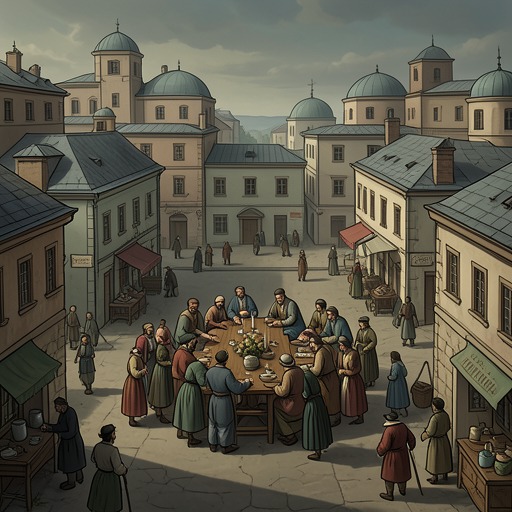
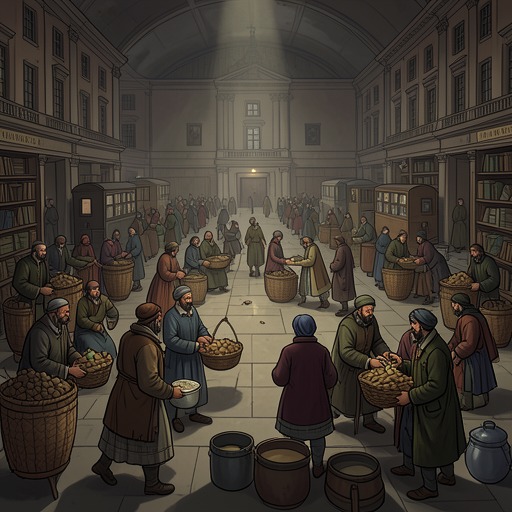
Within each city, four equal divisions meet at market places. Goods produced by families are sorted and stored in designated houses, where any father may take what his household needs without paying or leaving anything in exchange. Refusal is unnecessary, Hythloday explains, because supplies are abundant; nor is there an incentive to take more than needed when people trust that necessities will continue to be available. He identifies fear of want as a source of greed and ravenous behavior, and pride as a motive for displaying superiority through pomp and excess. In his account, reliable access and the absence of private accumulation remove the pressures that make such conduct rewarding.
The shared principle also shapes the built environment. Houses have a street entrance and a back door opening onto a garden; their doors are easily opened, and residents may enter any house. Every ten years, people exchange houses by lot. The arrangement limits the idea that a dwelling is an enduring private possession, while gardens remain carefully cultivated and their improvement is encouraged by friendly competition between streets. Common use therefore does not mean that the town is undifferentiated: collective arrangements coexist with household life, practical stewardship, and local emulation.
Coordination, Provision, and Governance
The system depends on coordination beyond the neighborhood market. Utopia has fifty-four cities, and each sends three senators to Amaurot once a year to consult about shared concerns. Each city also sends representatives to a great council that examines which communities have abundant provisions and which face scarcity. Supplies are transferred freely between them, without exchange, so that the island functions, in Hythloday’s phrase, as one family. The obligation to maintain common welfare is thus paired with regular review and inter-city redistribution rather than left to private charity or uncertain trade.
Before exporting goods, the Utopians lay up stores for two years to guard against the effects of an unfavorable season. Only the overplus is sent abroad. Their exports include corn, honey, wool, flax, wood, wax, tallow, leather, and cattle; a seventh of the goods is given freely to poor people in the receiving countries, and the remainder is sold at moderate prices. Foreign trade supplies what the island needs, especially iron, and also brings in gold and silver. These transactions show that communal distribution does not eliminate exchange with other societies: it distinguishes internal access, which is not priced, from carefully managed external commerce.
The institutions that govern the stores and trade are part of the property system’s safeguards. City magistrates and councils handle public affairs, while major proposals pass through deliberation rather than being decided hastily by a small group. Important matters may be communicated to families through their Syphogrants and referred to the wider council of the island. The procedures are described as protection against the Prince and senior magistrates conspiring to alter the government or enslave the people. The distribution of goods is therefore supported by procedures intended to make political decisions accountable to the community, not merely by the assumption that supplies will somehow be shared.
Money, Reserves, and the Measure of Wealth
Utopia’s internal rejection of money does not mean that its people have no accumulated wealth or no use for precious metals. Hythloday explains that the island has acquired a great treasure through trade, much of it held in bonds rather than immediately collected. In some cases, Utopian towns allow other communities to use the money owed to them, calling it in when they or their neighbors have greater need. During war or sudden emergencies, the reserve can be used to hire foreign troops. Money is thus retained as a public resource for uncommon contingencies, not as the ordinary measure of private standing or access to necessities.
The Utopians’ valuation of metals follows this distinction. Since they do not use money among themselves, they value gold and silver according to practical use and prefer iron, which they regard as essential to life and work. They also fear that visibly storing precious metals in a tower would arouse suspicion of private advantage by the Prince or Senate, while making them into valuable tableware could make people reluctant to surrender them in an emergency. Instead, they deliberately give the metals low-status uses: chamber pots and closestools are made from gold and silver, and the same metals are used for slaves’ chains and fetters. Pearls and precious stones found on the coasts and rocks may decorate children, who outgrow them as they mature. These customs make visible the difference between possessing a reserve and treating wealth as an object of private prestige.
Social Consequences and Significance
Hythloday’s concluding defense measures the system by the life it is said to make possible. Where public stores remain full, each person has a right to what is needed, and no one must prefer private provision over public well-being for fear of hunger. He describes Utopians as free from the anxieties of want and from the burdens of securing a livelihood for their families; care also extends to people who can no longer work. The claim that no one owns anything yet everyone is rich turns conventional measures of wealth inside out: richness means a secure, cheerful life rather than private abundance surrounded by other people’s deprivation.
The same contrast informs Hythloday’s criticism of other governments, which he describes as arrangements in which the rich preserve what they have acquired and make the poor labor for little. He argues that money’s use and desirability help sustain fraud, theft, conflict, and other harms that strict laws punish without preventing. His example is a famine year in which thousands die even though the grain stored by the wealthy could have supplied those in need. In that account, scarcity is not only a failure of production; it can also be a failure of distribution when private hoarding obstructs access to necessities.
Communal property and distribution therefore functions in Hythloday’s argument as an interlocking order: household provision depends on public stores, public stores on coordinated production and reserves, and the whole arrangement on civic rules that restrain private accumulation and organize common decisions. Its force lies in making material equality a practical condition of public-minded life, not merely a generous sentiment. Yet More’s objections remain part of the subject’s meaning. The system invites readers to weigh the security and reduced inequality Hythloday attributes to it against the question of whether its labor and political arrangements can prevent the idleness and disorder More fears.