Utopian six-hour working day
UtopiaThe Utopian six-hour working day limits ordinary labor to three hours before dinner and three afterward, making a short work schedule the organizing principle of a society that claims to supply its needs without exhausting its people. Its logic depends on more than the number of hours: Utopians expect nearly everyone able to work to undertake useful tasks, teach practical skills widely, and avoid both needless production and unnecessary public labor. The arrangement makes leisure possible, but treats that leisure as time for learning, chosen pursuits, and rest rather than as withdrawal from common responsibilities.
The Rule and Its Daily Rhythm
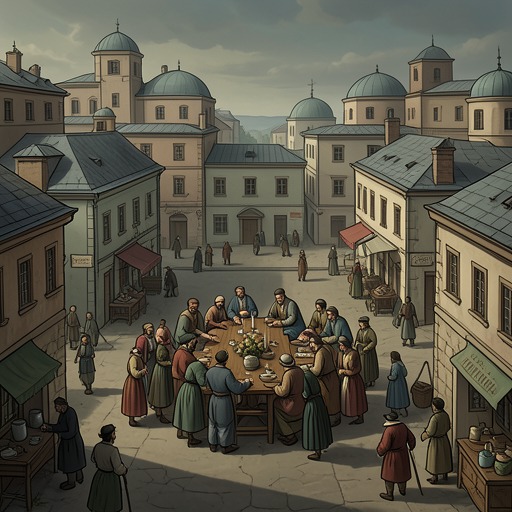
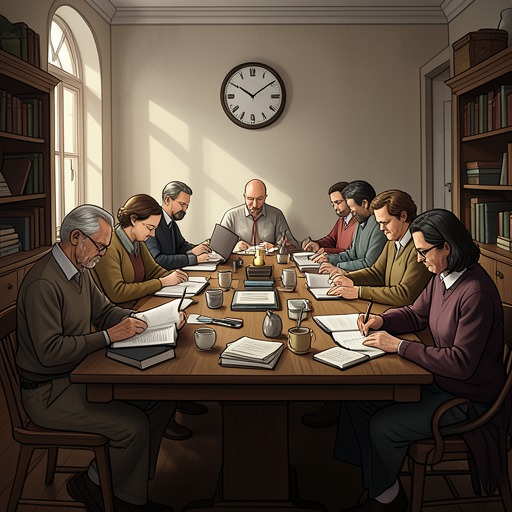
The day is divided into twenty-four hours. Utopians work for six, divided into a three-hour period before dinner and another three-hour period afterward; they then sup and go to bed at eight o’clock, counting from noon, for eight hours of sleep. The time remaining outside work, meals, and sleep is left to individual discretion, but not for luxury or idleness. Reading is the most common use of it, connecting the shorter working day to the society’s stated priority of developing the mind.
Learning is available beyond those formally selected for literary study. Public lectures take place every morning before daybreak, and attendance is required only for those assigned to study, yet people of different ranks and both sexes attend according to their inclinations. Those who prefer to use that time in their trades are not prevented from doing so and are commended for serving their country. After supper, people spend an hour in diversion: in summer in gardens, and in winter in the halls where they eat, with music or conversation. The schedule therefore does not erase work or prescribe every free hour; it creates time for a range of pursuits while setting limits on how that time should be used.
Shared Skills and Useful Employment
The work rule rests on a broad expectation of competence. Agriculture is taught to everyone from childhood, both at school and through practical work in the fields. Alongside it, each person learns a particular trade, such as making wool or linen goods, masonry, smithing, or carpentry. Women as well as men learn trades; women generally work in wool and flax, while men undertake the rougher trades. A trade commonly passes from parent to child, but a person whose aptitude lies elsewhere may be placed with a family practicing the desired occupation. Learning a second trade is also permitted, and the worker may choose between the two unless the public has greater need for one.
The Syphogrants’ chief responsibility is to see that no one lives idle and that people attend diligently to their trades. Yet the rule is expressly set against treating people as beasts of burden: the Utopians distinguish a disciplined working day from continual toil. Even Syphogrants, although legally excused, work themselves to encourage the rest by example. Selected people may be exempted to study, following recommendation by the priests and a secret vote of the Syphogrants; if their ability does not fulfill expectations, they return to work. Conversely, a craft worker who advances substantially in learning may be released from the trade and counted among the learned. The rule thus directs labor broadly while allowing limited, conditional movement between manual work and study.
Why Six Hours Are Said to Suffice
The account explains the short day by contrasting Utopia’s labor arrangements with those elsewhere. It argues that many people in other societies do no productive work: among them are people kept idle by wealth, many religious figures, and able-bodied beggars. It also points to labor spent on occupations that serve luxury rather than genuine needs. If more people worked and labor were directed toward useful goods, the account contends, fewer hours would be required to provide what is necessary, profitable, or pleasant, provided pleasure remained within bounds.
The comparison is given a concrete measure: in a large city and its surrounding territory, scarcely five hundred people of working age and strength are said not to be engaged in labor. This figure includes the example of the Syphogrants, who work despite their exemption, and the limited number set aside for study. The claim is not simply that six hours of effort produce more; it is that labor is distributed across almost the whole able population and is not absorbed by work deemed unproductive. Utopia’s abundance is therefore presented as an institutional outcome, not as the reward for longer hours.
Production, Maintenance, and Public Need
The account further argues that necessary work itself requires less effort because goods and buildings are used and maintained differently. Utopians seldom build on new ground, repair houses promptly, and take steps to prevent decay. Their buildings consequently last with little labor, while builders can keep timber cut and stone squared so that materials are ready when construction is required. Clothing is also standardized and durable: workers wear leather or skins that last seven years, and the public outer garment is uniform in color. People are described as content with one such garment, often for two years, rather than seeking numerous alternatives. These practices are offered as examples of how restrained consumption and preventive care reduce labor without leaving necessities unmet.
When useful work is temporarily scarce, large numbers are sent to mend highways. But this does not make road repair a permanent pretext for keeping everyone occupied. If there is no public undertaking to perform, working hours are reduced. Magistrates are specifically said not to impose unnecessary labor: the constitution’s purpose is to regulate work according to public need and leave people enough time to improve their minds, which the Utopians regard as central to happiness. The day’s length is therefore adjustable at its margins, not an immutable quota to be filled regardless of circumstances.
Social Design and Its Tensions
The six-hour rule belongs to a wider civic order in which the same customs and laws are shared across fifty-four cities, and representatives from each city meet annually at Amaurot to discuss common concerns. Its work ethic is supported by distribution and coordination: at the annual council, towns with provisions supply those facing scarcity, and the island stores provisions for two years against bad seasons. This collective planning helps explain how the account connects limited individual work time with security of supply, rather than making each household’s survival depend on accumulating more than it needs.
The ideal nevertheless contains a firm demand: nearly everyone capable of work is expected to contribute, leisure is not to become idleness, and those granted time for study may lose that privilege if they do not meet expectations. Its promise of free time is thus inseparable from supervision, shared standards of usefulness, and public judgments about where effort is needed. As a social proposition, the rule challenges the assumption that abundance requires exhausting labor; its force comes from linking fewer hours to the redistribution of work, the restraint of wants, and the claim that saved time should enlarge intellectual life.