Utopian Common-Property and Moneyless System
UtopiaThe Utopian Common-Property and Moneyless System is the organizing principle Raphael Hythloday presents as the foundation of Utopia’s prosperity: citizens hold no private property, take necessities from common stores without payment, and rely on public provision rather than personal wealth. It is not a simple disappearance of money from every activity. The island exports goods, accumulates precious metals, and uses funds in exceptional circumstances; within its domestic life, however, money loses its ordinary power to measure security or rank. Raphael’s account links this arrangement to a political claim: a commonwealth serves its people only when public welfare, not private accumulation, governs the distribution of resources.
Common ownership and everyday distribution
Utopia’s common ownership is made practical through arrangements for households, markets, and storage. The island’s fifty-four cities share the same laws and customs, and each sends three senators to Amaurot once a year to consult on common affairs. Families are regulated in size, and population can be redistributed between households and cities. These rules connect the local household economy to island-wide planning rather than leaving the supply of necessities to individual purchasing power.
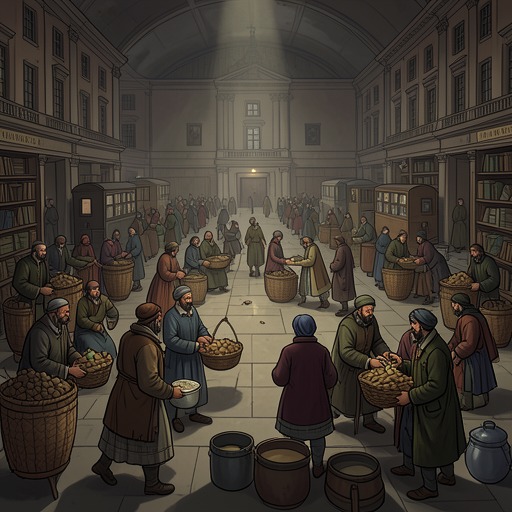
Within each city, goods produced by families are carried to designated storehouses and sorted by kind. A father of a household can take what the family needs without paying or leaving anything in exchange. Raphael argues that a denial is unnecessary because supplies are abundant, and that people have little reason to take more than they need when they can trust that necessities will remain available. He contrasts this security with the fear of want, which he identifies as a cause of greed, and with the pride that makes people seek distinction through display and excess. Shared stores are therefore not merely a transfer mechanism: in Raphael’s account, they are meant to remove the pressures that make private hoarding and competitive consumption seem necessary.
Labor, household organization, and public provision
The system depends on collective work and a continuing supply of food and other necessities. The cities maintain farmhouses across the countryside, where residents serve in rotation and learn agriculture from those with prior experience. This arrangement is intended to keep agricultural knowledge in circulation and prevent errors that might cause a shortage of grain. Some people choose to remain at farm work longer, but the rotation prevents anyone from being compelled to spend too long in that demanding occupation.
Distribution also operates through shared meals and specialized provisioning. Each city is divided into four parts, with a marketplace in the middle of each. Public halls serve as dining places for families in their districts; stewards collect food from the market according to the number of people to be fed. The account places care for the sick within this public system as well: each city has four large hospitals outside its walls. These institutions extend the logic of provision beyond routine household needs, making collective support part of the social structure rather than a benefit dependent on private means.
Coordination, reserves, and exchange beyond the island
The system scales up from household stores to island-wide coordination. At the annual council in Amaurot, representatives assess which towns have abundant provisions and which face scarcity. They transfer supplies freely between them, without exchange, so that the island functions, in Raphael’s description, like one family. The council also ensures that stores are laid up for two years against an unfavorable season. This reserve links present abundance to preparation for future need: resources are not treated solely as property to consume or sell, but as security held for the community.
Only after provisioning the country and storing reserves does the island export its surplus. Raphael lists corn, honey, wool, flax, wood, wax, tallow, leather, and cattle among the goods sent abroad. A seventh of the exports is given freely to poor people in the countries receiving them, while the remainder is sold at moderate prices. The trade brings back a small number of things Utopia needs, especially iron, as well as gold and silver. Thus the moneyless order describes domestic distribution, not economic isolation: foreign trade supplies goods and builds a reserve that the Utopians can draw on when circumstances require it.
Money, precious metals, and exceptional use
Raphael explains the Utopians’ low regard for gold and silver through their limited usefulness within the island. Because the metals are not needed for ordinary exchange, he argues, their value should reflect their practical use rather than their scarcity. Iron, which has essential uses, is preferred. Gold and silver are kept as provision for rare events, including war, rather than treated as the natural measure of wealth.
The metals are not simply locked away. Utopians use gold and silver to make chamber pots and restraints for enslaved people, and attach gold ornaments to some of those serving as slaves. This deliberate reversal is intended to make the metals objects of low esteem rather than prestigious possessions. Children may wear pearls and precious stones found on the coasts and rocks, but, as they grow older, they put them aside after recognizing them as childish ornaments. The arrangement turns material display into a learned habit that the society tries to outgrow, rather than an adult marker of rank.
The island nevertheless maintains a considerable store of precious metals. Its trade can be conducted on credit: contracts are made in the name of a town rather than a private individual, and towns holding debts may keep or use the money until it is called in. The Utopians can also recall funds and lend them to neighbors in need. In war or sudden emergencies, they use their treasure themselves, including to hire foreign troops, whom they are more willing to expose to danger than their own people. The moneyless system therefore limits money’s domestic authority without erasing its strategic and international functions.
Political argument and limits of the ideal
Raphael presents common ownership as a remedy for the way private wealth distorts government. In his critique of princely counsel, he argues that rulers who impoverish their subjects make them more submissive but also less secure; a king should care more for the people’s welfare than for his own advantage. He later describes other governments as serving the rich, who use public authority to protect their holdings and keep laborers’ wages low. The Utopian arrangement stands against that order because public provision removes the need for each person to secure necessities through private accumulation.
His argument culminates in a contrast between money’s declared purpose and its effects. Raphael imagines a year of famine in which a survey of rich people’s granaries would reveal enough stored grain to prevent many deaths if it were distributed. In this example, scarcity is not simply a shortage of goods: unequal control over supplies can make people go hungry even when food exists. He claims that abolishing the value and desire for money would also remove many anxieties and offenses associated with it, and identifies pride as a deeper obstacle to adopting such a system because it derives satisfaction from comparison with those who have less.
The account also makes clear that this ideal has institutional conditions and exclusions. Distribution is administered through households, councils, magistrates, and regulated labor, not through unrestricted individual choice. Utopian expansion can include colonies on underused land; if local inhabitants refuse the Utopians’ rules, they may be driven from territory the newcomers mark out, with force used if they resist. Nor does the society renounce slavery or the use of money in war. At the dialogue’s close, Thomas More acknowledges that several Utopian customs, especially common living without money, seem absurd to him, while declining to argue with Raphael at that moment. The system is therefore both a detailed alternative to private accumulation and a contested political proposal, whose promise of shared security sits alongside constraints that Raphael’s praise does not dissolve.