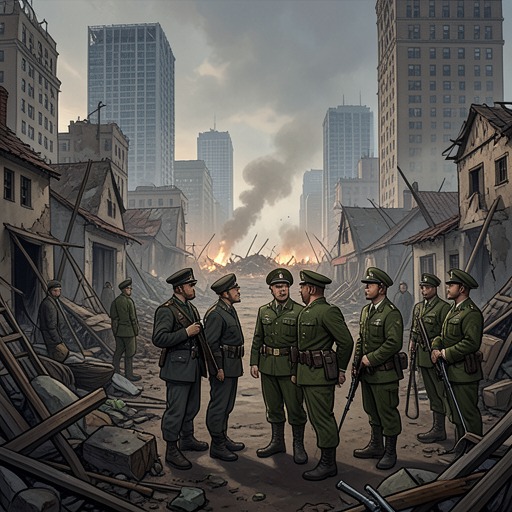
Utopian just-war doctrine
UtopiaThe Utopian just-war doctrine sets narrow grounds for armed action and rejects military glory as a legitimate aim. It requires preparation even while condemning war, and it favors security, redress, and limiting wider harm over battlefield acclaim. Its governing tension is clear: the Utopians present war as a last resort, yet authorize forceful and covert methods when they judge that resort necessary.
Grounds for War and Military Preparation
The Utopians regard war as a brutal practice, shameful because people pursue it more readily than other animals do. They reject the honor attached to military victory and nevertheless train regularly in military exercises and discipline. Women as well as men receive this training, so that they will not be useless in a necessity. Preparation, in this account, is a safeguard against danger, not a celebration of war.
They identify two broad grounds for taking up arms: defending themselves or their friends against unjust aggressors, and assisting an oppressed nation in escaping tyranny. They will support friends in offensive as well as defensive wars, but only after being consulted before the breach occurs. They must be satisfied with the grounds for action and find that demands for reparation have been rejected, making war unavoidable. The condition places investigation and an opportunity for redress before military commitment; alliance alone is not sufficient cause.
Injury, Reparation, and Proportion
The doctrine treats commercial injustice as a possible cause of war. An attack carried out under public authority is not the only injury that may warrant intervention: the Utopians also object when one country’s merchants are wronged abroad through unjust laws or the perverse application of otherwise good laws. They regard such injuries as especially troubling because legal forms can lend an appearance of legitimacy to injustice.
The war in which they assisted the Nephelogetes against the Aleopolitanes illustrates the danger in this principle. The dispute arose from what the Nephelogetes considered grave injustice against their merchants. The conflict drew in neighboring states, shook some flourishing powers, and afflicted others; it ended in the Aleopolitanes’ conquest and subjection. Although the Utopians had helped the Nephelogetes, they claimed no share of the spoils. The example places their stated concern for commercial justice beside the far-reaching consequences of enforcing it by war.
Their response to comparable fraud against their own citizens is more restrained. If no one has suffered personal violence, they will stop trading with the offending people when satisfaction is refused rather than make war. The distinction reflects the Utopians’ communal economy: a commercial loss falls on the public, while neighboring merchants trade with their own resources and may therefore suffer more directly. They consider it disproportionate to answer a loss that barely affects their lives or subsistence with the deaths of many people.
Wrongful killing or wounding of one of their people crosses a different threshold, whether committed under public authority or by private individuals. The Utopians send ambassadors to demand that the guilty be handed over. If the demand is refused, they declare war; if it is accepted, the offenders are sentenced to death or slavery. The sequence makes the delivery of those responsible, rather than a general campaign against the offending country, the stated object of their demand.
Ends, Victory, and the Limits of Glory
The Utopians say that war aims to obtain by force what would have prevented war if granted in time. If that cannot be achieved, they seek severe enough retribution to deter repetition. They describe these ends as matters of security, not fame or vainglory. Their preferred victory is one secured through dexterity and good judgment without bloodshed; they consider a costly, bloody triumph a foolish exchange, not an honor.
They mark a bloodless success with public celebrations and trophies. For them, overcoming an enemy through understanding distinguishes human action from the contests of physical strength found among animals. This ideal does not remove force from their doctrine, but it orders the means of victory: reason and economy of life rank above displays of courage or conquest. The account’s moral emphasis is therefore not simply on whether a war is won, but on what the victory costs and whether it achieves the stated purpose.
Covert Strategy and the Conduct of War
Before a battle is fought, the Utopians try to unsettle an enemy’s leadership. After declaring war, they secretly post sealed schedules in conspicuous places across the enemy’s country, offering rewards for killing or capturing the prince and other leading figures. Capturing a named person alive earns a larger reward than killing that person. The offers extend to those listed themselves if they will turn against their own countrymen. The strategy is intended to spread suspicion and fear within the opposing ranks; the account says that trusted associates, and even princes, have sometimes been betrayed.
The Utopians defend these inducements as a way to end a war that might otherwise drag on and cause greater loss of life. They regard the targeted deaths of those they hold most responsible as a way to spare people on both sides, many of whom, they argue, fight because their prince’s passions have drawn them into the conflict. If bribery fails to divide the enemy, they encourage a prince’s brother or nobles to seek the crown; failing that, they induce neighboring powers to press old claims and supply them generously with money but sparingly with troops. They are particularly unwilling to risk their own people. These methods reveal a practical side of the doctrine: minimizing battlefield deaths can justify manipulation and political subversion, means that sit uneasily beside its language of mercy and just cause.
The limits they place on military conduct also apply during and after combat. They keep truces faithfully despite provocation, do not lay waste to enemy territory or burn crops, and take care in their marches not to trample land they may later need themselves. They spare disarmed people unless they are spies. When a town surrenders, they protect it; if it is taken by storm, they distinguish between those who resist surrender and the rest of the garrison and inhabitants. They reward inhabitants who advised surrender, using the condemned people’s estates, and distribute the remainder among their auxiliary troops. The Utopians themselves take no share of the spoil. Taken together, these rules define victory less as possession than as securing submission while limiting destruction and preserving a future use for the conquered land.