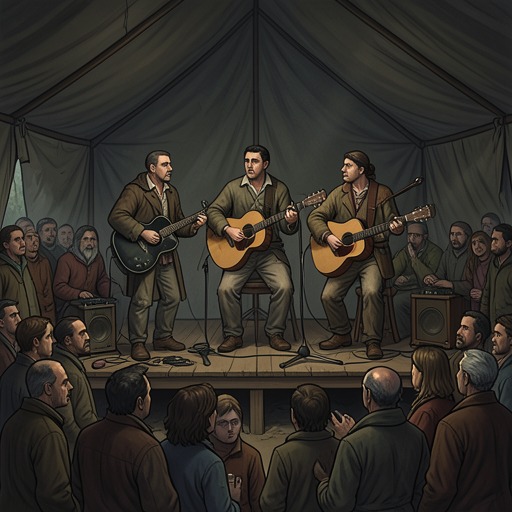
Billy Barf and the Vomitones
VinelandBilly Barf and the Vomitones are a band whose appearances link the Cucumber Lounge’s struggling stage to a later, all-night gathering among the Thanatoids. Their clearest musical signature is “I’m a Cop,” a three-note blues written and composed by Billy Barf: a deliberately abrasive song about police power that the lounge crowd receives with the fervor of a spiritual. The band’s scenes make performance a space where authority can be mocked, but also where a roomful of people can take pleasure in the performance without pausing to examine its implications.
Identity and Place in the Story
The available scenes present Billy Barf and the Vomitones through particular bookings and performances, not through a history of the band’s formation or a fixed account of its membership. At the Cucumber Lounge, Hector Zuñiga considers asking them to provide part of a film soundtrack, provided they do not demand too much. The possibility is still tentative: Hector leaves to speak with them, and the narration does not establish whether a soundtrack deal is made. The encounter nevertheless places the band within a local circuit where live music, low-budget filmmaking, and Hector’s professional dealings overlap.
At the lounge, the band appears after a comic set by Ralph Wayvone junior. The room has already endured the comedian’s failing jokes and his increasingly desperate efforts to win a response. His introduction of the musicians, with a drumroll from Isaiah Due Quattro, makes their entrance a change of act as well as a change in the room’s mood. The introduction promises a metal-oriented sound, but the first song the narrative describes is a spare blues. The contrast between the comic buildup and the song’s blunt musical form gives the performance its own kind of theatrical surprise.
The Cucumber Lounge Performance
Billy Barf and the Vomitones begin with “I’m a Cop,” a three-note blues credited to Billy Barf for both words and music. Its speaker boasts of sexual aggression and claims the authority of the law; the song’s vulgarity makes the figure of the policeman less a respectable guardian than an embodiment of unchecked power. The band does not need a complex musical arrangement for the point to land. The repeated, pared-down blues form supplies a simple frame for a voice that is at once swaggering and menacing.
The crowd responds as if the song were a spiritual, clapping, stamping, and shouting its approval. That response reverses the room’s earlier silence during Ralph junior’s jokes: where his performance produces embarrassed or absent laughter, the band finds an audience ready to join in. The scene does not present the song as a solemn political address. Its force comes from the collision of a crude comic performance, an audience’s enthusiastic recognition, and the song’s grotesque assumption that being the law means being able to do whatever one wants.
Zoyd Wheeler watches from the back of the room in disguise, with a shaved beard, shortened hair, and a borrowed tie. He is sensitive to police attention and does not join the applause, limiting himself to a nod. His restraint sets his private vulnerability against the crowd’s public exuberance: the song can be cheered as entertainment, while the threat associated with policing has immediate consequences elsewhere in his life. The band’s performance therefore gathers different responses in the same space without making them identical.
A Later Night of Music
Billy Barf and the Vomitones appear again at a crowded overnight gathering among the Thanatoids. The Holocaust Pixels are already providing music, and their repertoire could have carried the gathering through the night; Billy Barf and the Vomitones arrive to alternate with them. The scene places the band within a larger program rather than making it the sole attraction. Food is available, drinks are discounted, and people continue arriving as the gathering expands, so the music becomes one strand in a night shaped by both performance and communal assembly.
Alexei is with the band and proves capable of singing with extraordinary force, even without amplification. The narration compares him to a Russian Johnny B. Goode and notes that he can outsing both musical groups combined. The image enlarges the band’s part in the event: its contribution is not restricted to Billy Barf’s earlier satirical blues, but includes a performer whose voice can compete with the whole bill without technical support. Prairie, who has accompanied Alexei only as far as the band’s van, parts from him reluctantly and returns to the clearing. The episode thus connects the music inside the gathering to a separation occurring at its edge.
Narrative Significance
The two appearances give the band distinct functions. At the Cucumber Lounge, “I’m a Cop” turns a small stage into a scene of comic defiance, while Zoyd’s unwillingness to applaud reveals how differently a performance about police power can register for someone under pressure from law enforcement. At the later gathering, the band shares the night with the Holocaust Pixels, and Alexei’s unamplified singing becomes part of a wider, less formally bounded event. Across both scenes, the band is presented not as a fully documented musical institution but as a live presence: it changes the energy of a room, gives an audience something to answer, and carries its music into a night where performance and ordinary life mingle.