United States Armed Forces
VinelandThe United States Armed Forces are a looming presence in the novel’s account of political dissent and, during REX 84, a visible instrument of emergency control. First associated with a military reservation beside the rebellious College of the Surf, they later dominate Vineland Airport with vehicles, checkpoints, and passenger interrogations. Their deployment proves powerful but temporary: when the president ends the exercise, orders dismantle the operation and strip Brock Vond of his authority.
The military presence beside the College of the Surf
The College of the Surf lies between the Pacific coast and a military reservation extending inland from the shore, described as a smaller counterpart to Camp Pendleton. The setting makes military power part of the campus’s immediate geography. The college’s surrounding counterculture—sex, drugs, rock and roll, and eventually a declaration of independence as PR3—develops within sight of an institution capable of overwhelming it. The Armed Forces are not shown carrying out a specific assault on the campus in this account, but their nearby base supplies the force that could, in principle, end the experiment.
When PR3’s students and residents become trapped on campus, the threat is no longer merely geographical. After a final surrender offer over a loudspeaker, every route out—roads, waterways, sewers, and bicycle paths—is closed. The telephones have been cut off, while the mainstream media remain at a safe distance. The 24fps film collective alone has the exclusive record of the final night, on the condition that anyone survives to carry the footage out. The passage presents the military’s surrounding presence as part of the coercive landscape, while stopping short of identifying every force enforcing the blockade as a particular branch or unit.
The contrast is that PR3 initially flourishes despite its vulnerability. What might, by the usual logic of a riot, have been suppressed within hours instead grows over weeks into a small, crescent-shaped community. The Armed Forces’ capacity to erase it remains an implicit measure of its exposure; the campus’s survival does not mean the danger has passed.
REX 84 and the machinery of emergency
In 1984, a military commander attempts to read a statement identifying himself as commander of the armed forces in his sector and citing National Security Decision Directive 52, dated April 6, 1984, together with later amendments. He breaks off, stands, sits again, and tries a locked drawer. The moment places a formal chain of military authority inside a scene of interruption and uncertainty; the broadcast of a Sean Connery film then resumes without further military interruptions.
Hector Zuñiga recognizes signals that remind him of the approach to a major drug raid, but also of the weeks before the 1961 Bay of Pigs landing. He wonders whether the government might be preparing to invade Guatemala and, to secure the home front, detain tens of thousands, arm local defense forces, and dismiss Army personnel only to rehire them as deputy sheriffs in order to evade the Posse Comitatus Act. These are Hector’s alarming possibilities, not confirmed actions in the scene. The emergency plan itself, he notes, has circulated for some time and is no great secret. His unease is grounded in disruptions he recognizes: military-channel traffic, communications problems, and a sudden sense that ordinary civilian arrangements may be giving way.
As Frenesi Gates and Flash approach Vineland, the pilots report that air-traffic controllers are speaking in a manner associated with Vietnam, that the usual civilian personnel are absent from the towers, and that military frequencies are busy. The details make the emergency perceptible before the plane reaches the airport: military organization has entered the communications and transport systems on which civilian travel depends.
Vineland Airport under military control
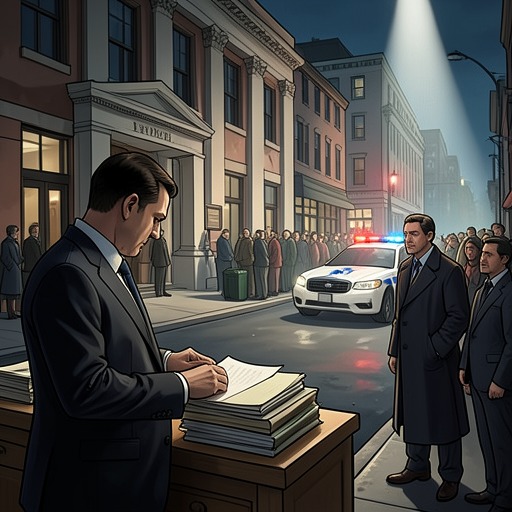
Vineland Airport sits south of the city in a broad valley near the mouth of the Seventh River. On the plane’s low approach over U.S. Route 101, the pilots’ reports foreshadow the transformation below. The airport has become a military staging ground, with vehicles spread across it. Arriving passengers are stopped and questioned individually; an operator enters their names and numbers at a keyboard. Some are allowed to continue, while others are told to wait inside an enclosure.
That procedure turns arrival into a decision made by military administration. Passengers are identified, processed, and either released onward or held within a bounded space. Flash wonders whether Hector has trapped them, but Frenesi points him toward Zuñiga, who is there with a film crew, lights, a Panaflex, and portable Arri cameras. Their presence does not remove the military checkpoint; it places a camera crew inside the same controlled environment and makes the militarized airport a scene open to observation.
The order to stand down
The operation’s reach is abruptly curtailed when a radio message from the field headquarters at Vineland Airport reports that the president has officially ended REX 84, including what had remained silent, undocumented, and deniable within the exercise. The instructions are comprehensive: strike the tents, return convoys to their bases, demobilize action teams, and send personnel assigned to special units back to their ordinary posts. Vond’s authorizations are withdrawn along with the broader deployment.
Vond is physically removed aboard a helicopter despite his protests. He tries to use his remote control, but Roscoe has taken over at the main control panel. On the flight back to Vineland Airport, Roscoe urges patience and obedience while Vond insists that those he is pursuing must not be allowed to escape. The exchange shows the distinction between Vond’s ambitions and the military authority that had enabled his operation: once the order changes, his command is no longer his to exercise.
The Armed Forces’ narrative role thus moves from latent threat to organized checkpoint and then to an apparatus instructed to disperse. The novel does not depict the end of REX 84 as proof that military power has vanished. Instead, the rapid shift from deployment to withdrawal reveals how much depends on executive authorization—and how abruptly a campaign of surveillance, detention, and pursuit can be made to stop when that authorization is revoked.