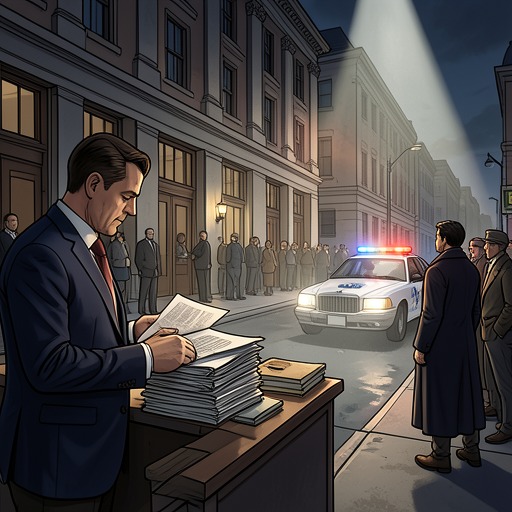
Drug Enforcement Administration
VinelandThe Drug Enforcement Administration is the federal agency most visibly represented in Vineland through Hector Zuñiga, an agent whose encounters with Zoyd Wheeler and Frenesi Gates reveal an organization that is at once a source of money, investigative pressure, and uncertain authority. The novel does not present a comprehensive institutional portrait. Instead, the agency emerges through field operations, informant payments, reassignment, and a film project, while Zuñiga’s increasingly ambiguous conduct makes it difficult to tell where official work ends and his own purposes begin.
Field Presence and Informant Payments
In the coastal neighborhood where Zoyd lives, federal narcotics agents are numerous enough that a person caught with drugs is more likely to be caught by a federal agent than by a local one. Their presence belongs to a publicly funded pilot project that includes the beach communities as well as Torrance, Hawthorne, and Walteria. The account emphasizes the scale of the public money distributed among drug-enforcement bodies at different levels of government, rather than depicting a single, neatly bounded operation.
Zuñiga makes that funding tangible by offering money for useful information. At one encounter, he produces a new five-dollar bill for Van Meter after hearing information, then explains that more money is available from a designated fund for good tips; false information earns nothing and can eventually exhaust the agents’ patience. The small bill is an immediate inducement, but it also opens onto a broader system in which public funds purchase access to neighborhood knowledge.
Zoyd refuses, as a matter of personal honor, to pocket tip money from Zuñiga. That refusal does not keep him outside the arrangement: he eats food and smokes marijuana bought with the money the agent circulates. He sometimes considers reporting a dishonest dealer after being cheated, but repeatedly finds reasons not to do so, from sympathy for someone in trouble to fear of retaliation. Zuñiga grows frustrated with this reluctance. The agency’s information network therefore depends on people whose loyalties, risks, and practical interests cannot be reduced to a simple choice between cooperation and obstruction.
The neighborhood itself frustrates enforcement. Its tiered houses, stairways, ramps, and hidden corners form a confusing terrain where agents can raid the wrong address, lose a suspect, or misread the route through a maze of streets. The narrative presents this difficult landscape as an operational problem for Zuñiga’s work: persistence alone cannot overcome an environment in which a wrong turn can undo an investigation.
Zuñiga as the Agency’s Unsettling Representative
Zuñiga returns to Zoyd’s life after a long absence, appearing at the Cucumber Lounge as the familiar federal agent whose visits have historically been followed by new misfortune. His reappearance turns an ordinary planned performance into a meeting with the past. Later, when Zoyd asks why he is present, Zuñiga says that his business concerns drugs. The exchange initially invites a comic misunderstanding: Van Meter takes the mention of drugs as a possible promise of supply, while Zuñiga is speaking as an agent. The scene shows how thoroughly his professional identity is entangled with the local drug economy he investigates.
When Zoyd later finds Zuñiga at Bodhi Dharma Pizza, the agent is furiously defensive, his hair disordered and his eyes aflame. Zoyd has to keep watch on him while trying to reach Prairie, who is shut in the staff restroom. Zuñiga’s agitated appearance contrasts with the ordinary authority implied by his federal position. In another warning, he tells Zoyd that a militarized Justice Department force led by Brock Vond—not a DEA team—is in town. The distinction matters: Zuñiga serves as a source of intelligence about a larger federal threat, but the armed force and the seizure proceedings against Zoyd’s home belong to a different operation.
Zuñiga also tells Zoyd that Frenesi had been under witness protection. He explains that the arrangement came from a different budget but was still managed by law-enforcement officials, comparing its handling to that of Mafia informants. His disclosure places the protection program near the same world of informants, police control, and government files that surrounds the drug investigations, without establishing that the DEA itself administered Frenesi’s protection.
Reorganization and Work in Los Angeles
Zuñiga’s account of agency life makes his position seem precarious. During a reorganization underway in his workplace, many older FBN subordinates and colleagues have been dismissed. He describes himself as fortunate still to have a job at all, even when the work amounts to what he calls a kind of marriage counseling. The passage gives his continued employment the feel of survival through institutional upheaval, rather than secure command within a stable bureaucracy.
A later assignment places him with the DEA’s Regional Intelligence unit in Los Angeles. There he is tasked with maintaining connections to a Hollywood anti-drug film project involving Sid Liftoff, whose lawyers have arranged for him to repay his debt to the community through public service. The assignment is presented as a favor: the regional intelligence posting is considered a punishment for poorly rated agents, so the Hollywood work is something Zuñiga is expected to appreciate and eventually repay. The agency’s role thus extends from street-level narcotics enforcement into the coordination of a commercial film production, linking law-enforcement service to public messaging and personal obligation.
That arrangement soon becomes hard to interpret. Zuñiga grows convinced that he is caught in a larger scheme and becomes less willing to make clear when he is working for the DEA and when he is acting for himself. Liftoff and Ernie Triggerman debate how much they can trust him, while Zuñiga’s fantasies about the film and its possible extensions further blur the boundary between assigned liaison and self-directed ambition. The narrative does not resolve the uncertainty by supplying a clear institutional account; it makes that uncertainty part of the agency’s representation.
The Agency, Coercion, and the Limits of Authority
When Frenesi encounters Zuñiga years later, she asks whether he is acting officially, with backing from the DEA or another department, or working independently. Her question registers how little his federal affiliation can settle. She recognizes him, but his worn, damaged appearance and troubled behavior make the old badge an inadequate explanation of what he is doing. The agency remains a possible source of authority, not a reliable guarantee that his actions follow a clearly defined chain of command.
At a later meeting, Frenesi objects to Zuñiga’s use of her daughter to pressure her into making a film. She wants the objection recorded in his report, framing the encounter as a misuse of official contact and a spiritual injury to Prairie. Zuñiga responds in terms of family unity and his own failed marriage, not in terms of a clear agency procedure. The scene leaves the coercive pressure visible while showing how personal grievance and professional identity overlap in his conduct.
At Shade Creek, a full film crew arrives amid an escalating atmosphere of raids and patrols. Zuñiga is part of the crew and is described as a DEA agent who is plainly unwell, repeatedly calling for Frenesi. His presence there fuses the agency’s anti-drug film work with the personal pursuit that has marked his relationship to the family. The institution is not shown directing every step of that pursuit; rather, its name and assignments accompany an agent whose official status no longer makes his motives legible.
Narrative Significance
The DEA’s recurring presence joins two forms of power that the novel keeps in tension: the formal authority of a federal agency and the improvised bargains through which agents gather information and carry out assignments. Tip money, informants, field confusion, a witness-protection disclosure, and a Hollywood film project give the organization several distinct points of contact with ordinary life. Each contact is mediated by people with their own fears and interests, especially Zuñiga, whose changing assignments and uncertain independence prevent the agency from appearing as a single, consistent force.
The result is not simply an image of effective surveillance or orderly enforcement. Federal resources are substantial, and agents are plentiful, yet investigations remain vulnerable to confusing streets, reluctant sources, internal reorganization, and the blurred responsibilities of individual agents. The agency’s institutional reach is real, but the novel presents that reach through unstable human relationships: money offered for a tip, a disclosure about protection, an assignment treated as a favor, and a film project in which official work and personal obsession increasingly overlap.