Industrial Workers of the World
VinelandThe Industrial Workers of the World (IWW) is presented through the labor struggles and family histories connected to its Vineland hall. For Eula Becker, the union is where she meets Jess Traverse and discovers a political life; for later generations, its legacy persists in memories of organizing, strikebreaking, and the costs of standing with workers. The novel gives the IWW no abstract institutional portrait. Its meaning emerges in rooms where people gather, on picket lines and in dangerous workplaces, and in the inherited loyalties that continue to shape family relations.
The Vineland hall and a shared commitment
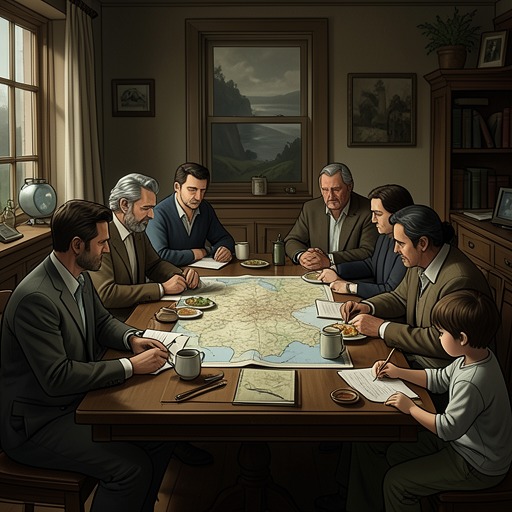
Eula Becker, from Beaverhead County, Montana, was not originally meant to be in town the evening she met Jess Traverse. Friends persuaded her to go with them to the Industrial Workers of the World hall in Vineland, where they knew people. There she saw Jess, a meeting the narrative describes as a turning point: through him, Eula came to recognize the person she wanted to be and the life she wanted to lead.
Jess was organizing lumber workers in Vineland, Humboldt, and Del Norte counties. The union’s appeal lay in the promise of a broad workers’ organization and in the dangerous idealism of Jess’s work. Eula chose to join him on the road rather than settle into the conventional security that others might have expected. In bleak mill towns among logged hillsides, she spoke to workers on muddy street corners, addressed strangers as fellow workers, and was arrested in free-speech disturbances. Their life together included May Day picnics and stretches in which one or the other could expect to spend time in jail.
Organizing, violence, and family memory
The dangers surrounding the union were not rhetorical. Eula remembered more vividly the first time Pinkertons shot at her, at a camp beside the Mad River, than the birth of her daughter, Sasha Gates. Jess, meanwhile, was maimed in an anti-union attack staged to intimidate witnesses. During a baseball game where he played center field, a redwood that had been partly cut in advance fell onto his legs and crushed them. The employers’ association paid compensation and Jess received a small pension, but the money could not support a family of three. A local lawyer failed to secure justice, and the man responsible escaped punishment.
After Jess was crippled, Eula’s commitment hardened into a lasting refusal to leave. When Sasha later moved away, Eula said she wished she could go too, but believed that remaining in town would keep alive the memory of the tree, who had cut it, and why. The family name itself became a reminder of the violence used against organizing. The union’s legacy is therefore shown not only in collective action but in the private burden of remembering what that action cost.
A legacy carried into later struggles
Sasha Gates carried the family’s labor politics into her own organizing. After moving to Los Angeles, she worked in several kinds of workplaces and joined efforts to organize agricultural laborers in California’s valleys. She lived among Mexican and Filipino migrants and Dust Bowl refugees, stood night watch against vigilantes and hired attackers, and was targeted by gunfire. Her letters home made those experiences part of the family’s account of labor struggle. Her daughter, Frenesi Gates, grew up hearing about strikes and organizing campaigns, so the history surrounding the IWW reached her as both political inheritance and family story.
That inheritance later sharpened tensions with Zoyd Wheeler. In Vineland, construction and development created work, much of it informal and badly paid. Zoyd took day jobs and described himself as an independent subcontractor, but his work as a nonunion laborer and strikebreaker strained relations with Eula’s Traverse and Becker relatives, who were proud unionists. Their tolerance of him rested partly on affection for Prairie Wheeler and partly on their understanding of his mental disability; it did not erase the conflict between their labor loyalties and his way of making a living.
The broader politics of labor
The novel also places the family’s union history beside a later Hollywood labor conflict. Hub Gates recalled encountering a studio strike when he first reported to Warner Bros.; the work arranged for him was to join a group of IATSE strikebreakers. He left the assignment and joined the picket line instead. The account describes a struggle between IATSE, aligned with studio interests, and the CSU, whose members faced blacklisting and pressure to abandon their union. Hub’s experience is not identified as IWW membership, but it echoes the older story’s central divide: whether workers accept the terms imposed by employers or stand with those organizing against them.
The IWW thus anchors a recurring contrast between solidarity and insecure employment. Its Vineland hall opens a path into organizing for Eula; Jess’s injury reveals the violence that can answer that choice; Sasha carries the struggle into new workplaces; and Zoyd’s precarious, nonunion livelihood exposes how the same inheritance can become a source of family friction. Across generations, the organization’s significance rests less on institutional detail than on the durable consequences of workers choosing whether to act together.