Chipco
VinelandChipco is an opaque international conglomerate whose destroyed research laboratory becomes the center of a puzzle about corporate insurance, manufactured evidence, and power operating beyond ordinary scrutiny. The company’s world is presented through contrasts: a ruined building that looks as though a giant animal crushed it, a corporate evacuation that leaves no casualties, and a technology campus whose public face turns secrecy into entertainment. The destruction is never conclusively explained, but its circumstances make Chipco more than the victim of an unusual industrial accident: it is an organization surrounded by uncertainty about who arranged events and who benefits from them.
Corporate identity and setting
Chipco is described as an equivocal international conglomerate. One of its research laboratories stands on a lightly frequented stretch of coast, a location that becomes important because the apparent destruction resembles the work of an enormous animal emerging from the sea. The company also has a vast industrial reserve and a Technology City, whose buildings are designed to conceal their internal activities from observers in the air. Yet that secured landscape includes parks, shopping centers, and amusement parks, placing ordinary recreation beside facilities whose purposes remain hidden.
A public announcement during a flight over the complex promotes Chuck, described as the world’s most invisible robot. The boast makes concealment part of Chipco’s corporate image: the company can present invisibility as a playful technological marvel while the surrounding architecture obscures what is actually done inside. The flight’s announcement does not explain the company’s work, and the contrast between its breezy publicity and its guarded industrial grounds leaves the promised transparency deliberately thin.
The destroyed laboratory and its investigation
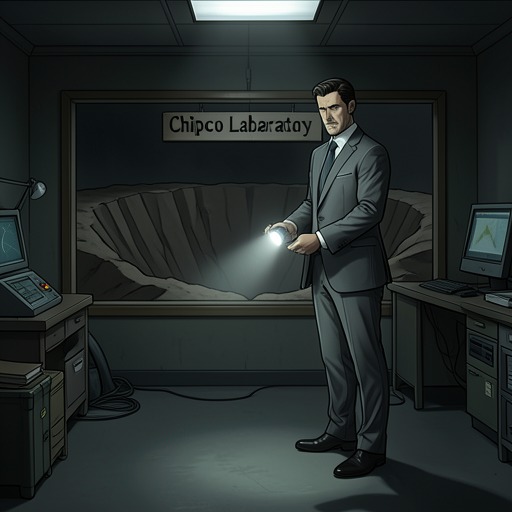
About a week after Brock Vond arrives in Tokyo, Takeshi Fumimota visits the site of the demolished laboratory. What remains is an enormous footprint-shaped crater, so wide that he cannot see across it through the morning drizzle. Technicians move along its muddy bottom collecting fragments for analysis, while parts of the rim have already begun to collapse. Temporary traffic lights and plastic walkways have been installed inside the crater, turning the wreckage into a busy worksite even as its cause remains unknown.
The site has the appearance of a carefully staged monster attack. Chipco can point to its recently amended insurance policy, which covers damage caused by animals of any species. Because the laboratory stood by the shore and the incident occurred at low tide, the returning water could have erased any additional tracks. Professor Wawazume, an eccentric executive of Wawazume Vita & Non-Vita and Takeshi’s former mentor, identifies both a reptilian creature and an outlandish environmentalist as possible explanations. Takeshi considers another: professionals. He knows of special-effects makers, imaginative bombers, Vietnam veterans, and possible factions of the Japanese organized crime (Yakuza), though he cautions that such networks are not always easy to control.
The scale of the apparent evidence sharpens the problem without solving it. Takeshi estimates that an artificial paw extending 20,000 centimeters from heel to claw could have made the print. That possibility makes the footprint legible as a piece of engineering, but it does not identify who built it or why. The animal explanation, the insurance clause, and the possibility of professional fabrication remain in tension; none is confirmed as the answer.
Evacuation and corporate spectacle
The supposed monster returns while Takeshi and Minoru are at the crater. A dark, scaled shape appears through the clouds, and people below begin to shout and run. Some try to photograph it; others raise radiation meters or microphones. The apparent creature then turns toward a makeshift landing ramp. It is a Chipco helicopter whose crew has covered its underside with plastic material to resemble the sole of a monstrous foot. The disguise fools the assembled observers, briefly making a corporate aircraft look like the very force that supposedly destroyed the laboratory.
The helicopter has arrived to evacuate everyone from the crater under a radio order. Its reveal resolves the immediate sighting, not the earlier destruction: the staged foot explains the airborne monster, while the giant footprint and the obliterated building remain part of the larger mystery. The crew’s prank and the official evacuation order coexist in the same scene, leaving Takeshi and Minoru to accept the ride without establishing whether the spectacle is merely a joke or part of something more consequential.
Insurance, corporate power, and uncertainty
The policy links the laboratory’s destruction to an earlier Himalayan incident that Takeshi and Minoru recall on their journey. In both cases, the policy was drawn up by Professor Wawazume; the Himalayan episode also involved Semtex of Czech origin and what they call a fictitious motive. Their comparison raises the possibility of self-inflicted damage, but does not prove it. They also consider whether the professor may have received a kickback. Chipco’s involvement in a much larger struggle is clearer than any particular account of the laboratory’s destruction: the narration places the company deep inside a conflict on a planetary scale, where power accumulates, lives lose value, and personnel are replaced.
That broader frame changes the meaning of the crater without supplying a final explanation. The technicians’ samples, the odd insurance coverage, the disguised helicopter, and the elaborate Technology City all belong to a world where evidence can be engineered, obscured, or turned into a show. Chipco is consequently neither presented as a transparent institution nor definitively exposed as the author of the incident. Its narrative significance lies in that unresolved position: the company stands at the crossing of industrial secrecy and theatrical evidence, amid forces whose scale exceeds the investigators’ view.