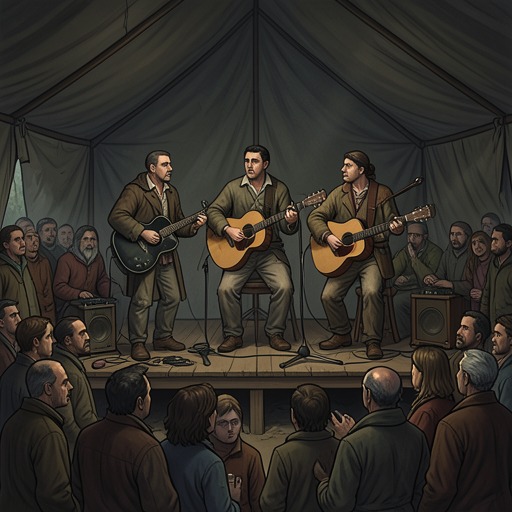
Gino Baglione and the Paisans
VinelandGino Baglione and the Paisans enters the story as the advertised replacement band for a lavish wedding, but the name conceals the performers’ real identity: they are The Vomitones, a rock group whose disguise is exposed during the celebration. The episode makes the booking a collision between an elite family’s expectations of Italian entertainment and a young band’s improvised impersonation. Music begins as a practical substitute for a missing orchestra and becomes the means by which the substitution is discovered.
The name and the booking
The wedding belongs to Gelsomina Wayvone, whose father, Ralph Wayvone senior, is staging a celebration on a scale that exceeds even the cost of his villa. The planned feast ranges from homemade wine to Cristal champagne, with hundreds of guests expected. Music is the one uncertainty: the San Francisco Symphony is touring abroad, and the popular group first engaged for the occasion has been held in Atlantic City by gambling debts. At the last moment, Ralph Wayvone junior finds a replacement in Vineland County in Northern California: Gino Baglione and the Paisans. He hires them without having heard them perform.
That booking supplies the name under which The Vomitones arrive, not evidence that the wedding has actually secured the advertised ensemble. The distinction matters because the family’s expectation rests on a label and a presumed cultural style, while the performers must make that label credible in front of the guests. The gap between the name on the booking and the band on the platform drives the scene from uncertainty to confrontation.
A disguise under inspection
The musicians reach the estate after a leisurely, two-day journey that has included detours through wine country, along the coast, and through Berkeley. Before entering the guarded residential enclave of Lugares Altos, they are asked to leave their bus for a discreet body search and checks by metal detectors and electronic devices. The security measures give the arrival the formality of an inspection, while the band’s own appearance is already a performance: the musicians wear shiny black synthetic wigs, mint-colored European-cut suits, false mustaches, and conspicuous gold jewelry.
At the villa, their female companions, including Prairie Wheeler, have also tried to make the group’s appearance less conspicuous, borrowing wigs, clothes, and cosmetics from bourgeois friends. Billy Barf considers speaking with a Neapolitan accent, although his knowledge of Italian culture is limited. Isaiah Due Quattro pulls him aside after recognizing that the attempt sounds inauthentic and could risk ethnic insult. Ralph Wayvone junior, who has spoken Californian all his life, mistakes Billy’s affected speech for a stammer or some other impediment. The episode thus shows the disguise working unevenly: its intended signals are obvious to some, but its host initially fails to identify them as a performance.
The requested repertoire and the exposure
The musicians unload their instruments and amplifiers beside the wedding pavilion, where uniformed servers are arranging food, flowers, glassware, and folding chairs. Ralph Wayvone junior repeatedly asks whether they have done this kind of job before. Isaiah cautions Billy to take care, and Lester, the rhythm guitarist, warns him that a failure could bring trouble for the whole group. The opening set is unexceptional: harmless popular numbers, rock-and-roll standards, and a couple of Broadway favorites.
During the first break, Carmine Torpidini, known as Two Ton and acting as Ralph Wayvone senior’s emissary, conveys the host’s mixed response. The younger guests have enjoyed the band’s contemporary sound, but Ralph wants music in which older guests can recognize themselves, something more Italian. The musicians respond with a medley they have rehearsed. It moves through the theme from Mondo cane arranged as salsa, Senza fine, and a nasal, English-language version of Al di là.
The medley does not meet the request. Two Ton returns with specific expectations: familiar group-singing songs such as C’è la luna and Way Marie, and perhaps an operatic selection such as Cielo e Mar, which Ralph’s brother Vincent can sing. Billy proposes going to the bus to fetch the requested material and starts to remove his guitar. Two Ton takes it from him and twists its strap around Billy’s neck, demanding to know why the band needs arrangements if its members are Italian. He then presses the point by suggesting Catholic songs. The pressure is not a musical critique alone; it is an attempt to force the supposed identity behind the booking to match the host’s assumptions.
The name falls away
As Two Ton tugs at the guitar strap, Billy’s Italian-looking wig slips, exposing his bright blue hair. The disguise gives way in public, and Two Ton recognizes that the musicians are not Gino Baglione and the Paisans. He calls the impersonation deceptive and warns Billy that it could be treated as fraud. The band stands stunned as its leader is threatened. Isaiah then releases the strap’s snap fasteners, allowing Billy to step back and recover his breath; the moment ends the immediate physical danger without restoring the fiction that brought the group to the wedding.
The scene’s comedy depends on a mismatch of performances: the guests seek a ready-made Italian identity in the music, while the musicians try to supply it through costume, accent, and selected songs. Yet the mismatch has material consequences once Two Ton treats the assumed name as a serious deception. The booking therefore exposes both the band’s false presentation and the host’s reliance on stereotyped signs of authenticity.
The Vomitones beyond the wedding
The wedding episode establishes a contrast between The Vomitones’ own musical identity and the role they are hired to counterfeit. Later, at a gathering associated with the awakening Thanatoids, Billy Barf and The Vomitones arrive to share the bill with Holocaust Pixels. Alexei performs with them and proves capable of singing Johnny B. Goode without amplification, louder than both groups together. This later appearance places the band in a different setting, where its name and musical company are presented openly rather than through the wedding’s Italian disguise. The contrast clarifies what the earlier booking obscures: Gino Baglione and the Paisans is the identity imposed on The Vomitones for one ill-judged engagement, not the name by which the group is otherwise identified.