The Vomitones
VinelandThe Vomitones are a working band led by Billy Barf, whose gigs range from standard rock-and-roll sets to an improvised wedding performance for the Wayvone family. Their role in the Gelsomina Wayvone wedding episode turns music into a test of social performance: the group is expected to satisfy both young guests and an older family’s idea of Italian tradition, while the musicians are never sure whether an employer’s dissatisfaction is merely artistic or dangerous. Their playing helps keep the reception alive, but the threat they believe surrounds the job alters the rest of the engagement.
Identity and working life
The band arrives at the Wayvone estate as a replacement hired by Ralph Wayvone junior after the original entertainment becomes unavailable. Ralph junior has booked them without hearing them play, so the engagement begins with uncertainty on both sides. The musicians’ long journey to the estate includes detours through wine valleys, along the coast, and through Berkeley; on the final stretch, they touch up their disguises, wearing synthetic black wigs, mint-colored European-cut suits, false mustaches, and gold-colored accessories. At the guarded entrance to Lugares Altos, they are searched and checked by security equipment before proceeding to the estate parking area.
The effort to pass as an Italian wedding band is an improvised disguise rather than a credible transformation. Billy Barf has only a haphazard knowledge of Italian culture and initially tries to adopt a Neapolitan accent. Isaiah Due Quattro quietly warns him that the imitation is inauthentic and could be taken as ethnic insult. Ralph junior, who has spoken Californian all his life, fails to recognize the act as an accent and mistakes it for a speech impediment. The mismatch between the band’s performance and its hosts’ expectations is thus present before the first note is played.
The Wayvone wedding engagement
As The Vomitones unload instruments, amplifiers, and electronic equipment, Ralph junior repeatedly asks whether they have done this kind of work before. Billy reassures him that weddings are their regular business; Isaiah tells him to take care, and rhythm guitarist Lester warns that failure could bring consequences for the whole band. Their first set is a safe mixture of popular standards, rock-and-roll classics, and a couple of Broadway numbers. The reception’s elaborate preparations—serving staff, tableware, flowers, folding chairs, and large quantities of crushed ice—make the group’s assignment one part of a carefully staged social occasion.
During the first break, Carmine Torpidini, known as Two Ton, relays Ralph Wayvone senior’s response. The younger guests have enjoyed the contemporary music, but the older host wants something more recognizably Italian. The band responds with a medley it has rehearsed, including the theme from Mondo cane arranged as salsa, Senza fine, and an English-language version of Al di là sung by Billy in a nasal tenor. The choices meet the broad request for Italian material, but not the more particular repertoire the host has in mind: singalong songs such as C’è la luna and Way Marie, and an operatic selection such as Cielo e Mar, associated with the good voice of Ralph’s brother Vincent.
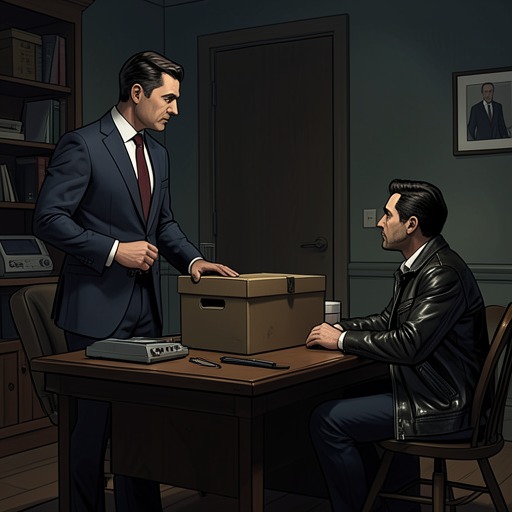
Two Ton’s return, flushed and excited, makes Billy fear that the band has misunderstood more than a musical instruction. The perceived possibility of an order to kill him leaves Billy unable to concentrate on the performance. Meathook, the band’s bassist, responds with macabre practical advice: Billy should obtain a military-style rifle and be prepared if anyone comes for him. The scene makes the musicians’ professional vulnerability part of the comedy, without resolving whether the danger is real or imagined. A job booked as entertainment has become, in Billy’s understanding, a matter of survival.
The wedding is nevertheless saved. Gelsomina, intent on protecting the ceremony from bad omens such as blood on the wedding cake, retrieves a copy of Deleuze and Guattari’s Italian Wedding Fake Book from Ralph Wayvone’s library and tries to bring it to Billy’s attention. But he already has the van keys and is stubbornly heading for the parking area. Gelsomina, wearing her grandmother’s wedding dress, runs after the blue-haired, non-Italian musician. The sight gives the family’s most reactionary traditionalists a fresh grievance, even as the music resumes, dancing continues, and the reception survives. Billy, convinced that an order to kill him has come from the highest levels, remains paralyzed by fear for the rest of the engagement.
Further bookings and later appearances
After the wedding, Isaiah reports that Ralph Wayvone junior has hired the group to play at the Cucumber Lounge, with the possibility of becoming its regular band if the arrangement works out. The prospect gives The Vomitones another engagement and a possible foothold in Vineland, but it does not establish that the offer becomes permanent. Isaiah is found in the band’s van with Meathook, preparing for a late and demanding shift. When Prairie asks whether the musicians are about to return to Vineland, Isaiah asks whether she is coming too; her answer—that she has made a promise to her father—keeps the band’s working plans distinct from her own journey.
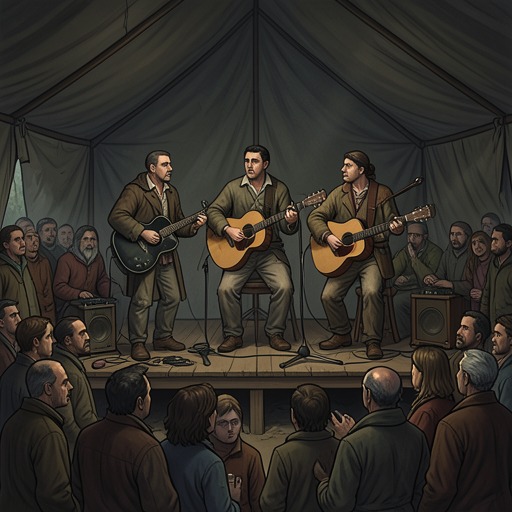
The group also appears at a later Thanatoid gathering. The event has an extended musical program, with Holocaust Pixels scheduled to play and The Vomitones expected to join them in rotation. Billy and the band arrive later than the other performers; Alexei is with them and proves capable of singing Johnny B. Goode loudly even without an amplifier. Prairie accompanies Alexei only as far as the band’s van before reluctantly parting from him. Here the group is not the center of a threatened private wedding but part of a larger, unsettled assembly, where performers, listeners, and unexpected arrivals share the night.
Narrative role
Across these appearances, The Vomitones’ music is adaptable but never entirely under their control. At the wedding, they shift from contemporary standards to Italian-themed selections, only to learn that the host’s request has a narrower, family-specific meaning. Their performance keeps the celebration going, yet the threat Billy imagines overwhelms the practical success of the set. At the later gathering, the band’s place in a rotating program connects it to a wider musical community without turning it into a settled institution.
The band’s episodes also make performance itself a source of uncertainty. Billy’s false accent, borrowed appearance, and increasingly fearful response to the Wayvones’ demands expose the distance between presenting the right act and knowing what an audience expects. The group can change its repertoire and take another job, but it cannot ensure that a performance will be judged by music alone. Its recurring function is to carry music across social worlds whose rules are only partly visible to the musicians playing in them.