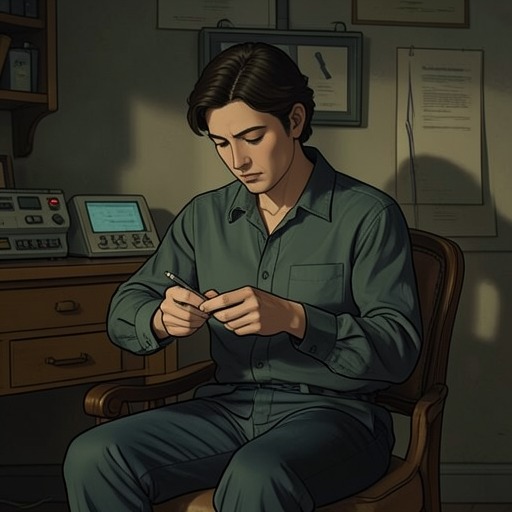
Focused attention in kunoichi practice
VinelandFocused attention in kunoichi practice is both a practical skill and a demanding standard of responsibility: it requires sustained observation, patient training, and precise action rather than a sudden revelation. Sister Rochelle’s example makes attention almost invisible; her instruction to DL makes it measurable in millimeters and fractions of a second; and DL’s later failure shows the cost of acting without it. The practice also challenges the assumption that experts should control what a person knows about and does with her own body.
Attention as a Learned Practice
Sister Rochelle introduces the discipline not as an occult gift but as knowledge built through ordinary effort. When Prairie sees Rochelle seemingly emerge from invisibility in the recreation room, the effect first appears magical. Its basis, Prairie later learns, is meticulous familiarity: Rochelle has memorized the room’s shadows and their movements, along with its objects and the spaces between them. She knows the room so thoroughly that she can blend into its transparency and emptiness. The apparent vanishing is therefore the visible result of accumulated observation, not supernatural power.
Rochelle describes learning as a process that does not arrive in one transcendent moment. Common sense and hard work are what it takes; progress occurs at the outer margins of perception, measured in millimeters and tenths of seconds. Her account gives attention a bodily and spatial precision. A practitioner must notice small changes and keep working at skills that may offer no dramatic sign of success. The invisibility Prairie admires is not an escape from the world but a way of knowing its details closely enough to move within them.
Discipline Against Shortcuts
At the retreat, Rochelle warns Prairie against expecting a spiritual quick fix. She has seen young visitors arrive seeking inexpensive secret powers, imagining the sisters can cleanse them of the dirt of the road in a weekend. Exhaustion, hallucinations, or an exciting mental experience might then be mistaken for a lasting improvement. The distinction is between an intense experience and the slow work of attention: the former may feel transformative without producing durable skill.
Rochelle’s warning is not merely an abstract rule. Prairie first encounters the practice through watching the women at the retreat and then through Rochelle’s precise demonstration in the recreation room. The scene unsettles Prairie’s expectation of an extraordinary power by showing that what looks like disappearance depends on remembering ordinary things—shadows, objects, and empty intervals. The discipline asks for seriousness over spectacle, and persistence over the desire to be changed all at once.
The Body as the Field of Practice
For DL, training under Inoshiro Sensei becomes a way of recovering possession of her own body. Years later, in an interview with Aggro Wortd, she describes that period as a return to herself. She understands the wider claim that people are often taught they cannot know enough about their own bodies to take responsibility for them, and should instead hand that responsibility to experts: doctors, laboratory technicians, trainers, employers, or sexual partners. DL draws a radical conclusion from her training: her body belongs to her.
That conviction does not mean mastery comes quickly. DL continues to practice every day, finding the time and space even when doing so carries a high cost, and she does not skip a day. Inoshiro Sensei’s instruction had included techniques that would require years of rigorous daily exercise before she could understand them; until then, she was forbidden to use them outside training. Attention thus governs not only how a technique is performed but whether a practitioner is ready to use it at all. Bodily autonomy entails discipline and restraint, not simply access to power.
Failure, Timing, and Consequence
The limits of DL’s attention become acute when she confesses her failure to Sister Rochelle. Asked whether she pulled back at the last moment, DL cannot be certain. Rochelle treats attention as decisive because the bodily transaction depended on several factors converging in one lethal instant: chi flow, time of day, memory, consciousness, passion, and inhibition. The action cannot be separated from the conditions that make it possible. Its success depends on attending to all of them together.
DL insists that she was taken, but Rochelle judges that, after returning to the corrupt world, DL rushed at appearances instead of taking time to prepare. Rochelle connects the mistake to DL’s wider habit of acting at a crucial moment without the necessary care. DL remembers Inoshiro Sensei’s warning about people who rush in, make a mess, and must live with the consequences. She recognizes the pattern in herself and asks whether the course can be reversed. Rochelle distinguishes between reversing a life and reversing the effects of the Vibrating Palm: the latter may be possible, depending on several variables, beginning with the timing of remedies. Even repair, like the original action, requires attention to particulars.
Continuity and the Demand to Persist
Rochelle’s criticism extends beyond one failed act. DL has repeatedly left the retreat and returned asking to be admitted again; she has moved in and out over the years without continuity or perseverance. Rochelle sees not a person who has found what lies beyond the struggle, but someone who keeps running as though stopping would mean falling. DL had assumed that the sisters would take her back whatever she did. Rochelle counters that the important question is whether DL will concentrate and use her full attention.
The exchange leaves attention as an ongoing obligation rather than a skill acquired once and kept automatically. Rochelle’s willingness to speak with DL does not erase the failures she names, and the possibility of returning does not substitute for sustained practice. Across the retreat’s instruction, DL’s daily training, and her later crisis, the same distinction holds: a body cannot be responsibly directed through impulse or borrowed expertise alone. Attention is the labor of staying with what an action requires, in time to choose and answer for it.