RICO civil asset forfeiture
VinelandRICO civil asset forfeiture turns Zoyd Wheeler’s home into the object of a civil case and, in the process, makes a property claim carry the weight of a criminal accusation. The mechanism is consequential because the government can proceed against the house while Zoyd, rather than the authorities, must prove his innocence to get it back. In the novel, the legal procedure is at once a material threat, a pressure point in personal relationships, and an image of political power working through ordinary property law.
The House as the Target
The house is not an abstract asset. Zoyd had spent years building it, and a photograph of his daughter sitting with the dog Desmond on its weathered porch makes the threatened loss intimate and visible. When Frenesi sees the photograph, she recognizes that Brock Vond has taken the house in the name of RICO. The account connects the seizure to the end of an old pact between Zoyd and Frenesi: Vond’s intervention has made a promise they had believed still stood impossible to keep. The house thus carries both the labor invested in making a home and the history of a relationship disrupted by state power.
The legal claim becomes physical before the dispute is resolved. The government has filed against the house in civil court under a new forfeiture law that Reagan is preparing to sign. A chain-link fence surrounds the property, federal Dobermans patrol inside it, and Zoyd can approach closely enough to hear his television from within. He makes furtive visits after the dogs have been fed, timing his return around their diminished appetite for blood. These details make the property’s status legible as a daily fact: the home remains recognizable as his, but access to it has become dangerous and conditional.
Procedure and Reversed Burden
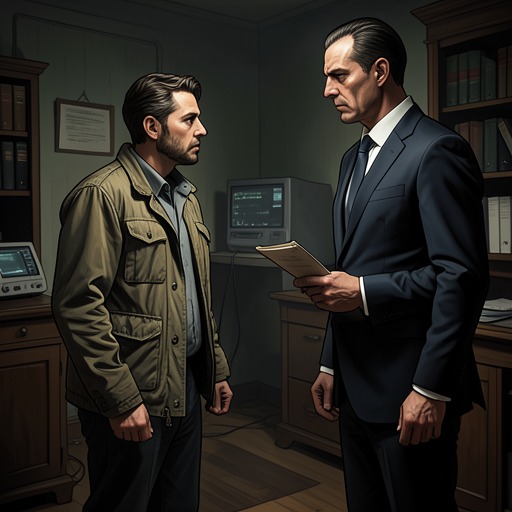
Elmhurst, Zoyd’s lawyer, explains the central procedural reversal: to recover the seized house, Zoyd has to prove his innocence. Zoyd invokes the familiar presumption that a person is innocent until found guilty; Elmhurst answers that this protection belongs to a vanished America and says that the Fourth Amendment has been sacrificed. In the case as described, the discovery of marijuana growing on Zoyd’s land makes him automatically guilty in the authorities’ account. Zoyd objects that he was not growing anything. Elmhurst’s response is that the officials say otherwise, and that their uniforms and weapons do not make their claims truthful.
This shifts the practical burden from the government’s allegation to the homeowner’s defense. The proceeding is civil, but its consequences reach into Zoyd’s home and its possession; the novel’s emphasis falls on what the procedure requires him to do, not on a technical account of the statute. Elmhurst accepts the case without charging Zoyd. He has inherited both his father’s law practice and its role as advocate for the condemned of California’s North Coast, and he has anticipated that civil RICO forfeiture could become a weapon of the future. Taking Zoyd’s case lets him begin learning how to confront it now.
Enforcement and Political Context
The house seizure belongs to a wider landscape of drug enforcement and public spending. In the coastal communities, including Torrance, Hawthorne, and Walteria, federal narcotics agents are so numerous that a person caught in the area is more likely to encounter a federal agent than a local one. A heavily subsidized pilot project directs public money to drug agencies at multiple levels of government. The account does not reduce Zoyd’s case to that program, but places the personal threat within an expanding apparatus in which drug enforcement is funded, dispersed, and difficult for residents to evade.
The campaign around Zoyd’s home gives that apparatus a neighborhood presence. Brock Vond’s troops terrorize the surrounding community for weeks, marching along dirt roads, conducting public strip searches, killing animals, and pouring herbicide into wells that could not even be used to irrigate marijuana crops. After the troops leave, police remain to guard the house. The sequence distinguishes the prolonged pressure on the neighborhood from the continuing control of Zoyd’s property: the broader force withdraws, but the house does not return to ordinary use.
Consequences and Significance
For Zoyd, the proceeding makes legal uncertainty concrete. The house has been built over years, yet its future depends on a process in which the authorities’ accusation immediately alters his standing. Elmhurst’s image of the justice system as a swamp accords with Zoyd’s distrust of legal entanglement; even seeking a lawyer means entering a system he expects to engulf those caught in it. His decision to consult Elmhurst is therefore necessary but uneasy: resistance must take the form of using the very institution he regards as dangerous.
The seizure also unsettles the pact Frenesi and Zoyd thought remained in force. Frenesi rejects the framing of the loss as merely a breach among men and assigns responsibility for the money cuts to Reagan; Brock, she is told, has also lost funding. The PREP program has been shut down, and the former camp is filling with refugees, while the house remains fenced and guarded. These developments place the property case amid changing federal priorities without erasing its immediate human cost. RICO civil asset forfeiture matters in the novel because it converts an allegation about land into a means of dispossession: the government acts against a home, and the person who claims it must try to prove that it is still his.