Shinzou (Vibrating Palm)
VinelandThe Vibrating Palm turns a light, nearly imperceptible touch into an act of delayed violence: its victim may die months later, while the person who struck them is far away. In DL’s story, the technique is not a frictionless weapon or a dependable trick. It requires years of martial training, careful attention to timing, and an ethical discipline that DL herself may fail to observe. Its central paradox is that the gentler the touch appears, the more consequential—and less immediately legible—its violence can be.
Technique and Tradition
The technique is also called the Ninja Death Caress. In the account given to Takeshi Fumimota, it was invented centuries earlier by Chinese practitioners in Malaysia and later adapted by ninja and Japanese organized crime (Yakuza). Different methods are taught, but the doctor says they produce the same effect. The description makes the technique less an isolated secret move than a body of knowledge transmitted and modified across settings.
Its operation depends on more than physical contact. DL explains to Ralph Wayvone that using the Palm requires a long history of martial-arts training, and that it is not properly applied simply to someone one dislikes: resort to it is a profoundly moral act. The weapon’s apparent simplicity—a touch so slight that the recipient may not notice it—conceals years of preparation and a judgment about when violence is justified. Ralph, who has heard accounts of a victim dying a year after the encounter, initially treats it as an ingenious way to kill at a distance. DL’s explanation insists on a seriousness his casual interest does not grasp.
The method also depends on the body’s internal timing. During DL’s account of her attempt, she recalls the old hour system and identifies the hour of the rooster, which belongs to the early hours of night under the laws of the technique. In that system, the victim’s chi has reached the triple burner, associated as a wife with the bladder and therefore vulnerable. The Dim Mak needle-finger DL intends to use can be calibrated to postpone death, potentially for as long as a year. The effect varies with the force and direction of the touch; a light touch may leave its recipient alive longer. The technique’s delay is thus not simply a countdown but a consequence shaped by the strike’s execution and the body’s moment in the cycle.
Training, Memory, and Attention
DL’s knowledge comes from Inoshiro Sensei, who called the practice the art of the dark meridians and repeatedly warned her to attend to chronology. A perfect blow delivered at the wrong time could be worse than staying home to watch a Run Run Shaw film. The warning makes timing inseparable from skill: technical accuracy alone cannot ensure that a strike will have the intended result.
The account contrasts this learned bodily knowledge with the fantasy of instant calculation. The narrator imagines that a portable Ninja Death Caress calculator can now perform the research, calculation, and design in a flash. In DL’s youth, however, there was no such aid; she relied on her own memory and what she had learned from Inoshiro Sensei. The contrast is comic, but it also emphasizes what the device cannot reduce to a convenient computation: training, attention, consciousness, passion, inhibition, and the precise instant of action.
That emphasis returns when Sister Rochelle examines DL’s failed attempt. She describes the bodily transaction as complex and dependent on chi, the hour, memory, consciousness, passion, and inhibition converging at one lethal instant. DL is unsure whether she drew back at the last moment. Sister Rochelle interprets the failure as a consequence of DL’s impulsive return to a corrupt world: instead of attending, taking time, and preparing, DL rushed toward outward appearances. The technique therefore exposes a gap between knowing its rules and being able to inhabit the discipline they demand.
The Attempt and Its Misidentification
DL intends to kill Brock Vond, but her attempt is shaped by a mistaken identity. She is wearing contact lenses meant to make her eyes blue like Prairie’s mother’s; the department store failed to provide a pair that suited her. In the intimate room where Takeshi is undressing, DL continues to address him as though he were Brock. The scene’s bodily closeness and the error of recognition converge at the moment when she is preparing to strike.
DL considers using the technique’s delay to her advantage. If she struck Brock then, he might die months later, when she was elsewhere and had an apparently perfect alibi. But the intended target is not the man in front of her: Takeshi is present, while DL believes she is confronting Brock. The story links the Palm’s delayed effect to a second kind of delay, the interval between seeing a body and understanding who it is. The strike is not rendered as an uncomplicated success. Takeshi later asks what the woman did to him, saying that he felt nothing; the doctor explains that a lighter touch is said to leave its recipient longer to live.
Treatment and Consequences
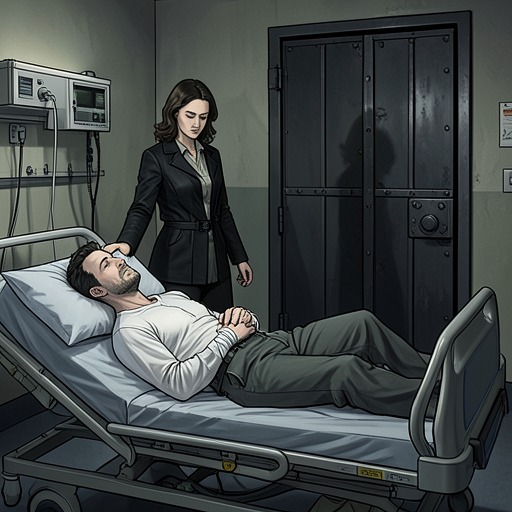
After DL confesses, Sister Rochelle asks whether she is sure she did not pull back. DL cannot be certain. She wants to know whether the course can be reversed, and Rochelle distinguishes between changing DL’s life—which she tells her not to imagine—and reversing the spell of the Palm, which may be possible depending on several variables. The first is how promptly remedies are given.
The retreat has changed since DL was last there. It now has a medical ward with new therapeutic machines and two trained nurses. Cases of the technique are uncommon, but Rochelle says the victim’s chances improve the sooner he is admitted. This practical response makes the Palm more than a piece of martial lore: its consequences create an urgent medical problem, and the technique’s delayed action leaves a narrow interval in which intervention may matter.
Takeshi’s consultation with a doctor supplies a further measure of uncertainty. The doctor has not personally seen a case; his knowledge comes from articles and stories told at the club. He distinguishes the technique from a place with a similar-sounding name, then explains its reported origins and adaptations. When Takeshi asks whether the woman has done this to him and protests that he felt nothing, the doctor treats the absence of sensation as potentially good news: according to what is said, the lighter the touch, the longer the victim may have to live. The exchange does not establish a precise prognosis. Instead, it leaves the effect dependent on a degree of force no observer can readily measure.
Narrative Significance
The Vibrating Palm makes violence difficult to locate in time. A touch can be almost unnoticed when delivered, yet remain consequential months later; a distant alibi can coexist with an intimate act; and a practitioner may understand the theory without being certain what she has done. That structure gives the technique its narrative force: it makes attention, timing, and responsibility inseparable from the physical strike.
The story also refuses to let the technique stand as a purely exotic marvel. Its elaborate system of bodily timing is set beside a joking image of a calculator, while its supposed precision is tested by DL’s mistaken identification, uncertain follow-through, and the need for urgent treatment. The Palm’s most important measure is consequently not only how long it can delay death, but whether its practitioner can attend closely enough to know whom she has touched and what must happen next.