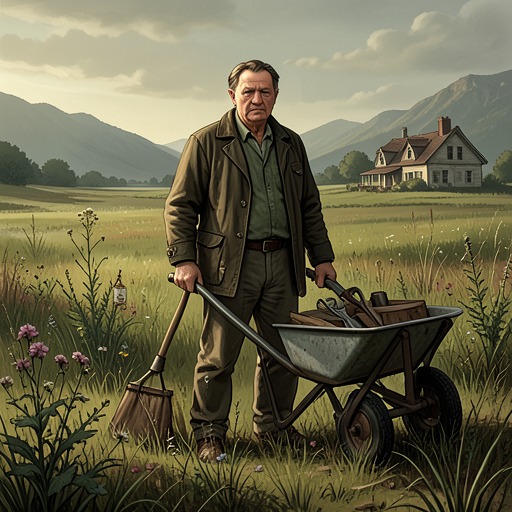
Attempt to buy Hollowell Farm
WaldenThe Attempt to buy Hollowell Farm is a near-purchase that becomes a comic demonstration of the narrator’s preferred freedom from possession. He comes close enough to sort seeds and collect wheelbarrow materials, but when the seller’s wife changes her mind and the owner offers ten dollars to release him, he lets the farm go. He ends with the ten cents, seeds, and materials he had before—and with the landscape still available to him—so that giving up ownership becomes, in his account, a way to remain rich without damaging his poverty.
The Purchase Almost Made
The narrator sets the episode against his conviction that a person is rich in proportion to the number of things he can afford to leave alone. He imagines having refused several farms, insisting that refusal itself was enough; actual possession, by contrast, might burn his fingers. Hollowell is the point at which the imagined relation to property almost becomes a deed. He buys the place, begins sorting seeds, and gathers materials to make a wheelbarrow for carrying the farm’s produce or equipment. The practical preparations show how close the transaction comes to changing his life: the prospect is no longer an abstraction, but something to be worked and carried.
That threshold is not crossed. Before the owner gives him a deed, his wife changes her mind and wants to keep the farm. The owner then offers the narrator ten dollars to release him from the sale. The narrator’s account makes this reversal decisive without turning it into a dispute: rather than insist on completing the purchase, he accepts the opening to withdraw. The farm is not secured as his property, and the practical preparations do not mature into possession.
Releasing the Farm
The narrator says he had only ten cents in the world, and jokes that he could not calculate whether he was the man with ten cents, the man with a farm, the man with ten dollars, or all of them together. The joke unsettles the ordinary arithmetic of the bargain. Money and property do not add up to a stable identity when he is willing to relinquish both; his measure of gain is not simply the sum of what he owns.
He describes the settlement as letting the owner keep the ten dollars and the farm, then corrects the description: more generously, he sold the farm back for what he had paid and made the owner a present of ten dollars. The self-correction turns a retreat into a gift, while revealing the narrator’s control over how the transaction is framed. Its material outcome remains plain: the owner retains the property, and the narrator keeps his ten cents, his seeds, and the materials for a wheelbarrow. He can therefore claim to have been rich without any damage to his poverty—not because he has acquired a farm or profited from it, but because he has declined to be bound to it.
Ownership and the Landscape
The farm’s relinquishment does not, in the narrator’s telling, mean losing the place altogether. He retains the landscape and says that he has since carried off annually what it yielded. That distinction gives the episode its lasting consequence: property changes hands, but the narrator’s experience of the land and its produce continues. The wheelbarrow materials and sorted seeds mark how concrete his intentions had been; the annual harvest marks what remains possible after the sale is undone.
The episode compresses a larger contrast between possession and use into one small negotiation. A deed would have made the narrator the owner, with the obligations and boundaries that ownership entails; releasing the farm leaves him able to enjoy its landscape without treating title as the only form of relation to it. His withdrawal is neither presented as a practical failure nor as a purchase that secretly succeeds. Instead, he makes non-possession the point: the land can remain part of his life, while the farm does not become an encumbrance. In that reversal, the abandoned transaction becomes an illustration of wealth measured by what can be left alone.