Thoreau’s visit to John Field’s hut
WaldenHenry David Thoreau’s visit to John Field’s hut turns a chance shelter from rain into a close encounter with poverty and the assumptions behind advice. Field’s account of strenuous work for little return gives material shape to Thoreau’s criticism of labor spent securing necessities, while the two men’s divergent standards of comfort keep the conversation from becoming a simple exchange of wisdom. The episode closes not with a settled agreement but with Thoreau’s observation that a fresh impulse has brought Field away from his work before sunset.
Arrival at the hut
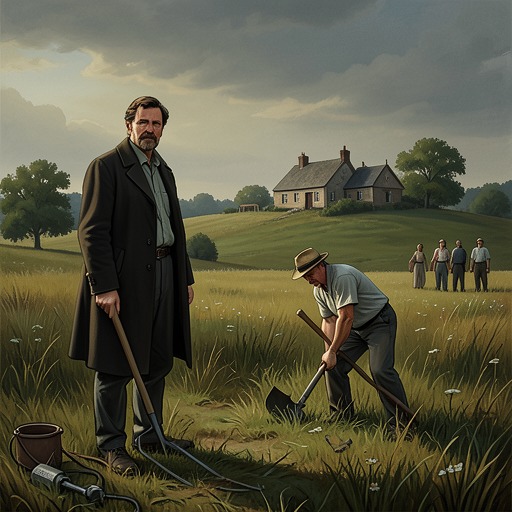
Caught in a shower, Thoreau stands for half an hour under a pine, piling branches over his head and using his handkerchief as a makeshift shelter. The weather interrupts his fishing and leads him to the home of John Field, an Irishman who lives there with his wife and several children. The hut is not an abstraction in a meditation on poverty: it is a household with children and animals, and Field’s son assists him at work.
The arrival follows a poetic image of a cabin heading toward destruction, but Thoreau immediately turns from that fable to the people actually living inside it. The contrast sets the terms of the episode: the cabin can be imagined as a symbol, yet the hardship at issue belongs to a family whose daily circumstances are concrete. A shower and a temporary shelter bring the observer into contact with a neighbor whose life his general arguments about labor will have to confront.
Work and unequal bargains
Field tells Thoreau how hard he works “bogging” for a neighboring farmer, turning up a meadow with a spade or bog hoe. His compensation is ten dollars an acre and the use of the land, with manure, for one year. His broad-faced young son works cheerfully beside him, unaware, as Thoreau interprets the situation, of how poor a bargain his father has made. The arrangement binds labor, land, and payment together: Field’s strenuous effort produces a limited return, while the son’s cheerful participation makes the family’s predicament visible across generations.
Thoreau tries to speak from his own experience, telling Field that he is one of his nearest neighbors and that he too can look like a loafer while fishing. That comparison attempts to establish common ground, but it also exposes a difference in perspective. Thoreau presents his own apparent idleness as a chosen alternative to conventional labor; Field’s work is an immediate necessity and a bad bargain. Their shared proximity does not make their economic positions interchangeable.
Advice, domestic life, and departure
The scene is not confined to the men’s conversation. Field’s wife is present, and the household’s ordinary life surrounds it: animals move about the room, seem almost too humanized to roast, and look into Thoreau’s eye or peck at his shoe. These details keep the encounter from becoming a debate staged outside domestic reality. Thoreau’s view of the family is shaped by the work and conditions he sees, but the household appears through his own account, not through an independent explanation of its members’ choices.
When the shower passes, a rainbow above the eastern woods promises a fair evening, and Thoreau takes his leave. Field’s wife, her face glistening and hopeful, tells her husband that he had better go; John hesitates. The moment registers an immediate domestic difference of response without explaining the couple’s hopes beyond what the narrator observes. Outside, Thoreau asks for a drink, hoping to see the well, and then continues toward the pond.
The episode’s turn and significance
The visit belongs to Thoreau’s larger criticism of a society in which people labor for years to obtain material necessities and comforts, while a poor minority may be degraded below even a supposedly primitive condition. In the hut, that broad argument acquires a specific measure: ten dollars an acre, a year’s use of land and manure, a spade or bog hoe, and a child working alongside his father. The episode’s force lies partly in this movement from social diagnosis to a named neighbor’s bargain, though Field’s inner life remains limited by the narrator’s account.
As Thoreau nears Walden Pond, he reports that a fresh impulse has brought Field out with an altered mind, letting go of “bogging” before sunset. The change gives the encounter a brief consequence, but not a documented transformation of Field’s circumstances or a lasting conversion to Thoreau’s views. Thoreau’s reflections on coming home from daily adventures with new experience and character frame the encounter as an episode in his own education: he has met a neighbor whose labor makes his critique tangible, while the ending leaves the distance between their lives unresolved.