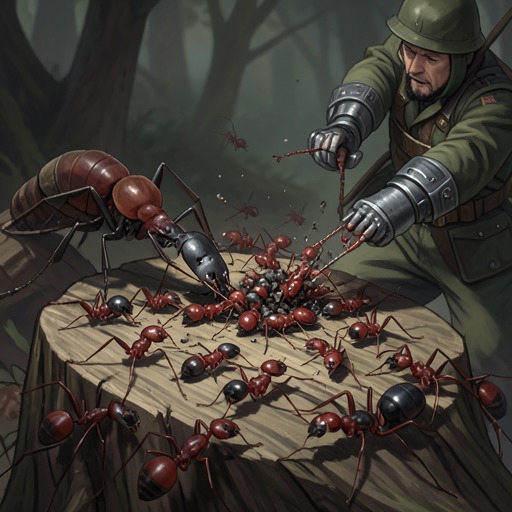
Walden Pond ant battle
WaldenWalden Pond ant battle is an observed conflict between red and black ants in the wood-yard, rendered with the scale and intensity of a human battlefield. Henry David Thoreau first encounters it among the chips of his wood-pile; when he carries one of the contested chips indoors to watch the outcome, the scene becomes at once a record of animal violence and a meditation on the disturbing force of war—and on the limits of witnessing it.
Discovery in the Wood-yard
The encounter begins during an ordinary visit to the wood-pile, or, more precisely, the pile of stumps. Thoreau notices two large ants locked together, one red and one much larger and black. Their grip does not loosen: they struggle, wrestle, and roll over the chips. The opening sight is not a detached specimen displayed for study but combat already in progress, close enough to interrupt the routine of gathering wood.
Looking beyond the first pair, Thoreau finds that the chips are covered with combatants. What might have seemed a duel expands into a war between two races of ants: the red are repeatedly opposed to the black, and often two red ants fight against one black. The conflict spreads across the hills and hollows of the wood-yard, where the ground is already strewn with dead and dying ants of both colors. The miniature battlefield has its own scale, opposing sides, casualties, and ongoing violence.
A Battle Made Visible
Thoreau emphasizes how far the scene exceeds the tranquil image of nature. He describes this as the only battle he has witnessed and the only battlefield he has trodden while fighting was still under way. That claim gives the ants’ struggle unusual narrative weight: this is not an abstract comparison made from history books, but a spectacle he encountered and watched at close range. Yet the scale remains a source of tension. The combat is minute, while its pattern—armies, opposing groups, and carnage—is immediately recognizable.
To observe the outcome of a particular struggle more closely, Thoreau lifts the chip carrying three ants he has singled out, takes it into his house, and places it beneath a tumbler on his window-sill. The change of setting does not end the combat. It isolates a small part of the larger battle and makes continued observation possible, but it cannot explain how the conflict began or establish the fate of the war as a whole.
The Enclosed Struggle
Under the tumbler, the ants struggle for another half-hour. Thoreau attends to the physical intensity of their fight, including a warrior whose breastplate seems too thick for his opponent to pierce. The enclosure offers a clearer view of an individual contest, but it also sharpens the violence: observation brings him closer to the combat without giving him control over its result.
When he looks again, the black soldier has severed the heads of its foes from their bodies. This is a definite outcome within the captured encounter, not a verdict on the larger battle. The distinction matters: the window-sill supplies evidence of a brutal local victory, while the open wood-yard remains too extensive and unresolved for Thoreau to identify a winning party. The glass does not turn the observer into an all-knowing witness.
Human Analogy and Uncertainty
The episode’s human resonance arises from its details rather than from a claim that the ants’ conflict has been explained. Thoreau’s language makes the wood-yard battle legible through the forms of human war, and the sight leaves him feeling as though he has been excited and harrowed by witnessing human struggle, ferocity, and carnage. The comparison carries emotional force precisely because it does not erase the ants’ own encounter: red and black bodies lie dead and dying on the chips, and the observed fight ends in a killing.
But the analogy does not resolve the central questions. Thoreau never learns which side won the war or what caused it. The answer available beneath the tumbler—a black ant killing its foes—cannot settle the outcome of the wider conflict, much less disclose its cause. The battle therefore ends in an asymmetry of knowledge: its violence is unmistakable, one small contest has a visible result, and the war’s larger meaning remains beyond the observer’s reach.