Thoreau’s refusal to pay the poll tax
WaldenThoreau’s refusal to pay the poll tax is the practical test of his claim that conscience must not cooperate with injustice. He presents the refusal not as a dispute over one tax item or an escape from public responsibility, but as a deliberate withdrawal of allegiance from a government whose actions make its demands morally compromising. Its force lies in the sequence: identify the injustice, refuse to serve as its agent, and accept the penalty rather than purchase comfort through compliance.
The refusal as political encounter
Thoreau describes meeting the American government—or its representative, the state government—directly and face to face once a year, in the person of the tax collector. The encounter is brief but decisive: the government demands recognition, and the payment of the tax becomes a concrete way of expressing that recognition. Refusal therefore makes an otherwise abstract relation of allegiance visible. Instead of treating government as distant machinery, Thoreau locates the conflict in the moment when its representative asks an individual to acknowledge its authority.
The refusal is rooted in the government’s larger conduct. Thoreau argues that when a nation which claims to be a refuge of liberty holds one-sixth of its population in slavery, and when the country unjustly invades and conquers Mexico and subjects it to military rule, honest people have reached the point at which rebellion and revolution are warranted. He insists that the conquered country is not his own, but that his country is the invading army. In this context, paying the tax is not a neutral private transaction: it risks helping sustain an institution and a war that he judges unjust.
The argument extends from identifying injustice to deciding what participation requires. Thoreau distinguishes an injustice that may be merely part of government’s necessary friction from one that makes a person the agent of injustice toward another. In the latter case, he says, the law should be broken and a person’s life should act as counter-friction against the machine. The tax refusal is thus aimed not simply at announcing disagreement but at withholding personal cooperation where cooperation would implicate the payer in harm to others.
A refusal sustained over time
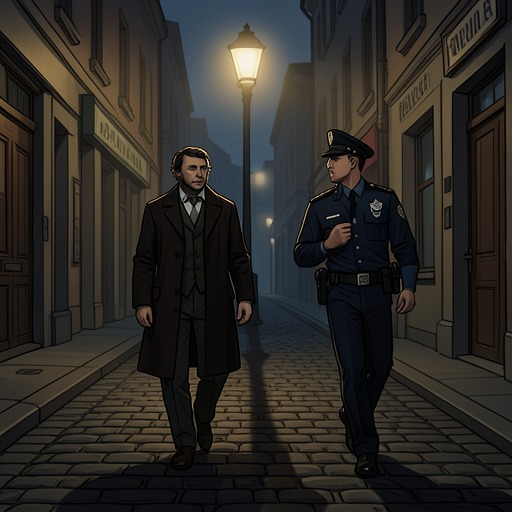
Thoreau reports that he has paid no poll tax for six years. The duration makes the act a continuing principle rather than a single dramatic gesture. He has been jailed once on this account, but the punishment does not end the refusal: it demonstrates the government’s power to penalize him while leaving the underlying moral conflict unsettled. The account gives the resistance a measured rhythm—years of nonpayment, one night in confinement, and a return to the same position.
He recalls the jail through its physical barriers: walls of solid stone two or three feet thick, a wooden-and-iron door a foot thick, and an iron grating that strained the light. The prison makes the state’s coercion tangible, but it does not give the state moral authority in his eyes. Thoreau says that he came out because someone intervened and paid the tax. The release therefore does not represent his own capitulation; the tax was settled by another person, while his account leaves the choice and its ethical meaning intact.
The episode is deliberately small in outward scale. Thoreau was held for one night, and when he came out he did not notice great changes on the common. That lack of visible transformation contrasts with the moral importance he assigns to the act. The refusal does not claim an immediate public victory; its significance is that an individual can decline to make injustice his own responsibility through payment and recognition.
Prison, conscience, and political consequence
For Thoreau, imprisonment is not only a penalty but a revealing consequence of the conflict between law and justice. He declares that under a government which imprisons people unjustly, the proper place for a just person is also a prison. The statement reverses the usual presumption that confinement marks the wrongdoer: in an unjust political order, the cell can expose the government’s injustice and mark the dissenter’s refusal to endorse it.
This stance is connected to his demand that abolitionists withdraw their support, both in person and property, from the government of Massachusetts. He treats withdrawal as an effective political act, not merely a declaration of opinion. In his account, a person more just than the neighbors already constitutes a majority of one: moral independence does not depend on waiting for a numerical majority to authorize resistance. The poll-tax refusal gives that independence a specific, repeatable form.
The tax itself is not the whole target. Thoreau says he has never declined to pay the highway tax because he wants to remain a good neighbor even while refusing to be a good subject. He also says that he does his part to educate his fellow citizens through support for schools. He refuses not because of a particular item in the tax bill, nor because he wants to trace each dollar’s destination, but because he wishes to refuse allegiance to the state and stand aloof from it effectively. These distinctions separate principled noncooperation from private evasion: he continues to acknowledge particular obligations to neighbors and education while rejecting a political allegiance he considers unjust.
The meaning and limits of the act
The refusal stages a conflict between the ordinary appearance of civic payment and its possible moral consequence. Thoreau warns that if injustice requires a person to become its agent, obedience is no longer innocent; the relevant choice is not between comfort and inconvenience but between participation and refusal. Yet his own account does not claim that every tax or every public obligation has the same meaning. His continued payment of the highway tax and his stated contribution to education give the argument its boundary: he distinguishes the specific refusal of allegiance from blanket indifference to communal life.
The episode also tests the difference between visible consequence and ethical consequence. A night in jail leaves the common apparently unchanged, and someone else’s payment secures Thoreau’s release. Neither fact cancels the refusal. Its political significance resides in the relation it makes explicit: government asks for recognition through its representative, while the dissenter answers by declining the form of support he believes ties him to injustice. The act remains limited in immediate effect, but it makes conscience legible as conduct rather than sentiment.