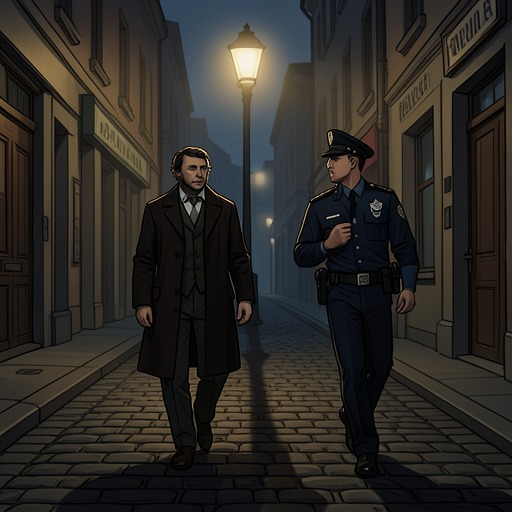
Thoreau’s imprisonment for refusing to pay taxes
WaldenThoreau’s imprisonment for refusing to pay taxes is the brief, consequential collision between his deliberate life in the woods and the authority of the State: arrested on a trip to Concord for a repaired shoe, he spends one night in jail and returns to Walden the next day. The episode makes his political dissent practical rather than abstract. He refuses to pay or recognize a government that buys and sells people, accepts the State’s power to imprison him, and presents refusal of complicity as a way to resist injustice without answering force with force.
Circumstances and Cause
Near the end of his first summer at Walden, Thoreau went to the village to get a shoe from the cobbler. The errand was ordinary; the arrest that interrupted it was not. He was seized and put in jail because he had not paid a tax and would not recognize the authority of the State. He identifies the State’s defining injustice as its buying and selling men, women, and children like cattle at the door of its senate-house. His objection therefore reaches beyond the tax as a personal financial burden: payment would mean recognizing and supporting a political power bound up with slavery.
The scene also sharpens the contrast between the life Thoreau had chosen and the claims made upon him by government. He had gone down to the woods for other purposes, yet the State’s representative could reach him in the village and put him behind bars. His arrest shows how even a brief trip for a practical necessity could become the point at which private conscience and public authority meet. The clash is personal in its immediate form, but the reason for it is institutional.
Arrest, Release, and Return
Thoreau did not describe himself as trying to overpower the society that arrested him. He says that he preferred to let society run amok against him, since it was the desperate party. That choice defines the character of the resistance: he accepts the coercion directed at him rather than turning his refusal into a physical attack. His imprisonment thus exposes the State’s force while preserving the distinction between conscientious noncooperation and violent retaliation.
The confinement lasted only one night. Released the next day, Thoreau obtained his mended shoe and returned to the woods in time to get his dinner of huckleberries on Fair Haven Hill. The sequence is strikingly matter-of-fact: arrest, release, the unfinished errand, and a return to the landscape of his chosen life. The repaired shoe and the berries place the political episode within ordinary material needs, without reducing its stakes to an inconvenience. Thoreau adds that no one had molested him except people representing the State, locating the pressure he experienced in official authority rather than in the surrounding community as a whole.
The Episode in His Political Argument
In the later argument on government, the imprisonment becomes an example of the personal consequences that can follow from refusing cooperation. Thoreau says that he meets the American government, or its representative, the State government, directly and face to face once a year, in the person of the tax-gatherer. The image makes government both remote and immediate: an expansive political institution is encountered in the concrete demand for payment. His night in jail gives that encounter a bodily consequence, turning an annual transaction into a test of what a person is willing to support.
Thoreau’s general rule is conditional. If an injustice is merely part of the necessary friction of the governmental machine, he says, it may wear smooth—or the machine itself may wear out. But when injustice requires a person to become its agent against another, his conclusion is direct: break the law. He calls for a life that acts as counter-friction to stop the machine. His imprisonment supplies a lived instance of that principle: rather than pay a tax to a government he condemns, he withholds cooperation and undergoes confinement.
The passage also distinguishes principled refusal from a concern with the penalty alone. Thoreau remarks that a person imprisoned by an unjust government belongs in prison as well, and that prison may be the place the State has provided for its freer inhabitants. This reverses the usual moral meaning of confinement: the cell does not prove the prisoner’s injustice, but may reveal the injustice of the authority that put him there. In this argument, accepting punishment does not erase the conflict; it makes the conflict visible.
Significance and Limits
The episode’s brevity is part of its force. Thoreau is not held for an extended campaign, nor does the arrest end his chosen life in the woods. He leaves jail, completes the shoe errand, and goes back to Walden. Yet the interruption supplies a concrete form for the larger political claim: a person need not wait for a majority or for a government to reform itself before refusing personal participation in injustice. Thoreau presents individual moral resistance as possible even when the resister is temporarily powerless before the State.
The incident is also set against his account of work, property, and unequal material conditions. He considers Concord’s farmers, many of whom have labored for twenty, thirty, or forty years, and asks how the poor fare when some have been raised above a supposedly savage condition while others have been degraded below it. This social comparison does not replace the specific ground of his arrest, which is the State’s support of slavery, but it gives the refusal a wider setting: his political and economic reflections repeatedly ask whose lives are burdened, whose labor sustains apparent comfort, and what moral cost is concealed by ordinary arrangements.
The result is neither a triumphant escape from authority nor a change in government recorded within the incident. Thoreau is released, but the injustice he condemns remains. The lasting consequence is argumentative: the one-night imprisonment becomes a test case for conscience over compliance, showing how a private refusal can expose the machinery of public power without pretending that a single act has already dismantled it.