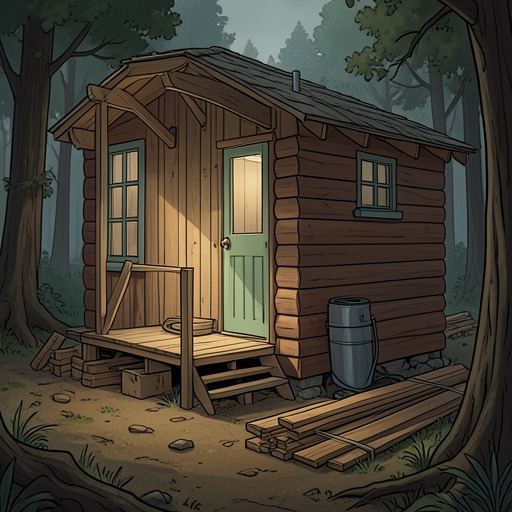
Build a cabin by the lake of Walden
WaldenThe construction of the Walden Pond cabin was the practical beginning of Henry David Thoreau’s experiment in living at Walden Pond. He built it by hand from locally gathered and reclaimed materials, enlisted acquaintances to raise its frame, and began living in it on July 4. Its precise dimensions and total material cost make the cabin a test of how much shelter a person could create without conventional expense; its place beside the pond also gave Thoreau a lasting vantage on a landscape later altered by woodcutting, railroad work, and commercial use.
From borrowed axe to framed house
Near the end of March 1845, Thoreau borrowed an axe, went into the woods beside Walden Pond near the intended building site, and began cutting tall, straight white pines. The undertaking started not with a completed plan or purchased building, but with a borrowed tool and trees cut close to where the house would stand. The choice of site joined construction to the landscape from the outset: the cabin was made in the woods by the water, not brought there as a finished dwelling.
By mid-April, working without haste and trying to make the most of the labor, Thoreau had framed the house and prepared it for raising. He had already bought a shanty belonging to James Collins. The account of the work therefore combines new timber with a pre-existing structure, rather than presenting the cabin as an entirely new collection of purchased materials. Thoreau’s pace matters as much as the progress: framing was a process he chose to inhabit, not simply a task to finish as quickly as possible.
The construction also took place in the company of others. In early May, acquaintances helped raise the frame. Thoreau emphasizes that their assistance was not necessary so much as a chance to make a neighborly occasion of the work. The house thus embodied a measure of self-reliance without being an account of solitary labor: its builder did much himself, but its frame rose through a shared effort. He began occupying it on July 4, once it was boarded and roofed; the boards were feather-edged and lapped, giving the enclosure a close-fitting exterior.
Materials, dimensions, and cost
The finished house was ten feet wide and fifteen feet long, with eight-foot posts, a garret, a closet, a large window on each side, two trapdoors, and a door at one end. Thoreau describes it as tight, shingled, and plastered. These particulars present the cabin as a working dwelling with enclosed space, storage, light, access, and an upper loft, rather than as a purely symbolic shelter. Its limited footprint makes the scale of the experiment concrete: the account gives the reader an actual small house to imagine, not an abstraction about simplicity.
Its materials also register a deliberate economy. Thoreau counted the listed materials and transportation at a total of $28.12, while excluding timber, stones, and sand that he claimed by squatters’ right. He carried a good part of the materials on his back. The total therefore does not represent the full value of every resource used: it distinguishes purchased and transported items from materials taken from the site. That accounting makes the cabin’s low cost legible while showing that its construction depended on access to land and its resources as well as on labor.
A dwelling set within a changing landscape
The cabin’s setting was not merely scenic background. Thoreau says that Walden’s scenery was beautiful but modest in scale, and that it mattered especially to someone who had frequented the pond or lived by its shore. From the cabin and its surroundings, repeated observation gave a familiar landscape its significance. The shore’s belt of smooth, rounded white stones, broken by a few short sand beaches and steep enough in places for a single leap to reach the water, belongs to the close physical world in which the dwelling was built.
That setting changed after Thoreau left. He recalls that woodchoppers further cleared the woods along the pond, so that the aisles through the trees and their occasional openings onto the water would no longer be available for rambling. The trunks on the bottom, an old log canoe, and the dark woods surrounding the water also disappeared. The contrast between the cabin’s construction and this later removal is sharp: the house was made in and for a wooded place, while subsequent human activity stripped away features that had shaped its character. The cabin’s meaning therefore extends beyond its building materials to include the landscape it once occupied and the losses Thoreau later records.
The cabin as vantage and threshold
Thoreau’s account situates the house near a road whose earlier human history persisted in local memory. Within the recollection of many townspeople, that road had resounded with the laughter and gossip of inhabitants. The cabin was therefore not placed in a landscape without people; the woods held traces of previous settlement and nearby social life even when Thoreau’s own dwelling enabled an unusually solitary routine. Its construction makes that tension visible: a personal retreat built in woods already shaped and remembered by human use.
The house also gave Thoreau a window onto changes beyond the immediate building site. In the winter of 1846–47, a hundred men arrived at the pond with farming implements and teams as part of the ice harvest; for sixteen days he watched them working from his window. The cabin had begun as shelter made with hand labor and modest expense, but it became an observer’s station from which commercial labor transformed the frozen pond into a scene of organized extraction. The building thus links the daily scale of one person’s shelter to the larger human uses of the surrounding land and water.
As a physical structure, the cabin was small, carefully enclosed, and assembled through a mixture of personal work, neighbors’ help, reclaimed building, and materials claimed from the site. As a narrative device, its construction marks the passage from intention to lived experiment: Thoreau’s plans acquire a date, a cost, a frame, and a roof. The place he made for himself also became the measure against which later change could be seen. Its significance rests in both acts—the making of a dwelling and the attention to what happened around it.