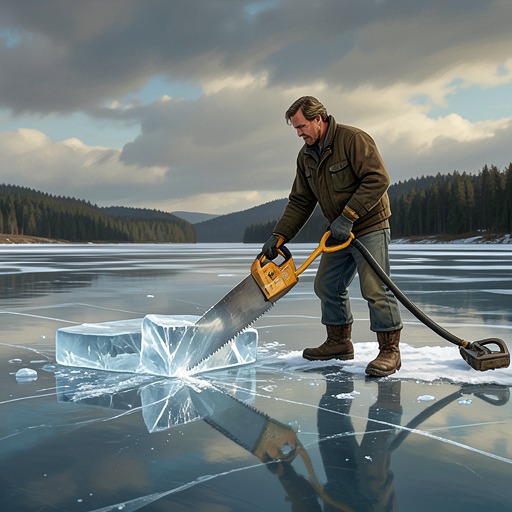
The 1846–47 ice harvest on Walden Pond
WaldenThe 1846–47 ice harvest on Walden Pond was a large commercial operation that stripped the frozen pond for a distant market, making the contrast between its quiet natural beauty and its use as a commodity visible on the ice itself. Henry David Thoreau watches a hundred workers and their teams transform the surface into a field of labor. The enterprise promises profit, but much of its enormous stack never reaches its intended destination; left behind, it survives through another summer and winter before melting back into the pond.
Background and Commercial Aim
In the winter of 1846–47, a hundred men of what Henry David Thoreau calls “Hyperborean extraction” descended on the pond one morning, bringing carloads of farming implements. Their equipment made the frozen surface resemble land prepared for cultivation: the ice was plowed, harrowed, rolled, and furrowed. The appearance of agriculture was not incidental. The workers and teams moved in an orderly fashion, like husbandmen, though the crop they were harvesting was the pond’s frozen surface.
The operation was backed by a gentleman farmer who, Thoreau was told, already possessed half a million dollars and wanted to double his money. The harvest thus joined a remarkable natural resource to an explicitly commercial ambition. In Thoreau’s account, the investor’s effort to add another layer to his fortune required taking the pond’s “only coat,” even its “skin itself,” in the middle of a hard winter. The clothing metaphor makes the extraction at once material and bodily: the enterprise does not merely collect ice but strips the landscape that bears it.
Workers and Methods
Thoreau first presents the operation through a comic resemblance to farming, then clarifies its labor force and organization. Literally, a hundred Irishmen came every day from Cambridge to cut the ice, under Yankee overseers. The distinction identifies both the daily workforce and the supervisory arrangement without obscuring the scale: this was not a solitary local use of frozen water but coordinated wage labor, drawing men to the pond day after day.
The cutting and removal leave marks like those of work on solid ground. Sleds travel repeatedly along the same routes, wearing deep ruts and “cradle-holes” into the ice; the horses eat their oats from ice cakes hollowed into buckets. In these details, the pond becomes a temporary worksite whose surface is measured by traffic, tools, and animal needs. The imagery of farming and the actual labor of extraction overlap, but what is being worked is not soil: it is the frozen body of the pond.
Scale and Storage
The yield was substantial: the workers said that on a good day they could remove a thousand tons, about the yield of an acre. The harvest accumulated in an open-air pile thirty-five feet high on one side and six or seven rods square. Hay placed between the outer layers was meant to keep air out and preserve the ice. The measurements give physical form to the operation’s ambition, converting a local winter surface into a monumental store of material.
The heap’s scale also makes its intended journey legible. It was prepared for shipment, yet the enterprise’s calculations acknowledged considerable loss: those involved estimated that not even twenty-five percent would reach its destination, with another two or three percent wasted in the cars. The disparity between the quantity cut and the fraction expected to arrive exposes the waste built into the commercial process even before the heap’s ultimate failure to reach market is known.
Failure and Return to the Pond
An even greater part of the stored ice followed a different course from the one intended. It may have contained more air than usual and therefore failed to keep well, or there may have been some other cause; Thoreau does not settle the explanation. The estimated ten-thousand-ton pile, made in the winter of 1846–47, was covered with hay and boards. It was unroofed the following July, and part of it was carried away, but the remainder stood exposed through that summer and the next winter.
The ice was not quite melted until September 1848. Thoreau concludes that the pond consequently recovered the greater part of what had been taken from it. This return is neither a claim that the commercial effort caused no disturbance nor a guarantee that every piece was restored: some ice was carried away, and the harvest had stripped the pond during a hard winter. Rather, the failed storage reverses the intended movement of the harvest. Ice meant to leave as merchandise remains on site and gradually becomes water again.
Observation and Environmental Significance
The episode belongs to Thoreau’s wider record of a landscape changing under human use. Elsewhere in his account, he remembers that woodchoppers further cleared the shores after his time there; the old trunks under the water, the log canoe, and the surrounding woods were gone. Against that altered memory, the ice harvest appears not as an isolated curiosity but as another instance in which commercial and practical uses remake the pond’s setting. The harvest’s conspicuous winter spectacle is especially striking because Walden’s scenery, Thoreau observes, is beautiful without being grand: its meaning grows through familiarity and attention to its particular shore and water.
His attention to the harvest also sits beside other kinds of close observation. Before the ice broke up early in 1846, he surveyed the pond’s bottom with compass, chain, and sounding line, seeking to recover its long-lost contours. Elsewhere he takes delight in the forms of thawing sand and clay flowing down a railroad cut, and finds in the fresh designs of thawing earth an image of the world’s creative force. These observations do not turn the ice harvest into a neutral natural-history report: the working crews, profit motive, scale, and failed shipment make it a human intervention. But they place it within a sustained attention to how water, earth, seasons, and human practices shape one another.
The harvest’s final irony is carried by its material outcome. A private effort to multiply wealth removes the pond’s winter covering, stacks the ice into a structure meant for transport, and then fails to deliver most of that stored mass to market. The heap lasts longer than its owners intended, while the pond slowly reclaims much of it. What begins as extraction ends, in large measure, as a return governed not by the investor’s plan but by the seasons and the melting ice.