Planting bean fields by the lake of Walden
WaldenThoreau’s cultivation of a bean-field at Walden turned subsistence farming into a test of economic independence: by recording the acreage, labor, costs, and harvest, he asked how much land a person actually needed when food and use—not luxury or accumulation—set the measure. The work began as a way to meet unusual expenses, but its small scale and reported yield became evidence for a broader claim that modest cultivation could free people from needless labor and consumption.
Purpose and Scale
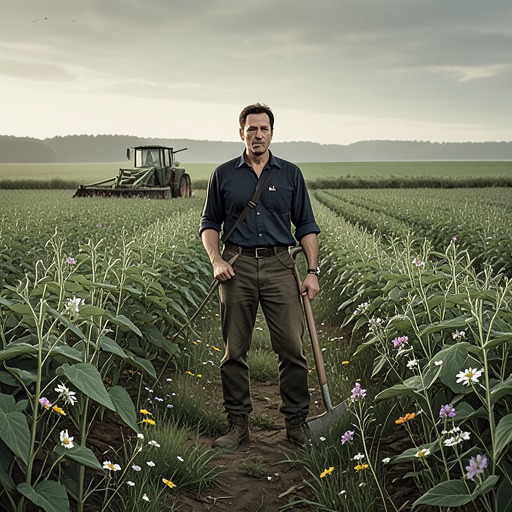
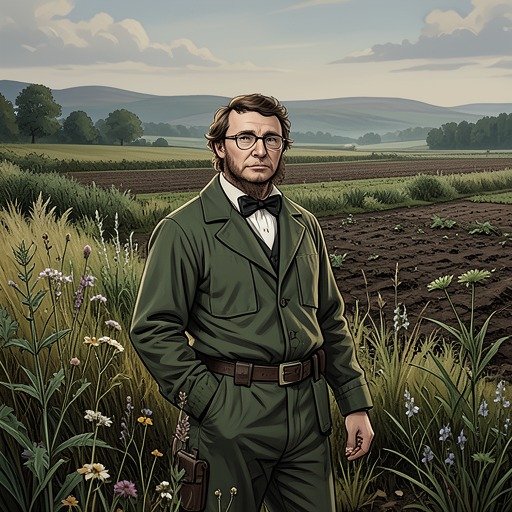
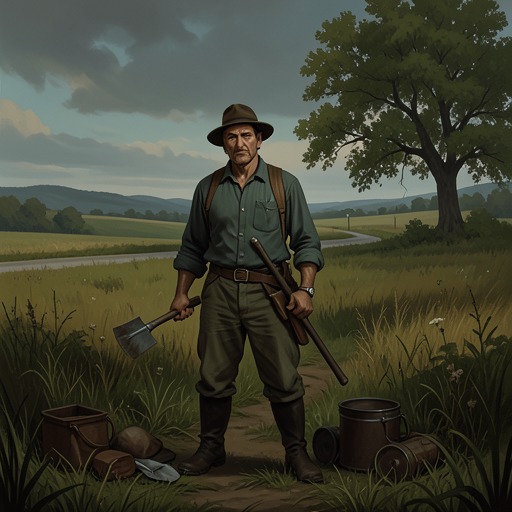
Before his house was finished, Thoreau wanted to earn ten or twelve dollars by an honest and agreeable method to meet the expenses he had incurred. He planted about two and a half acres of light and sandy land. The plot was thus both practical provision and experiment: he did not describe a farm organized for commercial expansion, but a limited piece of ground whose results could be weighed against the effort it demanded.
His treatment of the land remained deliberately spare. He put no manure on it because he was a squatter, not its owner, and did not expect to cultivate so much ground again. He did not hoe all of it even once. In plowing, he pulled out several cords of stumps, which supplied fuel for a long time; the work also left small circles of virgin mould visible in the field. These details show the cultivation producing more than crops: clearing supplied household fuel, while the unworked patches registered the limits of the labor he chose to invest.
Costs, Harvest, and the Second Year
Thoreau counted the combined expense of implements, seed, and work at $14.72, while noting that the seed corn had been given to him. The harvest included twelve bushels of beans and eighteen bushels of potatoes, as well as peas and sweet corn. The yellow corn and turnips came too late to produce anything. His accounting therefore includes failure and timing as well as yield; the field is presented not as an idealized abundance but as a trial whose outcomes could be measured crop by crop.
He nevertheless judged that, despite the experiment’s short duration—and partly because it was transient—he had done better than any farmer in Concord that year. The following year he improved on the first: he spaded all the land he needed, about a third of an acre. The shift from roughly two and a half acres to a third of an acre gives the experiment its clearest practical result. Experience did not persuade him to enlarge the operation; it helped him identify how little ground was required.
A Proposal for Economical Cultivation
From the two years’ experience, Thoreau drew a general proposition about farming. If a person raised no more than he ate, and did not exchange the crop for an insufficient quantity of more luxurious and expensive goods, only a few rods of ground would need cultivation. A spade could do that work more cheaply than oxen and a plow, while choosing a fresh plot from time to time could be preferable to manuring old ground. The proposal makes the method inseparable from the desired way of life: a small plot is sufficient only if production is limited to genuine need and its produce is not converted into greater expense.
This argument sharpens the bean-field’s contrast between labor and consumption. Thoreau’s neighbors, the farmers of Concord, had often spent twenty, thirty, or forty years toiling, although he considered them at least as well off as other classes. He also asks how the poor minority fare, and points to degraded poor people living in shanties beside the railroads. The bean-field does not erase these unequal circumstances or establish that every household could reproduce his experiment. Instead, its arithmetic offers a challenge to the assumption that more land, equipment, or accumulated goods necessarily bring a better life.
Land, Property, and Remembered Neighbors
The field’s position among other lives in the woods complicates any simple picture of solitary self-sufficiency. The same area holds the memory of John Field, an Irishman who lived with his wife and several children in a cabin. Across the road east of the bean-field had lived Cato Ingraham, an enslaved man belonging to Duncan Ingraham, who built him a house and permitted him to live there. Farther down, on Brister Hill, Brister Freeman had lived; the apple trees he planted still grew there. These recollections place cultivation and shelter within a landscape shaped by very different relations to property, work, and freedom. Thoreau’s own description of himself as a squatter underscores that his experiment took place on land he did not own, but the neighbors’ histories also mark limits to treating his independence as a universal condition.
The wider setting is changing even as it is remembered. Thoreau says woodchoppers had further laid waste the woods after his departure, removing the dark surrounding trees, trunks on the pond bottom, and an old log canoe. The loss meant that the former woodland aisles and views of water would no longer be available for rambling, and he connects the destruction of groves with the silence of birds. Against that clearance, the bean-field’s small-scale cultivation offers one kind of human use of land, while the later cutting and disappearance of familiar features show how use can also erase the conditions that made a place meaningful.
Significance
The bean-field is a practical demonstration rather than a claim that farming is intrinsically virtuous. Its costs, uneven harvest, unused ground, and second-year reduction in acreage give its argument material form. The experiment’s lesson is not simply that Thoreau grew food, but that careful attention to what a household actually consumes can alter the scale of the work thought necessary to sustain it.
At the same time, the field belongs to a book attentive to social rank and environmental change. Farmers labor for decades; poor households inhabit railroad-side shanties; formerly enslaved and working-class residents leave traces in houses, apple trees, and remembered roads; and woodcutting transforms the woods and pond. Read amid these contrasts, the bean-field is both a model of self-limitation and a situated experiment, dependent on land, labor, and a particular freedom of choice. Its modest arithmetic presses a large question: whether a life can be made more independent not by producing more, but by discovering how much less is needed.