Dee Dee Bronson
WomenDee Dee Bronson is an entertainment-industry executive and a figure from Henry Chinaski’s earlier underground-publishing circle. When she re-enters his life after Lydia Vance leaves, she offers him a home, companionship, and a crowded itinerary of outings. Their relationship briefly seems to provide a way forward, but Chinaski remains attached to Lydia; that unresolved bond drives Dee Dee’s distress and gives her arc its central significance. Her care for Chinaski and her own emotional vulnerability meet in a relationship that cannot displace the past.
Identity and Background
Dee Dee first appears in a black Mercedes, where she recognizes Chinaski as Hank. She tells him she has quit Capitol Records and now runs another music company, described as a famous firm with its home office in London. Their acquaintance predates this encounter: she used to visit Chinaski with her boyfriend, when both men had columns in a Los Angeles underground newspaper.
When Chinaski calls after Lydia’s departure, Dee Dee is living in the Hollywood Hills with Bianca, another woman executive. Bianca occupies the top floor and Dee Dee the bottom. At about forty, Dee Dee is presented as experienced in the cultural worlds of publishing, poetry, cartooning, and political activism. She knows prominent names across those circles, smokes marijuana continually, and carries herself as though she remains in the period when she had been mildly famous. The narration contrasts that remembered status and former beauty with the damage she associates with a long series of failed love affairs, while also describing her as small and buxom.
Reconnection and Courtship
Chinaski turns to Dee Dee after Lydia leaves him an angry message and returns the air conditioner. He calls, and she receives him at her home at 8:30 in the evening. Their renewed intimacy begins in the immediate aftermath of his breakup, a circumstance that makes Dee Dee’s offer of companionship both practical and emotional. The next morning she drives him in her black Mercedes to breakfast on the Sunset Strip. Although they move through an affluent public setting, Chinaski’s thoughts return to periods when he had been homeless and cold in Atlanta and El Paso; even in Dee Dee’s company, he remains preoccupied with Lydia and the painful remnants of their relationship.
Dee Dee makes the depth of her feelings explicit. She tells Chinaski that she believes she has been in love with him for years, including during earlier visits with boyfriends named Bernie and Jack. She recalls wanting him then, while he was absorbed in beer or other concerns and did not notice her. The disclosure recasts their reunion: for Chinaski, it follows Lydia’s departure, but for Dee Dee it answers a much longer-held desire.
Their outings expose the differences between Dee Dee’s social world and Chinaski’s sense of himself. At a fashionable restaurant, he notices the polished young patrons and the carefully dressed staff. Later, at a bar frequented by scriptwriters and small-theater people, he resents the writers’ air of superiority and judges their company corrosive. He contrasts their reported earnings of a thousand dollars a week with his own sixty-five dollars, imagining that one day he will be recognized in fancy restaurants and given a special table. Dee Dee has brought him into a world of professional and cultural status, but he experiences it through irritation, financial comparison, and a fantasy of future recognition.
A Relationship Under Strain
Dee Dee’s care takes the form of sustained activity. She takes Chinaski on long drives along the coast and into the mountains, and brings him to garage sales, movies, rock concerts, churches, friends’ homes, meals, magic shows, picnics, and circuses. Her friends photograph them together, giving the relationship a visible, shared social life. On their trip to Catalina, she tends to him when he is hungover, bringing him an Alka-Seltzer and water. The account shows her attending to him even when his attention wanders elsewhere.
That other attachment becomes impossible to ignore. After a telephone call with Lydia ends in a scream, Dee Dee keeps Chinaski away from his own home. On one visit there to go through the mail, he notices that the telephone has been taken off the hook and tells Dee Dee never to do that again. The episode reveals a struggle over access and contact: Dee Dee attempts to limit the route back to Lydia, while Chinaski objects to being cut off from his own affairs. The relationship’s care and companionship coexist with pressure around the woman he has not left behind.
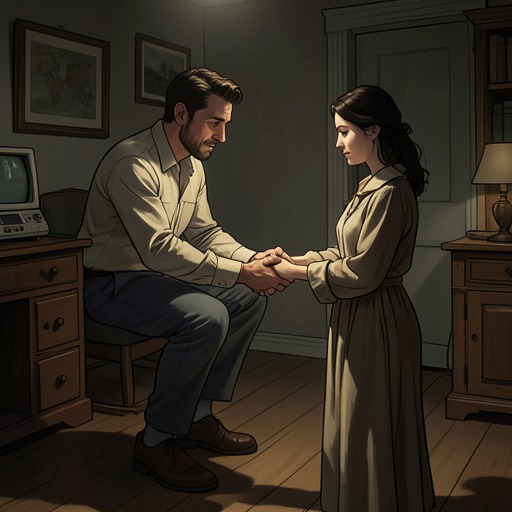
Dee Dee’s dependence on Chinaski becomes starkly visible when she takes a bottle of sleeping pills after learning that he is going back to Lydia. He finds her apparently unconscious, her arm limp, and the bottle empty; she manages to tell him that she does not care that he is returning to Lydia. The scene makes the cost of their divided relationship concrete without resolving its underlying conflict. Dee Dee survives long enough to ask to be taken home. Chinaski promises to stay with her that night, but when she asks whether he will eventually leave, he does not offer a lasting promise. The episode exposes the limits of his reassurance: he can respond to the immediate crisis, but his bond with Lydia remains.
Care, Class, and Narrative Significance
Dee Dee’s material circumstances and professional standing distinguish her from Chinaski’s insecure, low-paid life. She has a home in the Hollywood Hills, executive work, and the means to drive him around in a Mercedes; he measures himself against writers earning far more than he does and imagines eventual recognition. Yet access to money, fashionable places, and an active social calendar does not give her control over Chinaski’s loyalties. Her resources can shelter him and fill his days, but they cannot make him emotionally available on the same terms.
The novel frames Dee Dee’s relationship with Chinaski through a sharp contrast between sustained care and persistent displacement. She declares a love that has lasted for years, tends to him when he is unwell, and builds a shared routine around excursions and social gatherings. Chinaski accepts that care while continuing to think about Lydia and, after the crisis, to describe himself as unable to explain Lydia’s hold on him. A moment of rueful reflection invokes Valentino as someone who might have kept both women, turning the impossible wish to retain both relationships into a bleak joke rather than a solution.
Dee Dee therefore occupies more than the role of a temporary partner after a breakup. Her return brings Chinaski’s unresolved attachment into view and turns the consequences of his divided loyalties into an immediate personal crisis. She can offer companionship, shelter, and attention, but the narrative does not grant her a secure ending with him. The relationship’s central contradiction remains intact: Dee Dee’s long-standing desire and practical care meet Chinaski’s continued pull toward Lydia, and neither affection nor crisis settles the contest.