Henry Chinaski
WomenHenry Chinaski is a writer, poet, and heavy drinker whose life is narrated through a succession of work, readings, romances, and personal crises. His literary identity grows out of an uneasy bargain: alcohol accompanies the routines by which he writes and performs, while its costs damage his health and relationships; meanwhile, his candid account of his own behavior unsettles the swagger on which his public persona depends.
Identity and Background
At fifty, Chinaski describes himself as having gone four years without sex or a woman friend. He looks at women without expecting a relationship to follow, and even the thought of a nonsexual connection seems beyond his imagination. His past includes a daughter, born outside marriage, who lives with her mother, and an earlier marriage that lasted two and a half years. The woman he says he loved only once died of acute alcoholism when he was thirty-eight; his former wife continued to send him a long letter every Christmas for six years after their divorce, but he never answered. These details establish a history marked by loss and separation before the later relationships begin.
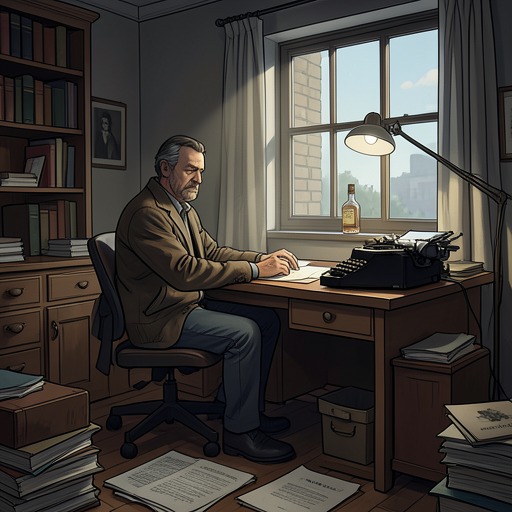
Chinaski’s professional life changes sharply when he leaves a twelve-year job as a postal clerk and tries to become a writer. Terrified by the transition, he drinks a pint of whiskey and two six-packs of beer each night while working on his first novel, smoking inexpensive cigars and typing to classical music until dawn. He sets a target of ten pages but only discovers his output the next morning, after vomiting and checking the pages on the couch. Some nights yield as many as twenty-five pages; he later has to revise or discard the work. The novel takes twenty-one nights to draft. The scene makes literary production both an act of sustained discipline and an extension of a routine that exacts a physical price.
From Postal Work to Literary Work
Alongside writing, Chinaski participates in small-press publishing. He edits The Laxative Approach with two co-editors, and the group regards its work as a venue for the best poets of its time, while also printing some less accomplished contributions. When the printed sheets are ready, the editors must collate and staple them into covers; the proposed solution is a party where guests drink and do the labor. The episode places his literary activity in a modest, practical setting: publishing depends not only on poems and claims of artistic importance, but also on assembling the pages by hand.
His public identity takes shape at a poetry reading at The Drawbridge bookstore. He arrives frightened but also, in his own account, conscious of his superiority; a packed room applauds as he enters. After reading for thirty minutes, he takes a break and sits at a table with a drink. Lydia Vance approaches, and he recalls her vivid presence and their immediate, complicated attraction. His attempt to flirt through a boast about tearing the fringe from her jacket fails, a revealing early instance of the gap between his confidence and his ability to connect.
Readings later become both work and performance. Chinaski dislikes them, but they help pay the rent and may sell books. At one engagement he travels to Houston with a heavily bandaged leg and is taking antibiotics; his doctor has warned that drinking would cancel their benefit. He reads sober at a modern art museum, where someone asks why he is not drunk. He answers by pretending that Chinaski himself could not attend and that his brother has taken his place. The joke turns the established drinking persona into a mask he can theatrically remove, even as the medical circumstances make the conflict between alcohol and bodily care concrete.
Alcohol, Work, and Self-Recognition
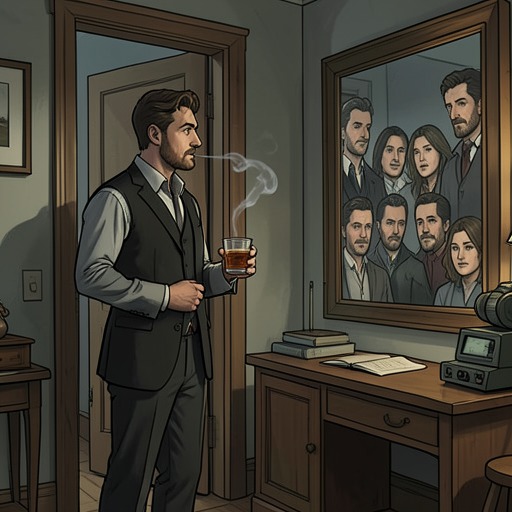
Alcohol functions for Chinaski as a near-universal response rather than a remedy reserved for one kind of pain. He reflects that he drinks after something bad in order to forget, after something good to celebrate, and when nothing happens in an effort to make something happen. That formulation links his private habits to his work: the drinking accompanies composition, fills time, and supplies a recurring explanation for action, but it also persists when its consequences are plainly damaging.
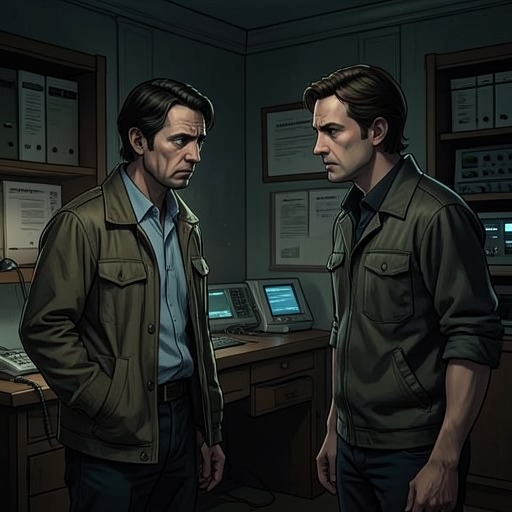
The strain becomes especially visible in his relationship with Lydia. Their conflicts recur around opposite expectations: she is angered by his drinking, while he describes her as a flirt whose closeness with his male friends makes him jealous. Their sex lives are also affected by alcohol; Lydia complains that he is too drunk at night or too sick in the morning. They separate as often as once a week, announce that the split is permanent, and then reconcile. A sculpted likeness of Chinaski becomes a physical token of this cycle: after a breakup he carries it to Lydia’s home and leaves it outside, calls to tell her where it is, and later the head goes back and forth between them.
One particularly volatile rupture shows drinking turning a relationship quarrel into a crisis. After a phone argument, Chinaski writes Lydia a four-page letter, cuts his finger, signs the letter in blood, and mails it. Later, when Lydia enters and tries to leave with a bottle of liquor, they struggle; she leaves after the bottle breaks. Alone, he seeks out the small amounts left in other bottles, then waits until the liquor store opens at six and buys another pint. He phones Lydia again to tell her he has bought it. The sequence does not present a clean separation or a moment of control: even after the confrontation and the broken bottle, his next actions return to obtaining alcohol and resuming contact.
Relationships and the Uses of Persona
Chinaski’s encounters with women often begin amid a tension between desire and detachment. At fifty, he describes a period in which he had ruled out even ordinary friendship with women; elsewhere, he meets Mindy at a gathering and answers her introduction with a teasing exchange. With Tammie and another woman, Arlene, he invokes their ages as a way of joking about his own age: their ages, added together, equal his. The line makes age part of his social performance, but the contrast with his earlier account of isolation remains. His relationships are not evidence of settled intimacy; they occur within a life repeatedly disrupted by drinking, travel, work, and self-protective humor.
His meeting with Joanna Dover likewise begins with a practical arrangement made over the telephone. He calls her in Galveston while drunk, says he wants to visit the following day, books a flight departing Los Angeles International Airport at 12:15 p.m., and confirms that she will meet him. Elsewhere, after returning to Los Angeles from a visit with Debra, he remembers Sara, whom he met at a reading, finds her number in his wallet, and calls her. These separate acts of reaching out show how quickly his attention can shift from one relationship to another, often through a phone call, a remembered number, or a planned journey rather than a declared commitment.
Chinaski’s public image is also a deliberate literary resource. At a reading with Tammie, he walks out beside her to applause and describes the old Chinaski act as working; he then reads a mixture of old and new poems, with beers waiting in an ice bucket. The performance makes the persona part of the event’s appeal, while the poems and the audience’s response sustain his working life. His humor works similarly at the sober Houston reading: rather than simply explain his condition, he invents a brother who has taken his place. In both scenes, he manages how an audience sees him, though the performance never fully separates him from the habits it disguises.
Conflict, Conscience, and Narrative Role
The most direct challenge to Chinaski’s self-image comes in his reflection on his conduct toward Debra and others. He questions whether he has been treating intimate relationships as research, and concludes that he has been acting for selfish pleasure without considering the lives involved. He describes himself as exploiting trust and taking liberties while presenting himself as a good man. The reflection turns the writer’s habit of making experience into material against him: the claim to be observing human relationships cannot excuse what he has done within them.
That self-accusation gives his narrative voice an important double quality. Chinaski can cast himself as a swaggering performer, make a joke at a reading, or describe his writing routine with comic bluntness; he can also register the damage and hypocrisy beneath that performance. His account does not resolve the tension by showing a stable reform. Instead, it repeatedly places literary work, drinking, and intimacy side by side, allowing the same habits to appear as material for writing and as sources of harm. The result is a protagonist whose candor is substantial but not absolving: he recognizes the gap between the man he advertises and the one his actions reveal, even when that recognition does not end the cycle.