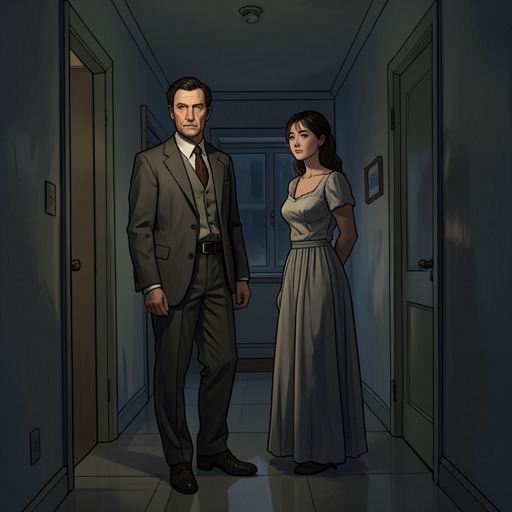
Katherine(Laura Stanley)
WomenKatherine(Laura Stanley) is a young Texan whom Henry Chinaski meets after a poetry reading in Houston and later invites to Los Angeles. Her brief relationship with him gives the possibility of marriage and ordinary domestic life a vivid place in his imagination, but her visit also exposes the gulf between her habits and values and his preference for drinking, isolation, and what he calls nothingness. The relationship ends with her departure, leaving his hopes of domestic change as a possibility he has felt rather than achieved.
Identity and Background
Katherine is introduced at a dinner following a reading. Chinaski describes her as about twenty-two, exceptionally beautiful, and reminiscent of the actress Katherine Hepburn. She is there with a girlfriend, and his jokingly calling her by Hepburn’s name appears to please her. At the end of the evening, Chinaski assumes nothing will come of their meeting; instead, she later arrives at the home of Nana, where he is staying. When she gives him her name, Laura, he tells her he will call her Katherine, turning his first impression into the name by which he continues to think of her.
Katherine tells Chinaski that she has slept with only two men before him: her former husband, Arnold, and the track athlete she married before Arnold. Her account of her marriage to Arnold is shaped by his escalating cocaine use and the crises that followed. She describes his transformation after he began using cocaine, repeated ambulance trips to hospitals, and his return to work the next morning as if nothing had happened. Arnold’s business dealings in the arts were deeply in debt but, by her account, still flourishing. Katherine continued to see him after their divorce: she brought coffee to the office each morning, remained on the payroll, and kept her house. They sometimes ate dinner together, but without sex; she still felt protective of him and believed he needed her.
Katherine also explains that Joanna Dover entered Arnold’s life as a business partner and became a regular presence. Katherine went along when Arnold and Joanna went out, forming what she describes as a trio. She was not especially concerned about a sexual rivalry because Arnold had a low sex drive; her worry was about the business. Joanna later disappeared from the picture, while Arnold’s cocaine use intensified. These details place Katherine in a history of caretaking and instability that contrasts with the uncomplicated future Chinaski briefly imagines for her.
Meeting and Reunion
Katherine’s first arrival into Chinaski’s private life is unexpected. Although she does not drink and says she dislikes alcohol, she comes to Nana’s bedroom after the Houston gathering. Chinaski says her presence frightens him because he cannot understand why she is there or what she wants. He nevertheless accepts the intimacy, treating the encounter as improbable luck and wondering what right he has to it. The difference between her refusal of alcohol and his reliance on it is present from the outset, even before it becomes central to his account of their time together.
After returning from Texas, Chinaski phones Katherine at her home in Austin. He says he is a recluse, despite her observation that he writes about women in his poems, and invites her to visit Los Angeles at his expense. He offers a loose itinerary—horse racing, Malibu, and whatever else she wants—rather than a defined plan. The call renews the connection, but it also shows how he presents himself: he claims social withdrawal while seeking a woman’s company and arranging a visit around the activities he knows.
When Katherine arrives in Los Angeles, the narration places her appearance beside Chinaski’s self-assessment. He sees her as poised and youthful, in a blue dress and a broad-brimmed white hat, and describes himself as overweight, unkempt, and confused. The contrast is not only about appearance. He regards her as natural and composed, while his own image is that of a man who does not seem to belong beside her. Their reunion therefore begins under the pressure of his awareness of their difference, even as he welcomes her and proposes going to a bar.
Domestic Possibility and Conflict
During Katherine’s visit, Chinaski briefly imagines a future more conventional than the life he usually claims to want. After they have spent the night together, he thinks of marriage, a house, a dog and a cat, and shopping at supermarkets. The domestic images are specific and ordinary, a striking contrast with the unstable relationships and drinking that structure his life. He also recognizes that the beginning of a relationship is the easiest stage and expects that flaws will emerge over time. His hope is therefore accompanied by his distrust of its durability.
The next morning, while Katherine sits brushing her long hair, Chinaski asks her to marry him. She tells him not to, saying she does not like it. Her answer punctures the proposal before it can become a promise. His sudden willingness to imagine marriage is a real change in his expressed desire, but Katherine does not reciprocate it, and the scene offers no indication that the two have reached a shared decision about their future.
Katherine’s visit also makes Chinaski’s habits and outlook harder for him to treat as harmless. On one evening she drinks half a bottle of red wine and is sad and quiet. He believes she sees him as connected to the racetrack and boxing crowd, and he accepts that she has perceived something troubling in him. He describes himself as drawn to drinking and laziness, without religion or ideals, and settled into a kind of non-being. He wants a soft, hazy space in which to be left alone, yet when drunk he can become loud and uncontrolled. He acknowledges the mismatch between his wish for quiet withdrawal and his behavior while intoxicated, but says he does not care. Katherine’s presence makes the contradiction legible without resolving it.
Departure and Narrative Significance
Katherine remains in Los Angeles for four or five more days. As the timing makes sex risky, she obtains contraceptive foam; Chinaski says he cannot stand condoms. Their remaining time thus includes a practical negotiation shaped by the brief duration of her visit, rather than a new commitment between them. The couple eventually say goodbye in bed, and Chinaski drives her to the airport in his blue Volkswagen, which has been recovered from impoundment and repaired after its battery was found dead. The restored car provides their ride to the airport, where they sit with little to say before her flight is called and they kiss.
Chinaski describes the day as unhappy. The departure gives the relationship a definite limit: Katherine leaves after a handful of days, and the account supplies no lasting domestic arrangement or marriage. What remains is the contrast between the life he momentarily pictured and the conduct he recognizes in himself. Katherine’s refusal of his proposal and departure do not erase the possibility he had imagined, but they show that desire alone cannot turn his solitary, self-destructive habits into a shared life.
The episode also clarifies the gap between Chinaski’s self-presentation and his actual need for connection. He calls himself a recluse, writes about women, invites Katherine across the country, and then imagines marriage when she is beside him. His longing is sincere within the moment, but it exists alongside drinking, withdrawal, and an admitted preference for being left alone. Katherine matters in the narrative not because the visit establishes a lasting partnership, but because her presence makes that conflict visible and gives it a concrete, ordinary form: a proposal, a refusal, a repaired car, and a ride to the airport.