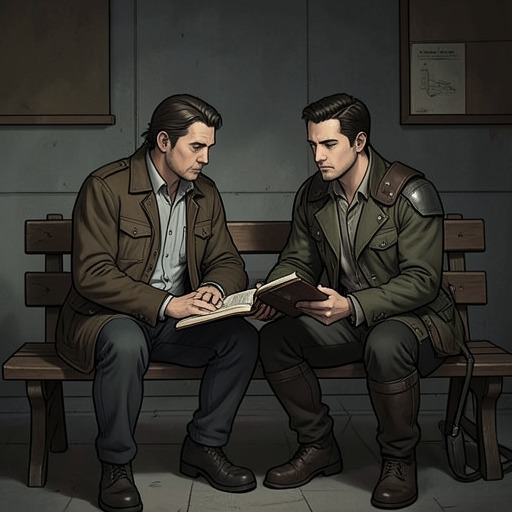
Carag and Brandon’s trusted roommate partnership
WoodwalkersCarag and Brandon’s trusted roommate partnership gives Carag practical help, companionship, and a dependable ally at Clearwater High. Its strength shows not only in Brandon’s willingness to defend Carag, but also in Carag’s ability to stop him when protective force turns reckless. As Carag prepares to leave alone, Brandon offers to go with him; Carag’s spontaneous embrace makes plain how much that loyalty has come to mean.
Everyday Life at Clearwater High
Their closeness is grounded in the ordinary routines of school and shared life as roommates. After a demanding lesson in human fighting techniques, Brandon greets the end of class by eating two kernels of corn at a time and looking ahead to mathematics and physics. Carag, by contrast, struggles with calculations, while he does better in history and geography. He asks whether he can copy Brandon’s homework, and Brandon readily agrees. The exchange is light, but it establishes a recurring pattern: Brandon’s competence can make Carag’s difficult schoolwork easier, and Brandon responds to a request for help with generosity rather than judgment.
That ease also leaves room for more serious talk. When Carag returns to Clearwater High after an encounter involving Andrew Milling and a folding knife, he tells Holly, Brandon, and Dorian what happened. Brandon breaks a corn kernel with his usual thoughtful expression and asks whether Carag thinks Andrew Milling is plotting something. Carag answers evasively, explaining that he does not want to draw his friends into trouble and that he knows little himself. He does, however, share what he has heard about wolves seeking revenge on him. The scene presents trust with a boundary: Carag brings his friends close enough to share the danger, but still tries to spare them from becoming involved in matters he cannot yet explain.
Strength, Protection, and Restraint
Brandon’s physical power gives the partnership a protective edge, but it can also create danger. During the Chrysler incident, Brandon charges the car in bison form. Carag calls out in alarm, warning that Brandon will get into serious trouble. Brandon reaches the vehicle, drives his horns into its radiator grille, and lifts its front end until its wheels spin uselessly. What begins as forceful action has become a threat to the car’s occupants and to Brandon himself.
Carag’s intervention works because Brandon recognizes him. When Carag calls his name, Brandon stops, confused, as if waking from sleep. Carag climbs onto the hood and tells him firmly that he has proved how strong he is and that they need to leave. Brandon agrees, though with some disappointment. Their roles briefly reverse: the physically stronger partner is the one who must be restrained, while Carag takes responsibility for setting a limit. Brandon’s willingness to stop at Carag’s urging makes their trust consequential rather than merely affectionate; Carag’s voice can interrupt the momentum of Brandon’s anger.
Concern Amid Wider Threats
The partnership is set against dangers that make Brandon’s offers of protection more than a casual gesture. Carag has already heard that wolves want revenge on him, and he shares that report with his friends alongside his suspicions about Andrew Milling. Later, as hunting dogs bark in the distance, Carag realizes that he may be far from the school’s safe territory and possibly beyond Grand Teton National Park. He recalls that cougar hunting season runs from October through March and that a permit to kill one of them is easy to obtain. These circumstances make the prospect of facing the wilderness alone genuinely perilous, even though the evidence does not show Brandon accompanying Carag on that journey.
After the exams have lasted into darkness, Carag decides to go out alone. Brandon looks from the window into the dark and offers for himself and Holly to come along, especially after Carag’s bad luck in the exam. Carag says he needs to be by himself, and Brandon pouts. He nevertheless presses the point that he could protect Carag because he is strong. The offer joins Brandon’s most visible quality—his power—to his role as a friend: strength matters because he wants to place it at Carag’s disposal.
The Parting and What It Reveals
Carag acknowledges that Brandon can protect him, then smiles and embraces him impulsively, thanking him for always being on his side. Brandon says that the gratitude sounds almost like a goodbye. The moment holds both affection and unease: Carag is determined to leave without company, while Brandon hears the possibility of a lasting separation in the way Carag speaks. Carag asks him to pass on a greeting to the others and walks alone into the star-speckled darkness of the Rocky Mountains.
The departure does not erase the partnership; it clarifies what Carag carries with him. Brandon has helped him with schoolwork, listened as Carag disclosed danger selectively, and offered physical protection when Carag was about to enter a risky situation alone. Carag, in turn, has trusted Brandon enough to intervene when his strength threatens to go too far. Their bond is thus expressed through practical care as much as through the final embrace: a willingness to help, a willingness to be stopped, and the painful recognition that loyalty does not always mean accompanying someone when they choose to go alone.