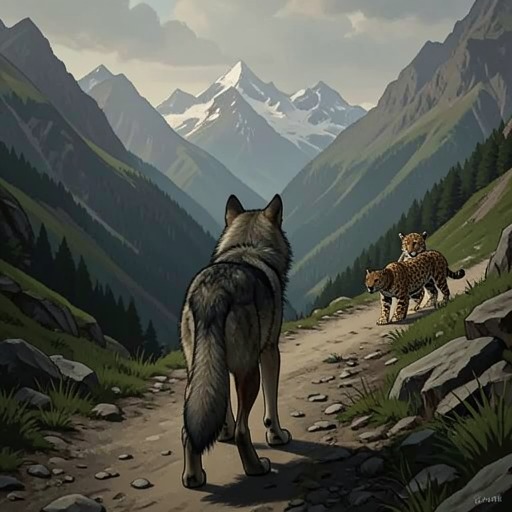
Carag and Xamber’s father-son relationship
WoodwalkersCarag and Xamber’s father-son relationship is tested when Carag’s attraction to human life collides with Xamber’s conviction that humans are dangerous. Xamber tries to keep his son within the puma family’s world; Carag leaves anyway, but carries his father’s example with him. Their separation is painful and unresolved, even as Carag later draws strength from remembering Xamber’s courage.
Identity and a Divided World
Xamber is Carag’s father and, like him, a puma. Their closeness is expressed through a shared mental voice as well as physical gestures, but their different judgments of humans place a deep division inside that family bond. For Xamber, human beings are cunning and dangerous, and distance from them is a matter of safety. Carag’s experience has made the human world alluring instead: after a visit to the city, he misses its many things to discover and wonders whether shapeshifters could live partly as humans and partly as pumas.
That question exposes the difference between what each father and son needs from belonging. Carag imagines a life that can hold both forms; Xamber answers that Carag must choose a side and cannot be both. The statement is not simply a warning about practical difficulties. It gives voice to Xamber’s firm division between the puma family’s life and human society, while naming the choice Carag feels compelled to make. Their conflict is therefore about more than where Carag will live: it concerns whether his identity can include both worlds.
Protection and Opposition
After the family’s experience in the city, Carag tries to reassure Xamber that the humans did them no harm and had been kind, at least until Mia began hunting in a refrigerated display case. Xamber rejects that reassurance. His anger and insistence that humans are dangerous show how little one positive encounter changes his view. The episode also makes clear that Carag and Xamber are interpreting the same contact differently: Carag remembers kindness and possibility, while his father sees a threat that calls for caution.
When Carag later announces his intention to leave, Xamber first tries to stop him outright. He says Carag belongs at home and redirects him toward hunting, offering to teach him how to take apart a wapiti. The offer has an affectionate, practical dimension: Xamber is proposing a skill rooted in their shared puma life. But it is also an attempt to turn Carag back toward the future Xamber recognizes, rather than accept the one his son has planned. Carag has spent weeks preparing, and his decision is not a sudden impulse that his father can displace with a lesson.
Xamber eventually tells Carag to go if that is what he wants, but attaches a sharp condition: the family wants nothing to do with humans. Carag is shocked by the apparent rejection and insists that living as a human would not make him human in truth. He understands himself as remaining the same person in a different appearance, whereas Xamber treats the choice of form and society as a line that cannot be crossed without consequence. The exchange makes their opposing positions explicit, without resolving them.
Departure and Separation
Carag is eleven when he makes his decision. His mother worries that he is too young to leave and warns that, if he chooses his second form, the family will no longer be able to stay near him; they may not see one another for a long time. She also reminds him that predators are not tolerated where humans live. These concerns sharpen the stakes of Xamber’s opposition: the disagreement is not only an argument between a strict father and an adventurous son, but a break from the family’s ability to protect and remain physically close to Carag.
Carag says that he will visit whenever he can. At the moment of departure, he embraces Mia, Xamber, and his mother. Xamber does not move when Carag hugs him and refuses to look at him. The stillness is a painful contrast with Carag’s effort to make the farewell affectionate. His father does not offer a spoken reconciliation or return the gesture, leaving Carag to hope that the refusal comes from anger and that Xamber will calm down.
Carag leaves with his clothes from the family’s hiding place and walks barefoot down into the valley in human form. He reaches the police station in Jackson Hole and says that he no longer knows who he is or where he came from. The plan works: he is taken for a human and receives the papers he needs. That success enables the departure Xamber opposed, but it does not answer the emotional question left behind at the farewell. The practical means of entering human society are secured just as Carag’s connection to his father becomes uncertain.
Xamber’s Continuing Influence
Although Carag is separated from his family, Xamber remains present in the way Carag understands danger and courage. During a later confrontation with a small wolf pack, Carag thinks of his father among the Rocky Mountains. He is wavering under pressure, with Holly and Brandon urging him to stop the unequal fight, when he measures the wolves against the example he remembers: Xamber would never be frightened by such a small pack and abandon his prey. Carag’s recollection helps him hold his ground before he attacks Cliff; the fight escalates when Jeffrey and Bo join in, and Brandon’s fall into Bo knocks Bo out.
This memory does not show that Carag adopts all of Xamber’s views. In particular, the father’s fear of humans remains at odds with the son’s decision to live among them. Instead, Carag carries forward a specific part of his father’s example: resolve in the face of animal danger. The distinction gives the relationship complexity. Xamber’s principles cannot keep Carag at home, but his courage still supplies a measure against which Carag tests his own.
The bond therefore persists in two forms: as the painful absence of a father who would not look at his departing son, and as an inward example Carag can summon when threatened. In the episodes surrounding their separation, no reconciliation is shown. What remains is the tension between Xamber’s demand for a single allegiance and Carag’s conviction that changing his appearance need not erase who he is.