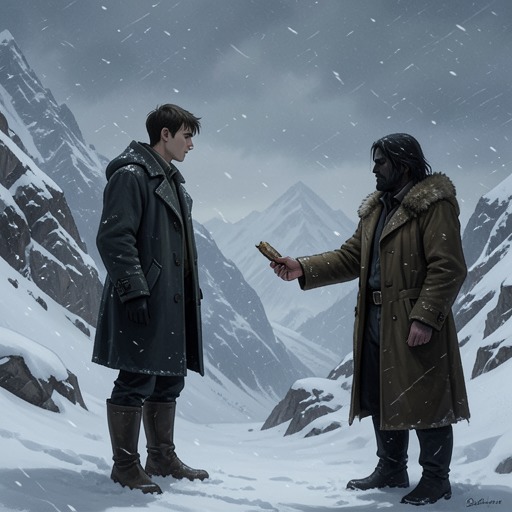
Carag and Lou Ellwood’s growing mutual closeness
WoodwalkersCarag and Lou Ellwood’s relationship grows from Carag’s uncertain attraction into a quieter, more reciprocal closeness, marked by shared questions about identity and Lou’s support when Carag is injured. Its decisive turns are small rather than declarative: a real smile in an empty dining hall, an apology beside a hospital bed, and advice that helps Carag consider refusing Andrew Milling. The book leaves their connection developing, not resolved into a formal romance, but shows Lou becoming someone whose judgment and concern matter to Carag.
First Attention and Awkwardness
Carag’s interest first comes sharply into focus when, in his puma form, he spots a young female wapiti grazing by the river and recognizes Lou. He wonders why she is out without her friends Viola, Cookie, and Wing, and speculates that she may be sad or seeking solitude. His thoughts turn quickly from concern to the possibility of going over to talk to her, only for Dorian to distract him by playing with the tip of his tail. When Carag looks back, Lou has disappeared. The scene establishes his attention to her, but also its tentative, easily interrupted quality: he can imagine approaching her more readily than he can actually do so.
At breakfast the following Monday, seeing Lou again produces what Carag experiences as a bodily jolt. He imagines his face brightening like the Ralstons’ Christmas decorations and wonders how he might win her over, while Lou gives him only a brief smile. The contrast matters: his feelings are already intense, but he cannot tell from her restrained response whether they are shared. He is left without a plan, and his hope of making an impression soon runs up against his difficulty controlling his transformations.
That difficulty becomes especially visible in a lesson with Lou’s father. Asked to transform only his hands, Carag is the sole student who instead sprouts a pair of furry ears. The embarrassment is more than a failed classroom exercise in the context of his attraction: Carag immediately judges the mistake as no way to impress Lou. His crush makes an ordinary lapse in control feel like evidence against his hopes, while the episode also underscores how little confidence he has in presenting himself as he wishes.
Solitude and Recognition
A different kind of encounter follows when Carag returns to the empty, dark dining hall to study after finding that studying with Holly can distract him. He hears a rustle, jumps in fright, and discovers Lou sitting alone, looking at the stars. His first impulse is to run, but he stays. Lou asks whether she startled him; Carag admits she did a little, then asks whether she often comes there at night and whether she likes being alone. He is surprised by his own courage in asking the second question. The conversation begins with his nervousness, but moves beyond the effort to impress her into an exchange about a subject Lou has chosen to inhabit for herself: solitude.
Lou explains that as a child she could hardly ever be alone because she was continually surrounded by her five brothers and there was always something happening. In those conditions, she says, it was difficult to discover who she really was. The disclosure gives her solitude a purpose beyond the impression Carag had first guessed at by the river. She is not merely waiting to be approached or defined by him; she is articulating her own need for space and self-understanding.
Carag answers that he understands, then asks whether she has discovered who she is now. Lou turns the question back to him. His reply, that he is working on it, meets her uncertainty without pretending that either of them has reached a final answer. They exchange what Carag experiences as a genuine smile. He feels a rush of warmth and recognizes, in that moment, that their different second forms do not matter to the sense of accord between them. The distinction is important: attraction had made him anxious about how to win her over, but this shared pause offers connection without requiring him to perform or master his form. Lou eventually gets up to leave, so the scene creates intimacy without turning it into a promise.
Concern and Reconciliation
The relationship becomes more openly reciprocal after Carag is found in danger and wakes in a hospital room. Still checking that his fingers and toes are intact and aware of the pain in his back from a grazing gunshot, he notices Lou sitting beside his bed. Her presence surprises him. She says awkwardly that she has not been truly kind to him and asks, in effect, whether her behavior was her fault. Carag turns onto his side to see her better, making the moment an exchange rather than a distant gesture of concern.
Lou names the prejudice behind her earlier treatment of him: she says she should not have acted as though he were at fault for being a puma. She acknowledges that he has always been kind and promises to be kind to him from then on. Her apology does not erase the difference between them or recast their earlier contact as uncomplicated. Instead, it identifies a specific injury in their relationship and takes responsibility for it. Carag finds the apology extraordinary, and his description of its emotional effect conveys how deeply it moves him.
Lou then tells him that after he left the previous day, and again toward dawn, she was seized by a bad feeling that something was wrong. At dawn the hunting dogs had picked up Carag’s trail and begun pursuing him. The parallel makes her unease consequential within the relationship: she has been attentive to his absence and danger, even though she cannot explain how she knew. Carag wonders whether she sensed the threat and feels his heart soften. He confirms that he really was in danger, allowing her concern to meet the facts of what happened rather than remain an unexplained intuition.
Trust and Counsel
Lou’s role in Carag’s life extends beyond attraction when he speaks about Andrew Milling and his hatred of humans. After asking what specifically frightens Carag about Milling, she listens and considers his answer at length. She advises him that the right course would be to say no, reasons that Milling’s pressure is a warning sign, and raises the possibility that he may not keep his promise or be able to find Carag’s family. Her counsel addresses the actual stakes of Carag’s decision: Milling’s offer is entangled with the hope of recovering his family, while the hatred driving Milling’s plans makes accepting dangerous.
Carag responds with gratitude. Lou is the second person he has known who is not impressed by how powerful Milling is or by the enterprises, jets, and swimming pools he owns. That detail distinguishes her support from admiration of status: she weighs Milling’s conduct and reliability instead. For Carag, who is trying to judge a powerful figure while longing for help finding his family, her willingness to question the offer gives him a perspective not governed by wealth or influence.
The connection remains at an early stage, but its pattern has changed. Carag begins by watching Lou from a distance, measuring himself against the possibility of winning her over; their conversation in the dark lets both speak about uncertainty, and her bedside apology turns that tentative accord into care and accountability. By the time she advises him about Milling, Lou is not simply the person he hopes to impress. She has become someone Carag can tell the truth to, whose independent judgment he values, and whose concern reaches him at a moment of physical and emotional vulnerability.